Mnemonics for Pi

The people who memorize thousands of digits of pi generally strike me as more inhuman than impressive – not at such tasks does the normal human mind excel. Nonetheless, being able to recall ten digits or so might allow you to win bets at geekier parties and, if that can be achieved painlessly, it may be worth doing.

Probably the best way to do so is with mnemonic techniques. You can get fifteen digits by using the number of letters in each word of the following phrase:

How I want a drink, alcoholic of course, after the heavy lectures involving quantum mechanics!

Many other examples, including an entire sonnet, are on the Wikipedia page for Piphilology.

Al Gore’s solutions

Al Gore recently gave a highly interesting speech on the future of energy in the United States. None of the points made in it are especially new, but he does a good job of tying together a great many important themes.

Here are some key points:

  • Because of climate change, “the future of human civilization is at stake.”
  • “[T]here is now a 75 percent chance that within five years the entire [Arctic] ice cap will completely disappear during the summer months. This will further increase the melting pressure on Greenland.”
  • “We’re borrowing money from China to buy oil from the Persian Gulf to burn it in ways that destroy the planet. Every bit of that’s got to change… The answer is to end our reliance on carbon-based fuels.”
  • Solar, wind, and geothermal are large and critical future energy sources.
  • “I challenge our nation to commit to producing 100 percent of our electricity from renewable energy and truly clean carbon-free sources within 10 years.”
  • “[S]harp cost reductions now beginning to take place in solar, wind, and geothermal power — coupled with the recent dramatic price increases for oil and coal — have radically changed the economics of energy.”
  • The national grid must be updated to link areas rich in renewable energy to areas with high energy demand.
  • Plug-in electric cars will play an important role in balancing the load on the electrical grid.
  • “[W]e need to greatly improve our commitment to efficiency and conservation. That’s the best investment we can make.”
  • “I have long supported a sharp reduction in payroll taxes with the difference made up in CO2 taxes. We should tax what we burn, not what we earn.”
  • “[I]t is also essential that the United States rejoin the global community and lead efforts to secure an international treaty at Copenhagen in December of next year that includes a cap on CO2 emissions.”
  • “[W]e must move first, because that is the key to getting others to follow; and because moving first is in our own national interest.”

The 100% target is probably not going to happen – it would require scrapping every coal, gas, and oil power plant – but it is a worthwhile aspiration nonetheless. Even getting a significant portion of the way towards that goal in the timeframe mentioned would be a huge advance.

It would be very interesting to see what role he would personally play in advancing this sort of agenda within an Obama administration. An administration that made a determined effort to implement this sort of agenda would be transformative, and could do a great deal to spur global transformation.

Is it ethical to fly?

Continuing our long debate, here is another entry.

It seems to me that there are four possible long-term outcomes of the conflict between preventing climate change and travelling long distances quickly:

  1. We come up with a way to keep flying without doing too much climatic harm. This could be sequestration of carbon from biomass, it could be carbon neutral fuels, it could be something unanticipated.
  2. We come up with another transport technology that is carbon neutral and just as good or almost as good as flying, such as very high speed trains.
  3. We cannot reconcile long-distance high-speed travel with the need to mitigate, so we essentially stop doing it. A few people are still able to get from New York to London in a day, but it becomes out of almost everyone’s reach.
  4. We cannot reconcile long-distance high-speed travel with the need to mitigate, so we choose not to mitigate and wreck the planet.

How does the choice to fly look, in relation to each possibility?

  1. It’s not your fault you lived in the era before green flying was possible. That said, it may have been immoral to choose a mode of transport you knew to be (a) unsustainable and (b) harmful to others. It may be laudable or morally necessary to minimize flying and/or compensate for your impact by purchasing offsets.
  2. It’s not your fault you lived in the era before non-flight green travel was possible. That said, it may have been immoral to choose a mode of transport you knew to be (a) unsustainable and (b) harmful to others. It may be laudable or morally necessary to minimize flying and/or compensate for your impact by purchasing offsets.
  3. Again, you are on the hook for choosing an unsustainable option – specifically, one that had to be harshly curtailed in the future. Of course, if you are (a) selfish and (b) desirous of seeing the world, the danger that flying will be either restricted or far more expensive in the future creates an incentive to do a lot of it now.
  4. Flying was hardly a laudable thing to do, but it probably didn’t affect the outcome. Once we get into a runway climate change situation, it doesn’t matter much whether emissions in year X were Y megatonnes or 1.5Y megatonnes.

The larger question of whether future outcomes affects the morality of present decisions must also be contemplated. It does seem a bit odd to say that an action in 2007 was right or wrong as a consequence of technologies developed later. This post really cannot provide any answers to these questions – though my position remains that virtually all flying taking place at present is immoral – but perhaps it will provide a new way to consider things.

Fishing and restraint

Colourful leaves, botanical garden

Research being done off Lundy Island, in the United Kingdom, shows how quickly some marine ecosystems can begin to recover when fishing is discontinued. A five year old marine protected zone has resulted in the lobster population increasing sevenfold, as well as benefits to other species. This is consistent with the kind of larger scale recoveries that took place during the world wars, when the need for merchant ships and the dangers of war prevented most fishing fleets from operating.

It makes a person wonder what would be involved in producing a genuinely sustainable national fishery (trying to do the same in the open ocean is probably impossible for the foreseeable future, given the sheer number of unapologetically rapacious national fleets). One idea that comes to mind is this:

  1. Ban all imports. This will ensure that all fish being sold were caught under the sustainable approach.
  2. Restrict all fishing equipment (except safety equipment) to that which was available at the height of the age of sail. That means no diesel engines, no fish aggregating buoys, no satellite navigation, etc.
  3. Set catch quotas at a level where marine ecosystems as a whole remains vibrant and robust.

This would make fish dramatically more expensive, probably reducing consumption considerably. Arguably, it would actually increase employment in the industry. It would also make the industry rather more interesting to those both within and without it. Fishing from wooden tall ships has a lot more aesthetic appeal and romance than smashing the ocean floor and stripping the sea with freezer trawlers.

Of course, the above is supremely unlikely to ever happen. The question, then, is whether we will ever be able to come up with a mechanism that provides society with fish in an ethical and sustainable way, or whether we will keep plundering the resource, earning poorer and poorer catches, until we must be satisfied with whatever worms and jellyfish remain.


Hierarchy of climate change uncertainty

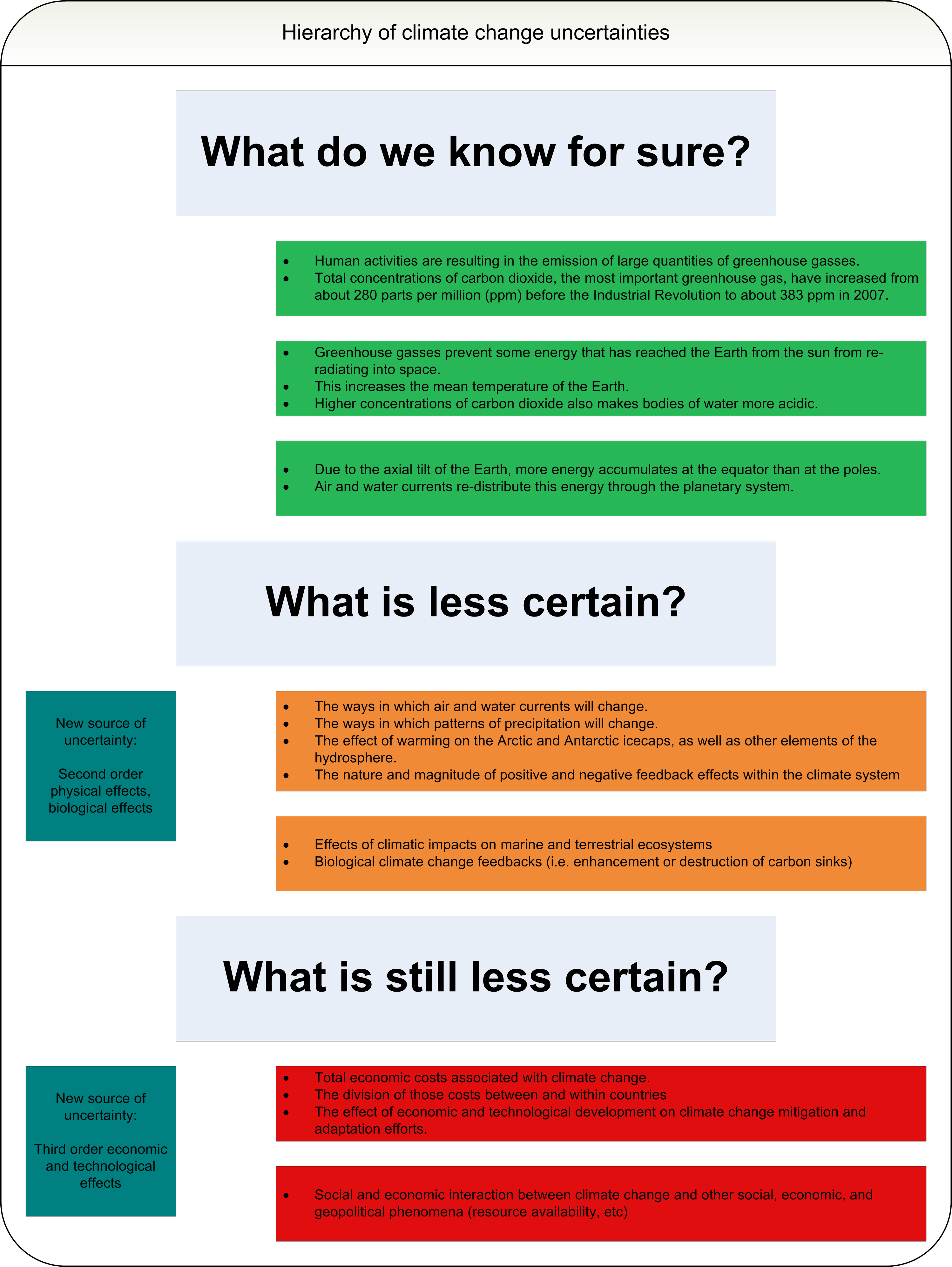
When people say that ‘the science of climate change is settled’ they are often being problematically imprecise. Elements of the science are certainly settled beyond a doubt – for instance, the simple fact that adding carbon dioxide to the atmosphere raises global temperatures. Other elements are certain but less precise: overall warming of the planet will alter air and water currents, though we do not know exactly how. Still higher order questions have answers at lower levels of both precision and certainty.

This graphic sketches out a bit of what I mean:

Climate change uncertainties

Responding to climate change is perhaps the ultimate case of needing to make decisions under conditions of uncertainty. Simplistic conceptions of what it means for something to be ‘certain’ must give way to a more nuanced appreciation of the nature of knowledge and evidence.

Green shifts and pine beetles

Concrete stairs

The July 5th issue of The Economist has two articles pertaining to Canada and climate change. There is one on the Dion carbon tax and another on the pine beetle infestation in our western forests. Both topics have come up here before, but remain pertinent and worthy of discussion.

The critical ongoing question in the first case is probably how effectively Dion will be able to build support for his plan. In the case of the pine beetles, it is probably the extent of the epidemic, as well as the volume of greenhouse gasses that will be emitted as a result. Despite considerable efforts to prevent it, the beetles have now become established in Alberta, having killed more than half the lodgepole pine in British Columbia. Natural Resources Canada estimates that the infestation so far will produce 990 megatonnes worth of emissions by 2020: equivalent to well over a year of total Canadian output. If they spread into the boreal forest, the ecological and climatic consequences could be massive.

How politicians think

Garden with wooden planter

The Oil Drum has an interesting post on the psychology of leaders, arguing that their mindset has important consequences in relation to how they evaluate long-term questions like the future of hydrocarbon resources. The argument there is being made about Peak Oil, but it could just as well be applied to climate change:

Our leaders base decisions on lawyer thinking.

The outcome of a trial is not based on the facts; it is based on what they can convince the jury the facts might be. Likewise the outcome of an election is not based on facts; it is based on what they can convince the electorate the relevant facts, issues and threats might be.

Politicians do not deal in facts. They deal in perception. After years of working this way it becomes a framework in which they think.

The basic point is similar to the old joke about how public figures use statistics rather as drunkards use lamp posts: for support rather than illumination. Furthermore, the awareness that other politicians and politically active groups and individuals will use statistics in this way somewhat debases numerical evidence as a form or empirical awareness about the world.

Another important point is made about the differences between political and objective reality:

Politicians tend to inherently believe that the outcome of an event will depend on people’s perceptions and beliefs about that event. Politicians have very little experience with situations where objective reality is more important to outcome than the subjective perception of the reality.

This tendency is especially damaging when it comes to climate change. Because it progresses at an uncertain rate, it may well be that climate changes slowly while the perceptions of most people remain fairly stable, then changes too quickly for anything low-cost and effective to be done. On a problem characterized by uncertain time frames and potentially strong feedback effects, we need to get out in front of the issue, rather than being led by public or elite political opinion.

Dyed panels for concentrating solar

A team from MIT may have developed a cost-effective solar collector system for buildings. It consists of panes of glass coated with particular dyes. Each pane collects light in a specific range of wavelengths and delivers it to a relatively small area of solar cells. As such, the technology would replace some relatively expensive photovoltaic components with cheaper glass ones. It would also do away with the need for moving sun-tracking mirrors.

As with many human innovations, there is a natural precedent. Photosynthetic pigments in chloroplasts help to capture the light used in photosynthesis. They too differ in colour depending on the peak wavelength being targeted, thus explaining why you can have your algae in red, brown, yellow-green, etc.

Unbalanced sea level rise

One intuitively expects that if enough of Greenland melts to raise global sea levels by, say, three centimetres, that rise will occur everywhere more or less simultaneously. Detlaf Stammer, of Hamburg University, has suggested otherwise. His research on meltwater data since 1948 shows that meltwater forms a ‘slow wave’ of “rising sea levels that gradually works its way south from Greenland, down the American coast, reaching the tip of southern Africa after about a decade.”

Fifty years after any Greenland melting occurs, Stammer’s model suggests that sea level rise will be thirty times greater around Greenland and the east coast of North America than it will be in the Pacific ocean. If true, this will have a big effect on the kind of climate change adaptation planning that needs to take place. Everyone is exceptionally worried about Bangladesh right now, but perhaps they should be more immediately concerned about Florida and the Maritimes.

American biodiversity

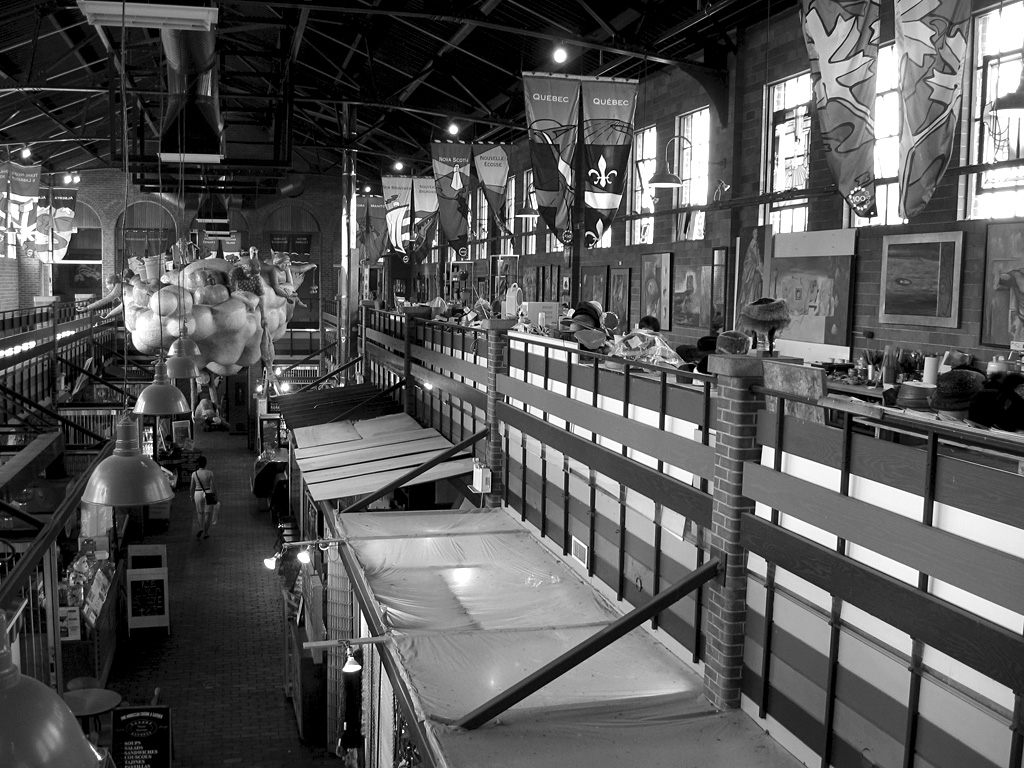
Byward Market, Ottawa

Over at Shifting Baselines, Josh Donlan has written a highly interesting history of American biodiversity, in the form of an open letter to the next American president. It touches upon the extinction of North American megafauna, philosophical questions about intrinsic value in nature, and then question of what should be done to protect the diversity of life.

It is long (for a web document), but well worth reading.