Ethics protocol going for full review

On October 10th I submitted the proposed research ethics protocol for my PhD research to the University of Toronto’s Office of Research Ethics.

My committee thought that the subject protection risks were minimal enough to make a delegated review adequate, but I learned today that the protocol has been escalated to the full-REB meeting on November 15th. I should expect comments a couple of weeks after that, and will almost certainly then need to modify the proposal and ethics protocol in response.

In the meantime I am continuing with reviewing key texts and developing the cross-Canada census on the basis of public documents. I also have both my sets of tutorials to lead next week, and will be receiving this year’s first batch of essays to grade on Monday.

Learning and teaching

Thesis proposal reading continues to dominate my information diet, but I bought a couple of unrelated books today.

Penny Le Couteur and Jay Burreson’s Napoleon’s Buttons — recommended by my friend Myshka — describes the influence of seventeen molecules on human history. I’m about 60 pages in and have been finding it entertaining and reminiscent of James Burke’s Connections television series (he also talks a lot about coal tar and the rise of synthetic chemistry) and Michael Pollan’s The Botany of Desire.

I also got Naoki Higashida’s Fall Down 7 Times Get Up 8: A Young Man’s Voice from the Silence of Autism, which was recently reviewed in The Economist.

Term time is rapidly approaching. In addition to my PhD research, I will be working as a teaching assistant for a second year “U.S. Government and Politics” course, which I did previously in 2013/14. I also applied for TA jobs in “Introduction to Peace, Conflict and Justice”, “Quantitative Reasoning”, and the “Canada in Comparative Perspective” course I have helped teach three times already. I’m done with coursework and comprehensive exams, so a double TA load should be manageable. It’s pretty important given that I haven’t had a paycheque since the spring, and my funding package as a sixth-year student is cut in half.

Ian Townsend-Gault

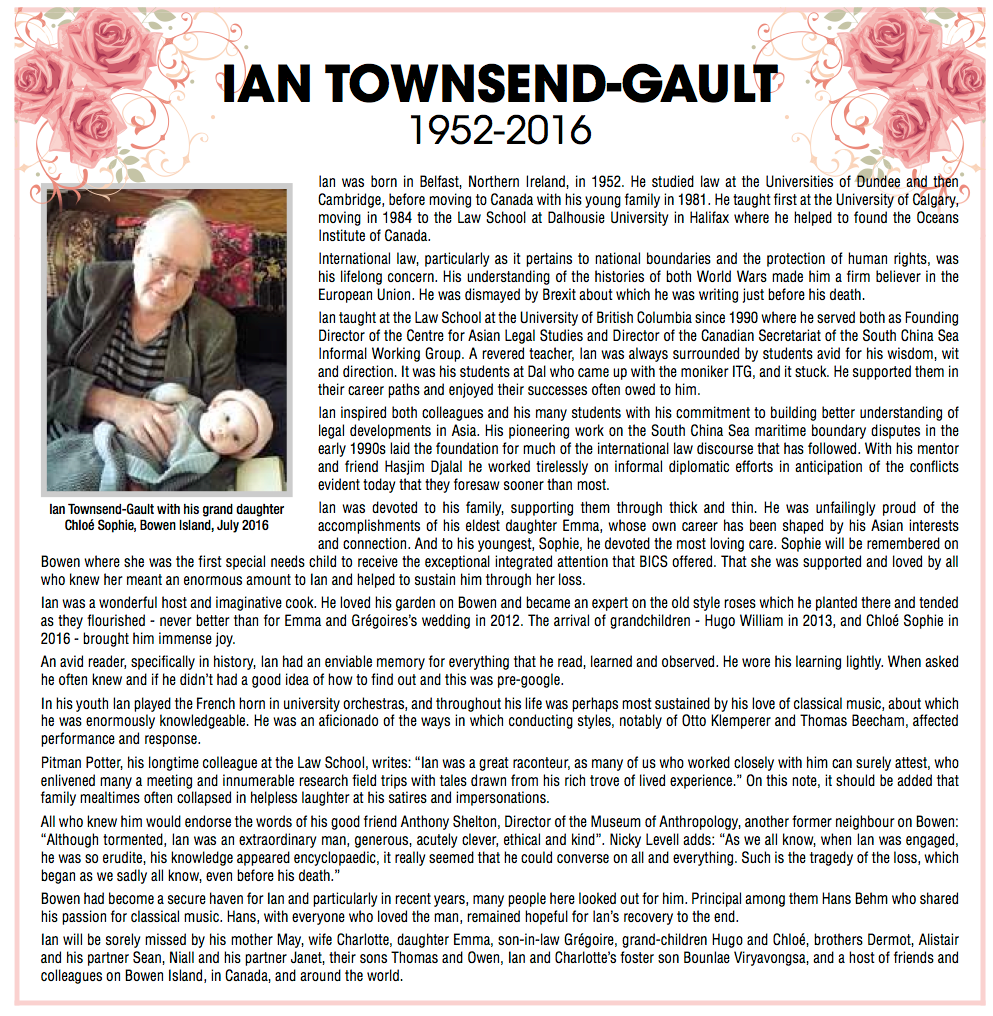
I was saddened to learn while watching the U.K. election that a former professor of mine — Ian Townsend-Gault — died in 2016.

I studied international law with him as an undergraduate, we had many engaging conversations over the years, he encouraged one of my early publications, he edited other early pieces of writing, I attended excellent parties at his Bowen Island home, he served as a reference for many of my grad school applications, he gave me good advice while I was at Oxford, and we met once in London.

Ian was memorable for his good humour, friendliness, and hospitality. He had a talent for making arcane subjects intriguing and even fascinating. I think the remarkably candid obituary above would not have displeased him.

Learning to write as an undergraduate

Most undergraduate students would really benefit from an intensive one-on-one tutoring program in writing essays. Even among third and fourth year students, it’s something most of them can’t or don’t do competently. While U of T offers some writing resources, you can’t really turn up at a writing centre with an unstructured, ungrammatical, and unconvincing draft and have someone teach you the basics of being credible and convincing in an hour or so.

It would be better to find a subject that is of particular interest to the student, and then begin with some lessons on what distinguishes credible sources and how to conduct research. The tutoring could then progress to a review of the basic essay template people should have learned in high school or earlier: an introduction with a clear thesis and a basic outline of the argument, body paragraphs with organized and coherent lines of evidence and argumentation, and a conclusion that wraps up and perhaps points to some broader implications.

They need to be guided away from both mindlessly vague claims with no substantive content and from the wild extrapolation and hyperbole where ludicrous statements are made about how the small topic of their paper will have vast, automatic, permanent, global effects. This one little UN initiative will save the world’s oceans, or one tweak in parliamentary procedure will save Canadian democracy, etc.

They could also be taught to edit. Clearly, most of them don’t even skim through their own writing looking for awkwardly phrased and ambiguous passages or language problems. They could, however, be taught to go beyond that to really think about making an argument and being convincing: evaluating whether each sentence and paragraph is serving their overall purpose, and how to hold the interest and win the respect of the reader.

Doing all this one-on-one would overcome the limitations of drop-in writing help, where the tutor doesn’t know the student’s strengths and weaknesses and can only provide ad hoc suggestions and corrections rather than a broad and coordinated program of improvement. A bespoke approach would let tutors avoid boring students by rehashing things they already understand, while letting the student focus on subject matter where they have actual passion.

Such a program of tutoring could do a lot to enhance what is almost the only tangible skill developed during an undergraduate program in the humanities or social “sciences”, and it would be a small investment of time and money compared to the undergraduate program as a whole.

Related:

Labour art project denied

Ages ago I submitted a photo essay to the Canadian Labour Congress for their “Workers’ Rights and the Struggle for Social Justice” project.

It was meant to be funded as part of the (at least dubious, and almost certainly offensive, given that people have lived here for many thousands of years) Canada 150 celebration.

The call to photographers in June 2016 explained: “The CLC invites photographers to participate in a historic exhibition on workers’ rights, social justice, and equity.” They went on to say:

Workers have historically taken the lead role in fighting for social justice issues, which have had an impact far beyond the workplace and into every part of the daily lives of Canadians. Therefore, the exhibition will be both a celebration of victories and an opportunity to take stock of the continuing struggles for social justice. Where have we succeeded as a social movement?

In the end, the people behind the proposal (Vince Pietropaolo and John Maclennan) told the photographers that it’s not going to happen due to lack of funding.

As such, I am making my photo essay submission public: Victories and continuing struggles.

Automation and labour

Arguably for millennia, but certainly since the industrial revolution, technological development has been driving changes in labour practices. This has been accelerated by globalization and automation and is likely speeding up as sensors and artificial intelligence improve and costs fall:

Both for individuals and governments, it’s hard to discern what this means when planning for the labour force of 2050 and beyond, except, perhaps, don’t build careers on anything that is easily automated.

Related:

My fifth year of teaching

The capricious forces directing undergraduate teaching in political science have set me up for an extremely difficult term.

First, I was assigned to teach an hour’s $6 shuttle drive away, at the Missisauga campus. Second, my “tutorials” are starting with 30 students each. With only five tutorials in the entire course, this raises the question of how students can be meaningfully graded on participation.

Most seriously, they allocated all of my 210 teaching hours for the year to just this term. Since my fellow TAs are only doing half their hours this term, my huge surplus of hours must be dedicated to grading. This means I will be spending huge blocks of time grading the midterm and the essay — so much that it seems impossible within the standard turnaround time for exams and assignments. As a further vexation, all the grading must be done through tedious and fiddly online systems, rather than quickly and intuitively on paper copies.

At the same time, I am working hard with my committee to get my PhD project formally approved by the department, and to get research ethics approval. Judo aside (which ought to help remain sanity), this will be a term where further extras are essentially inpermissible.

Summer TA work at U of T

In each year of my PhD, I have applied for all the summer teaching assistant (TA) positions offered in the Department of Political Science (and, after second year, in the School of the Environment too). I never heard anything back as the result of my applications, including for frequently-advertised ’emergency’ positions and jobs in statistics courses which I expected to be less popular.

Today I had a brief conversation with a prof who I worked for in a fall and winter term and learned that virtually all summer TA jobs go to people who are beyond the 5-6 year span where U of T provides funding. Apparently, summer TA jobs all go to people who are in their 8th or 9th year, or otherwise well beyond the “funded cohort” and seniority is the overwhelming criterion used to select them.

It’s reflective of how U of T generally under-funds its graduate students, as well as how the quality of teaching provided to undergrads is clearly not a university priority.