Reforming the IPCC

Alternative title: What to do when everybody ignores you?

In the wake of University of East Anglia email scandal, there has been yet another review of the work of the Intergovernmental Panel on Climate Change (IPCC). This one was chaired by Harold Shapiro, a Princeton University professor, and concluded that “[t]he U.N. climate panel should only make predictions when it has solid evidence and should avoid policy advocacy.”

The IPCC has certainly made some mistakes: issuing some untrue statements, and evaluating some evidence imperfectly. That being said, the details they got wrong were largely of a nitpicky character. The core claims of the IPCC reports – that climate change is real, caused by humans, and dangerous – remain supremely justified. The trouble is, governments aren’t willing to take action on anything like the appropriate scale.

The situation is akin to a doctor giving a patient a diagnosis of cancer, after which the patient decides that he will try to cut down on his consumption of sugary drinks. That might improve the patient’s health a bit, but it is not an adequate response to the problem described. At that point, it would be sensible for the doctor to engage in a bit of ‘policy advocacy’ and stress how the proposed solution is dangerously inadequate.

It can be argued that the IPCC works best when it presents the bare facts and leaves others to make policy decisions. The trouble is, people don’t take the considered opinions of this huge group of scientists sufficiently seriously. They are happy to let crackpots tell them that there is no problem or that no action needs to be taken. While scientists should not be saying: “Here is what your government’s climate change policy should be” they should definitely be saying: “Here are the plausible consequences of the policy you are pursuing now, and they don’t match with the outcomes you say you want to achieve (like avoiding over 2°C of temperature increase)”. They could also very legitimately say: “If you want to avoid handing a transformed world over to future generations, here is the minimum that must be done”. James Hansen accomplishes this task rather well:

Today we are faced with the need to achieve rapid reductions in global fossil fuel emissions and to nearly phase out fossil fuel emissions by the middle of the century. Most governments are saying that they recognize these imperatives. And they say that they will meet these objectives with a Kyoto-like approach. Ladies and gentleman, your governments are lying through their teeth. You may wish to use softer language, but the truth is that they know that their planned approach will not come anywhere near achieving the intended global objectives. Moreover, they are now taking actions that, if we do not stop them, will lock in guaranteed failure to achieve the targets that they have nominally accepted.

Scientists don’t lose their integrity when they present scientific information in a way that policy-makers and citizens can understand. Indeed, it can be argued that they show a lack of integrity when they hide behind technical language that keeps people from grasping the implications of science.

Greenland offshore oil

In a development that seems to reinforce a number of ongoing trends, it seems there may be oil to exploit off the coast of Greenland. As with other places in the Arctic, the combination of new technologies, higher oil prices, and retreating ice is making it plausible to access fossil fuels that would once have been out of reach. At least as reported by The Economist, residents seem moderately intrigued by the prospects for increased wealth, but largely disinterested in the ongoing climate change that could profoundly transform the massive island:

Most of Greenland’s 56,000 inhabitants seem persuaded [that the risk from oil spills is acceptable]. Despite the vulnerability of the country’s ice sheet to global warming, a recent Greenpeace meeting in Nuuk drew a paltry 45 people. Even this minimal interest in the environmentalists’ message could fall further as the implications of this week’s news start to sink in.

Cairn Energy, a British oil and gas firm, already has an area designated for exploration which is thought to include 4 billion barrels of oil. United States Geological Survey data suggests that a total of 17 billion barrels may lie in the waters between Canada and Greenland.

As with so many issues related to climate change, there is an important disjuncture here between different relevant timescales. Whereas it is plausible that the next few decades could see the deployment of offshore oil and gas platforms in the Arctic – and at least the beginning of significant revenues from them – the warming of the climate will largely occur over a more extended span of time. Nevertheless, we have good reasons to believe that the emissions trajectory humanity is investing in right now is incompatible with the continued existence of the Greenland icesheet, though the disappearance will probably take centuries. Of course, that change will profoundly alter life in the region. At the same time, the seven metres of sea level rise embedded in that ice would surely prove problematic for many of the cities and nations that may find themselves benefitting from the use of Greenland’s oil and gas in the interim.

Climate and the timing of emissions

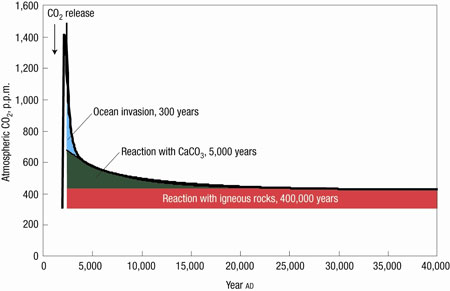
Climatologist James Hansen emphatically argues that cumulative emissions are what really matter – how much warming the planet experiences depends on what proportion of the world’s fossil fuels get burned.

One reason for this is the long lifetime of CO2 in the atmosphere, with much of it remaining after thousands of years. That being said, the model simulation I have seen shows concentrations dropping sharply, and then tapering off with time:

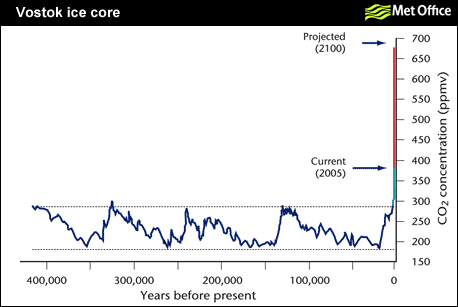
It seems like it would be helpful to put together that chart with this one, showing historical and expected CO2 concentration increases:

Atmospheric concentration of CO2

A combined chart on the same scale would illustrate what would happen to CO2 concentrations if we stopped emitting at some point soon, specifically what the next few decades would look like.

It seems at least logically possible that timing of emissions could matter. Imagine, for instance, that having emissions cross a certain concentration threshold would really matter. If so, spreading out human emissions so that absorption of CO2 by the oceans would keep the concentration below that cap could be quite beneficial.

It seems an important question to sort out, given how the whole BuryCoal project is focused on limiting total human emissions, rather than trying to space them out.

CO2 is plant food

One of the many things that falls into the category of ‘things that climate change deniers say that are true, but deeply misleading’ is the claim that carbon dioxide (C02) is ‘plant food’ and thus beneficial to the planet.

This video does a nice job of smashing that argument.

Ironically, in the very long term, life on Earth actually is imperiled by the possibility of insufficient CO2, though not on a timescale that human beings need to worry about now. A billion years from now, it could be a problem.

Climate change ‘winners’

Today’s Globe and Mail makes a good point about the ongoing Russian heatwave and wildfires, namely that they are a partial counter to the argument that northern countries like Russia and Canada would benefit from a warmer climate:

Russia’s summer heat wave has dimmed prospects that northern countries will “win” from climate change thanks to factors such as longer crop-growing seasons or fewer deaths from winter cold, experts say.

Canada, Nordic countries and Russia have been portrayed as among a lucky few chilly nations where moderate climate change will mean net benefits such as lower winter heating bills, more forest and crop growth and perhaps more summer tourism.

“It’s not a matter of a benign shift to a longer growing season” for northern nations, said [Kevin Trenberth, head of climate analysis at the U.S. National Center for Atmospheric Research in Boulder, Colorado]. Russia’s heat wave doubled death rates in Moscow, wrecked a quarter of Russia’s grain crop and may cut $14-billion from gross domestic product.

It is certainly odd to see climate change deniers who – in the course of the same speech or article – will claim that climate change isn’t happening at all, that it is pefectly natural, that it is actually going to be beneficial, and that it is all China’s fault for building too many coal plants.

The fact is, all of our infrastructure was designed for the kind of climatic conditions human civilization emerged in. While it is certainly likely that a few people will benefit from climate change, for the most part it will mean that roads, buildings, agricultural systems, and so on are increasingly poorly suited to the area where they are situated.

I wrote before about climate change and Australian brushfires.

Pondering mosquito-cide

Generally speaking, it seems like a bad thing when human beings eliminate an entire species. That said, it is usually done by accident, as a consequence of habitat destruction and pollution. To a considerable extent, we should probably scale back those harmful activities, and think about backing up some DNA in the meantime.

In at least one case – the eradication of smallpox – the destruction of a species seems unambiguously excellent. Indeed, it is a shame we didn’t manage to finish the job, and that Russia made such huge quantities of smallpox as a weapon. Mosquitoes are another candidate for a species we could wipe out without guilt, especially since ecologists are arguing that they don’t serve a major ecological role.

The ethical question is: if it were practical to do so, should humanity exterminate all mosquitoes?

Energy in wasted food

Here’s a sobering fact: there is apparently more energy in wasted food in the US than in the Gulf of Mexico:

Americans aren’t, technically, eating an average of 3774 calories per day. This figure is calculated by looking at food produced, divided by the number of Americans. It assumes we’re eating all that, but, in reality, according to environmental scientist Gidon Eshel we really only eat about 2800 calories per day. That whopping 3774 includes both what we eat—and what we waste…

We use a lot of energy producing, transporting, processing, storing and cooking food we don’t eat. About 2150 trillion kilojoules worth a year, according to a recent study. That’s more kilojoules than the United States could produce in biofuels. And it’s more than we already produce in all the oil and gas extracted annually from the Gulf of Mexico.

This is suggestive for several reasons. Firstly, it reinforces the point that the United States cannot drill the way out of their oil addiction problems – domestic oil supplies just aren’t adequate to make much of a difference. Secondly, it is a reminder of how energy is both a critical and a largely hidden part of our society. Thirdly, it shows how people respond to economic incentives – such as the cheapness of food – by acting frugally or wastefully in response. Fourthly, it shows yet another area where conservation can help us, as we make the shift to sustainable and zero-carbon forms of energy production and use.

Sea ice extent and volume

Over at RealClimate, Dirk Notz has written a good post about climate change and Arctic sea ice. In it, he highlights the importance of aggregated data, pointing out how, despite variations in regional weather, the mean temperature of the entire globe during the last 12 months is the highest it has been since the beginning of the records 130 years ago.

The figure that is most watched, when it comes to Arctic sea ice, is the extent of ocean covered by ice. This isn’t a spectacularly good measure, however, as Notz explains:

The reason for this is mostly that sea ice in the Arctic has become very thin. Hence, in contrast to the much thicker ice of past decades, the ice now reacts very quickly and very sensitively to the weather patterns that are predominant during a certain summer. This currently limits the predictability of sea-ice extent significantly.

A better measure is ice volume, which has been falling consistently as the planet warms.

Ten indicators from the Met Office

One reason we can have a lot of confidence about the basic science of climate change – that the world is warming, because of people, in ways that could be harmful to humanity – is because there are numerous independent indicators showing the same trends. A new report from the Met Office in the United Kingdom highlights this, pointing to ten distinct indicators that all show the planet warming:

  1. Rising air temperature over land
  2. Rising sea-surface temperature
  3. Rising marine air temperature
  4. Rising sea-level
  5. Rising ocean heat
  6. Rising humidity
  7. Rising tropospheric temperature in the ‘active-weather’ layer of the atmosphere closest to the Earth’s surface
  8. Declining arctic sea-ice
  9. Declining glaciers
  10. Declining spring snow cover in the northern hemisphere

Deke Arndt, who co-edited the report, explained that: “The records come from many institutions worldwide. They use data collected from diverse sources, including satellites, weather balloons, weather stations, ships, buoys, and field surveys. These independently produced lines of evidence all point to the same conclusion: our planet is warming.”

None of this is new, really, but there is value in re-expressing it and stressing how the different indicators reinforce one another. Climate change deniers often fixate on details, raising doubts about a single measure and then suggesting that this calls into question the whole edifice of climate science. What work like this Met Office report indicates is how climate scientists are approaching the problem in a way that reduces the danger of such dangerous extrapolations.

Of course, that means climate change is something we really do need to worry about, and which we ought to be taking much more action about.