
Bicycle physics

For those with an interest in both cycling and physics, the Wikipedia article “Bicycle and motorcycle dynamics” is well worth reading. It is interesting to note that lateral movements of bicycles (basically, those involving turning) are so mathematically complex that they require “two coupled, second-order differential equations… to capture the principle motions” and that these equations cannot produce exact solutions.

That contrasts in an interesting way with the experience of making turns at speed on a bicycle, and the appreciation one gains for the relationship between body movements, bicycle movements, and the condition of the ground.

Energy efficiency and Ottawa’s Dominion Observatory

Dominion Observatory - NRCan Office of Energy Efficiency

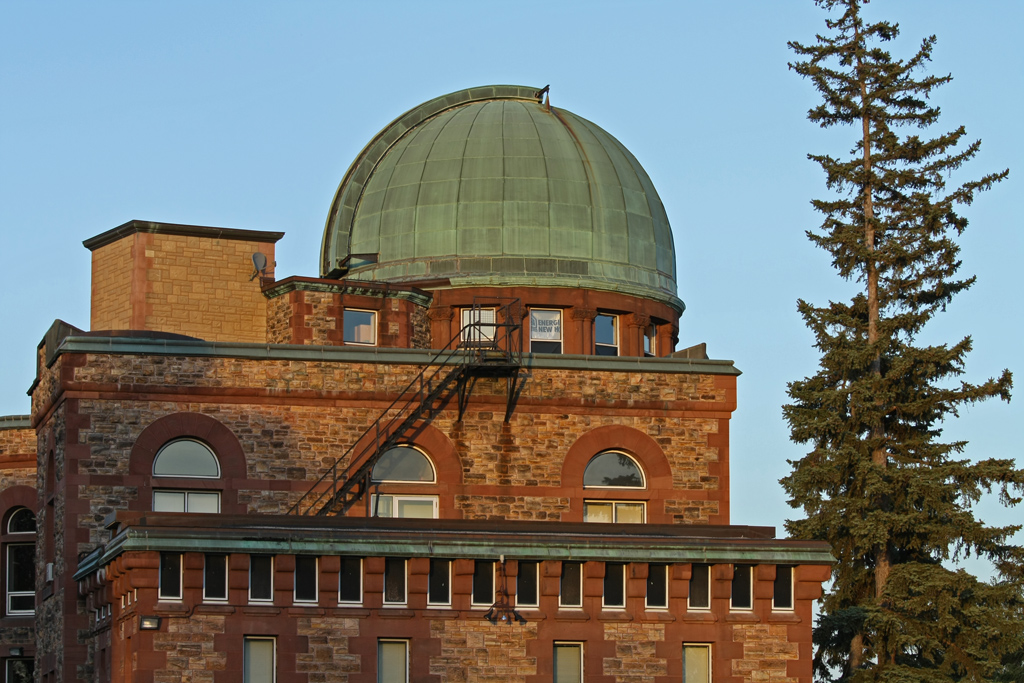
Wandering around the experimental farm, I ran across one of my new favourite buildings in Ottawa. Natural Resources Canada has an Office of Energy Efficiency housed in an old observatory that would look at home in Oxford, Myst, or a neo-Victorian steampunk fantasy. It has great brickwork, an attractive green copper dome, interesting detailing, and a nice setting uphill from Dow’s Lake. The building is called the Dominion Observatory, and served in that capacity from 1905 to 1974, with a 15″ refracting telescope installed in the main dome.

I will need to find some pretense for getting invited in. I will also need to go back at a time when the lighting is more favourable, and when I have a tripod with me.

Photos of Ontario and Quebec birds

Here is a list of the birds I have photographed so far as part of my open-ended project. The links go back to the posts in which the photos originally appeared. Eventually, I might sub-divide this list according to type or location.

Presently unidentified birds: none.

Soft rules for the oil sands means harder targets for others

Canadian Goose (Branta canadensis), near the Ottawa River

Environmental Defence has put out a new report on the oil sands that speaks well to both a general and a specific issue. Climate change policy is often about deciding on a total permissible quantity, then haggling over how it gets divided, with everyone asserting that their special circumstances justify lenient treatment. For instance, Canada argues that it should be able to cut its emissions by less than other states because it is large, cold, an energy exporter, etc. By contrast, other states argue for more generous targets on the basis of past action, ongoing extreme poverty, and many other reasons.

Of course, for everyone who gets lenient treatment, someone else needs to pick up the slack, if you are going to meet your targets. What the Environmental Defence report highlights is how giving an easy ride to the oil sands will mean higher costs for everyone else, if Canada is to hit its 2020 and 2050 mitigation targets.* The report – entitled Divided We Fall: The Tar Sands vs. The Rest of Canada – highlights how placing a disproportionate reduction burden on Ontario and Quebec could be harmful for their economic prospects, especially given how greater opportunities for mitigation exist in the fossil-fuel intensive western industries. Also, given the degree to which resource windfalls (in terms of both tax revenues and jobs) tend to accrue provincially, Ontario and Quebec have an even stronger case against allowing a weaker carbon pricing system for hydrocarbon production in Alberta and Saskatchewan.

Domestically, this is just one of the innumerable issues of Canadian federalism. Regional interests generate tensions that can sap the ability of Canada as a whole to achieve good outcomes. Certainly, some provinces will find it much easier than others to recognize and accept the fact that the fossil fuel industry has no long-term future. It’s a one-off bonanza that our legal and moral obligations on climate change will not permit us to fully realize. Instead of continuing to invest in a dead end, Canada needs to get serious about building an economy that can thrive in a low- and ultimately zero-carbon future.

The report is also available in French (PDF).

* It is worth remembering that, while the 2020 and 2050 targets have received much more media attention recently, the original announcement of the current government’s Turning the Corner climate change plan promised that total Canadian emissions would peak no later than 2012. Most people seem to have forgotten about the third promise.

Colour-based Google image searches

Google Image Search now lets you search for images that are predominantly similar to twelve different colours. For instance, the set of all photos from my site they have indexed can be restricted to just those with red highlights or those dominated by blue.

All told, Google currently includes 204 images from my site in their index. Here is the colour breakdown:

  • Red: 10
  • Teal: 7
  • White: 11
  • Orange: 17
  • Blue: 25 (lots of the sky)
  • Grey: 41 (many of them in black and white)
  • Yellow: 2
  • Purple: 2
  • Black: 47
  • Green: 8
  • Pink: 0
  • Brown: 45

You can also search for various image types: news content, faces, clip art, line drawings, and photo content.

As ever, Google Image Search is a somewhat perplexing creation. It’s not clear why it selects the photos it does or how it ranks them. I look forward to further improvements in the service.

New fuel efficiency standards in the US

Porcupine (Erethizon dorsatum) in a tree, near the Ottawa River

Obama’s decision to extend California-style fuel efficiency standards across the US is a very welcome one, not least because it seems likely that Canada’s government will copy them. The US rules take effect in 2012 and create a federal fuel efficiency standard. The aim is to push the efficiency of the US car and light truck fleet to 35.5 miles per gallon (6.63 L/100km) by 2016: 40% better than now. Such a move is long overdue, given the poor efficiency of the US vehicle fleet, the huge amounts of oil imported by the United States in order to keep them running, climate change concerns, and reasonable doubts about the availability of low-cost hydrocarbons in the near to medium future.

While the new standards are a marked improvement, it is worth thinking about them in context. They will not bring the US up to speed with Australia, China, the European Union, or Japan. Indeed, even in 2020, the planned American standards lag behind where the EU and Japan were in 2002. Given the degree to which North American taxpayers now own the big car companies, it may well have been possible to demand more progressive action from them.

Toughening standards may seem even more prescient if the end of the economic slump brings back high oil prices, as some are predicting. As reported in The Economist, the Saudi oil minister is concerned that a sharp increase in oil prices could slow or stop an economic recovery, while attendees at an OPEC summit apparently expect oil to return to $150-per-barrel territory:

The explanation is simple. Oilmen are worried because they believe that many of the factors behind the record-breaking ascent last year remain in place. Much of the world’s “easy” oil has already been extracted, or is in the hands of nationalist governments that will not allow foreigners to exploit it. That leaves firms to hunt for new reserves in ever more inhospitable and inaccessible places, such as the deep waters off Africa or the frozen oceans of the Arctic. Such fields take a long time and a lot of expensive technology to develop. Worse, new discoveries tend to be smaller than in the past and to run dry faster.

More efficient vehicles make sense as a near-term mechanism for dealing with the linked problems of climate change and energy security, but they are only an incremental step. Rather than being able to rely on increasing the efficiency of an unsustainable practice, we need to alter the basis on which that practice occurs, so as to make it both efficient and sustainable. By all means, we need to increase the efficiency with which vehicles of all kinds transport people and freight, but we must remember that we will only have attained our basic goals when those efficient vehicles operate using zero-carbon, sustainable electricity or sustainably grown, carbon-neutral biofuels as their fuel sources.

Climate sensitivity roulette

Big Bird in a cage

As discussed several times previously, two of the key uncertainties relating to climate change is (a) how much temperature would increase in response to any particular change in the atmospheric concentration of greenhouse gasses and (b) what humanity will actually emit between now and the achievement of global carbon neutrality. One way to express those uncertainties colourfully is with the Roulette wheels the MIT Joint Program on the Science and Policy of Global Change has created.

The wheels are based on results from the MIT Integrated Global Systems Model and have shaded areas proportional in size to different possible levels of temperature increase. The projections were recently updated, and the new ones contain significantly higher estimates of the risks of high levels of warming:

The new projections, published this month in the American Meteorological Society’s Journal of Climate, indicate a median probability of surface warming of 5.2 degrees Celsius by 2100, with a 90% probability range of 3.5 to 7.4 degrees. This can be compared to a median projected increase in the 2003 study of just 2.4 degrees. The difference is caused by several factors rather than any single big change. Among these are improved economic modeling and newer economic data showing less chance of low emissions than had been projected in the earlier scenarios. Other changes include accounting for the past masking of underlying warming by the cooling induced by 20th century volcanoes, and for emissions of soot, which can add to the warming effect. In addition, measurements of deep ocean temperature rises, which enable estimates of how fast heat and carbon dioxide are removed from the atmosphere and transferred to the ocean depths, imply lower transfer rates than previously estimated.

Full article

The ‘policy’ wheel assumes aggressive mitigation action, while the ‘no policy’ wheel assumes a business-as-usual course. It is notable that the chances of keeping warming below 2°C are infinitesimal, on that wheel. Even with aggressive action, our changes of keeping below 2°C of increase are looking increasingly distant, with effects that may be severe for both human and natural systems.

In addition to being a good visual image, I like the conceptual linkage between climate change and gambling. We are certainly taking a chance, whatever we do, but science can help us to assess the odds we face and make choices that reduce the risks of unacceptable outcomes.

Using the degree symbol

While this probably won’t be useful to most readers, I thought I would share how to produce the degree symbol (°) using only your keyboard, on both a PC and a Mac.

On a PC: Hold the Alt key, then type 0176 on the numeric keypad, and release the Alt key.

On a Mac: Hold the Option key, type k, release the Option key.

In Mac software, the symbol for the Option key looks like a two-pronged fork. The confusing key names and symbols are one of the things I like least about Macs. They really put me off using hotkey combinations, even though I have been using Macs daily for about four years now.

Anyhow, you can now use the appropriate symbol when writing phrases like: “avoiding a mean temperature increase of more than 2°C above pre-industrial levels.”

Coal cancellations in the US

Narrow leaves

The Economist has been bold enough to suggest that ‘the writing is on the wall’ for coal-fired power plants in the United States, unless they can be converted to run on biomass or incorporated into other ‘green’ compromises. While there have apparently been 97 coal plants cancelled since 2001 (and nine so far this year), those that are operating now are long lived; their contribution to US emissions will barely fall between now and 2030. Unusually, the article makes no mention of carbon capture and storage (CCS) technology, which many supporters of fossil-fuel based power hope will soon emerge as a cheap, safe, and effective mechanism for preventing greenhouse gas emissions. The omission is actually a welcome one, given how tempted industry groups, governments, and commenters in general have been to see CCS as a simple silver-bullet mechanism for maintaining the status quo.

Worldwide, there must be an ever-increasing determination to prevent the construction of new coal capacity, except where it incorporates safe and effective CCS technology (if that proves possible). Meeting climate change mitigation targets (including avoiding a temperature increase of more than 2°C above pre-industrial levels) probably also means a fair bit of existing coal capacity will need to be converted to biomass or brought offline before the end of its economical lifetime. That will provoke the fierce opposition of those who have invested in such projects, though that may be a necessary signal to the market at large that coal-fired power is no longer acceptable – the carbon in the world’s coal beds needs to remain there, rather than being added to an atmospheric stock that is already dangerously high.

States like Canada and the US should be working to rebuild the basis of their energy system on the basis of non-emitting and renewable options. In so doing, they will establish the prerequisites for their own prosperity in the future, as well as help develop the technologies and approaches that will make the same transition possible in rapidly growing developing states.