Energy security and climate change

Climate change and energy security

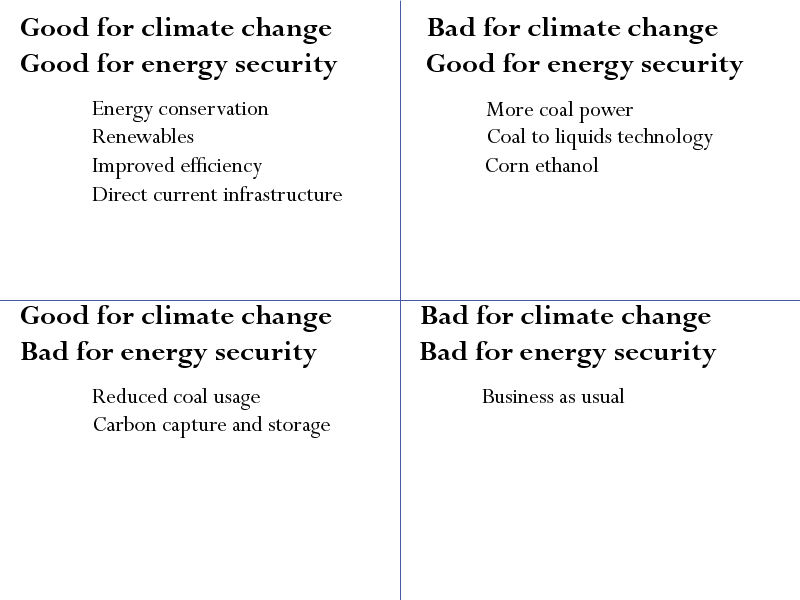
If you listen to the speeches being made by presidential candidates in the United States, you constantly hear two ideas equated that are really quite independent: ‘energy security’ and climate change mitigation. The former has to do with being able to access different kinds of energy (natural gas, transportation fuels, electricity) in a manner consistent with the national interest of a particular state. The latter is about reducing the amount of greenhouse gasses emitted in the course of generating and using that energy.

Some policies do achieve both goals: most notably, building renewable energy systems and the infrastructure that supports them. When the United Kingdom builds offshore wind farms, it serves both to reduce dependence on hydrocarbon imports from Russia and elsewhere and to reduce the link between British energy production and greenhouse gasses. Arguably, building new nuclear plants also serves both aims (though it has other associated problems).

There are plenty of policies that serve energy security without helping the problem of climate change at all. Indeed, many probably exacerbate it. A key example is Canada’s oil sands: they reduce North American dependence on oil imports, but at a very considerable climatic and ecological cost. Corn ethanol is probably an example of the same phenomenon, given all the emissions associated with intensive and mechanized modern farming. A third example can be found in efforts to convert coal to liquid fuel – a policy adopted during the Second World War by Germany and Japan when their access to imported oil was curtailed, but also an approach with huge associated greenhouse gas emissions.

Finally, it is possible to envision policies that help with climate change but do not serve energy security purposes. A key example is carbon capture and storage (CCS). Building power plants and factories that sequester emissions actually requires more energy, since it takes power to separate the greenhouse gasses from other emissions and pump them underground. If CCS technology allows the exploitation of domestic coal reserves without significant greenhouse gas emissions, both goals would be achieved, but CCS on its own contributes nothing to energy security.

The biggest danger in all of this is the unjustified muddling of two issues that are related but certainly not identical. It is simply not enough for developed states to ensure reliable and affordable access to fuels and power – they must do so in a way that helps to bring total global emissions in line with what the planet can absorb without suffering additional increases in mean temperature. Governments and private enterprises must not be allowed to pass off energy security policies with harmful climatic effects as ‘green.’

Three climatic binaries

Statue in North Vancouver

One way to think about the issue of mitigating climate change is to consider three binary variables:

  1. Cooperation
  2. Expense
  3. Disaster

By these I mean:

  1. Is there a perception that all major emitters are making a fair contribution to addressing the problem?
  2. Is mitigation to a sustainable level highly expensive?
  3. Are obvious and unambiguous climatic disasters occurring?

These interact in a few different ways.

It is possible to imagine moderate levels of spending (1-5% of GDP) provided the first condition is satisfied. Especially important is the perception within industry that competitors elsewhere aren’t being given an advantage. Reduced opposition from business is probably necessary for a non-ideological all-party consensus to emerge about the need to stabilize greenhouse concentrations through greatly reduced emissions and the enhancement of carbon sinks.

It is likewise possible to imagine medium to high levels of spending in response to obvious climatically induced disasters. For instance, if we were to see 1m or more of sea level rise over the span of decades, causing serious disruption in developed and developing states alike. Such disasters would make the issue of climatic damage much more immediate: not something that may befall our descendants, but something violently inflicted upon the world in the present day.

Of course, if things get too bad, the prospects for cooperation are liable to collapse. Governments facing threats to their immediate security are unlikely to prioritize greenhouse gas emission reductions or cooperation to that end with other states.

We must hope that political leaders and populations will have the foresight to make cooperation work. It may also be hoped that the cost of mitigation will prove to be relatively modest. The issue of disasters is more ambiguous. It is probably better to have a relatively minor disaster obviously attributable to climate change, if it induces serious action, than the alternative of serious consequences being delayed until it is too late to stop abrupt or runaway change.

Leguminous illustration

A comic in which Emily’s artistic talents have been combined with my egregious printing is now on her beanhead site. It is also mentioned on her blog. Tristan has produced a video about the whole beanhead phenomenon, featuring exclusive footage of Emily and I walking around in Vancouver’s Chinatown and inventing silly answers to silly questions.

Book project: month two

Entering the second month of our reading agreement, neither Emily nor I has finished the first book. Allowances can be made, however, for the fact that December ended with holidays and my visit. I am aiming to finish Love and Hydrogen in the next few days and move on to Nabokov’s Laughter in the Dark soon after. No doubt, she will be through the more hefty A History of Warfare before too long.

Despite my nervousness about assigning a second military-themed book in a row for Emily, I have given her Ender’s Game for January. It is quite a compelling read and it serves our original purpose of sharing books that have meant a lot to us and influenced us somehow. Not only have I read this Orson Scott Card novel dozens of times, but it was a pretty important aspect of the collective knowledge of some of my closest friends in high school.

Prior posts:

Drought subsidies

Pier in North Vancouver

The Australian government is working on plans to revise drought payments to farmers. This is in response to the drought that has persisted for the last six years – long enough that people are wondering whether this is actually a ‘drought’ in the sense of a discrete and temporary event, or simply a reflection of the kind of future climate Australia can expect. Already, production of water-intensive cotton is down 66% from 2002 levels. The reduction in Australian agricultural productivity is also contributing to record increases in world food prices.

One question raised by all this is when governments should accept that an industry has become untenable. This has certainly occurred already in many fisheries, including the cod fishery in Canada’s Atlantic waters. Farming could become similarly untenable in many areas due to climate change or the increased need for water elsewhere. Politically, it is extremely difficult to tell people that their livelihood can no longer be sustained through public assistance. That said, such cutoffs are eventually required if public funds are to be spent efficiently on adaptation, rather than simply trying to perpetuate the status quo against worsening conditions.

KombiKraftwerk

Detractors of renewable energy have always stressed the problems brought on by the inconstancy of wind and sun. At the same time, renewable boosters have stressed how storage and amalgamation of energy from different places can overcome that limitation. Now, a project in Germany is aiming to prove that this can be done. KombiKraftwerk will link 36 different power plants: wind, solar, hydro, and biogas. The pilot project aims to provide just 1/10,000th of German power while proving the concept of a purely renewable grid. To begin with, the system should power about 12,000 homes. The intent is to show that Germany could be powered entirely using renewable energy. Another aspect of the plan is to eventually generate enough energy to power carbon sequestration systems for industries where emissions are inevitable.

Particularly when you include hydro in the mix, maintaining a supply of renewable power that matches the minute-by-minute demand becomes feasible. With any luck, this undertaking will successfully highlight the possibility of moving to a climate-neutral and sustainable system of electricity generation at national scales and above.

Illinois

Emily Horn playing pool

Ever since my brother Sasha gave it to me for Christmas, I have been listening to this album several times a day. My plane ride between Vancouver and Ottawa consisted of drifting in and out of sleep, to its accompaniment.

It generally takes me a really long time to understand and appreciate music that is both complex and intuitively appealing to me (the best example of this trend in the past being the months I spent getting acquainted with Neko Case’s Fox Confessor Brings the Flood). I have an active policy of ignoring everything about musical artists aside from their music (avoiding interviews, books, etc). Musicians are virtually always dramatically less interesting as people than as creators of sounds. These Sufjan Stevens sounds are the most intriguing I have found to wander about in recently.

P.S. Today’s photo is a neat visual demonstration of Newtonian dynamics – taken during a game of pool between Emily and Neal, during my last night in Vancouver.

Electoral guessing game

With the start of 2008, we have entered the final year of the Bush presidency. The election in eleven months may prove to be the most interesting in recent memory, with a variety of candidates on both sides, no incumbent running, the country still deeply divided, and such important issues to be addressed.

Let this be an opportunity for readers to make bold predictions about the answer to the following questions:

  1. Which Democrat and which Republican will win the primary in Iowa?
  2. Which Democrat and which Republican will win the primary in New Hampshire?
  3. Who will win the Democratic nomination?
  4. Who will win the Republican nomination?
  5. Will Michael Bloomberg run as an independent?
  6. Who will win the 2008 presidential election?

If someone manages to guess all six within the next few weeks, they can spend next December rejoicing in their political savvy and living as an inspiration to their blog-reading peers.

[Update: 3 January 2007] The Iowa winners have been announced: Obama and Huckabee. It looks like the Intrade market got it right this time.

[Update: 9 January 2008] It looks like Clinton and McCain won in New Hampshire.

[Update: 7 June 2008] Clinton has left the race and endorsed Obama. It is now Obama and McCain in the general election.

Airborne and streaking eastward

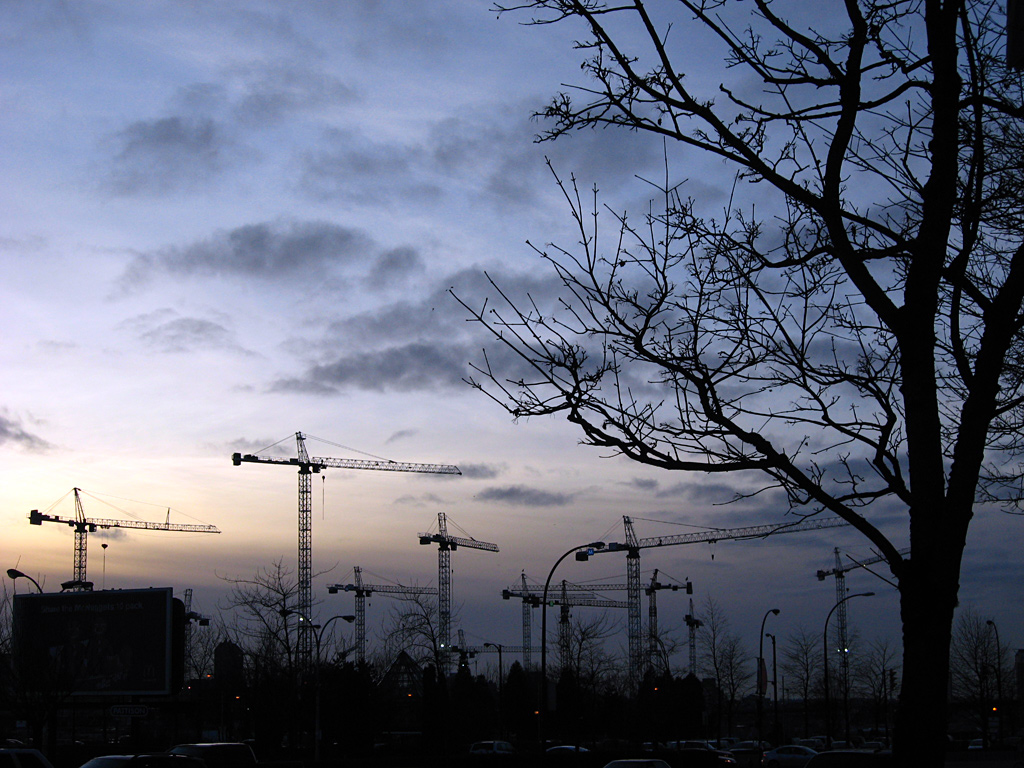
Cranes in Vancouver

I should now be in the air on my way back to Ottawa. Many thanks to all the people who helped to make my holiday in Vancouver so entertaining and personally meaningful. It has been a reminder of how important friends and family really are, and it has left me thinking with renewed energy about possible means of returning to British Columbia on a more permanent basis in the medium to long term.

For now, I need to get back on top of work projects and tardily finish my December book for the reading agreement with Emily.

Powershot A570 IS dead in three days

Three days after purchase, the battery hatch on my new camera broke during the course of ordinary use. I opened it to change the batteries and, when I tried to close it again, found that a little plastic bit was bent outwards. Afterwards, it would not close.

Future Shop refused to exchange it for a working one because they said the breakage was my fault. It was a reminder of just how poor their customer service is. The agent doing the return insisted that it had been dropped, even though it looked absolutely perfect aside from the bit that was bent.

The camera is being sent back to Canon for repair under the manufacturer’s warranty. Hopefully, they will simply repair or replace the hinge assembly. Irksomely, it can only be sent back to the store that did the original sale. When it comes back in a few weeks, it will therefore need to be mailed out to me in Ottawa.

[Update: 16 January 2008] More than two weeks after turning in my camera for repair, it remains ‘unprocessed.’ Perhaps, they say, they will be able to tell me the cost of repair within a week.

[Update: 23 January 2007] Apparently, the A570 has been repaired. My mother has kindly offered to pick it up and mail it to me tomorrow.

[Update: 31 January 2007] Oh, trumph and celebration! My camera has been returned and seems to be functioning properly. No more photos of the day from weeks past!