Critical mass

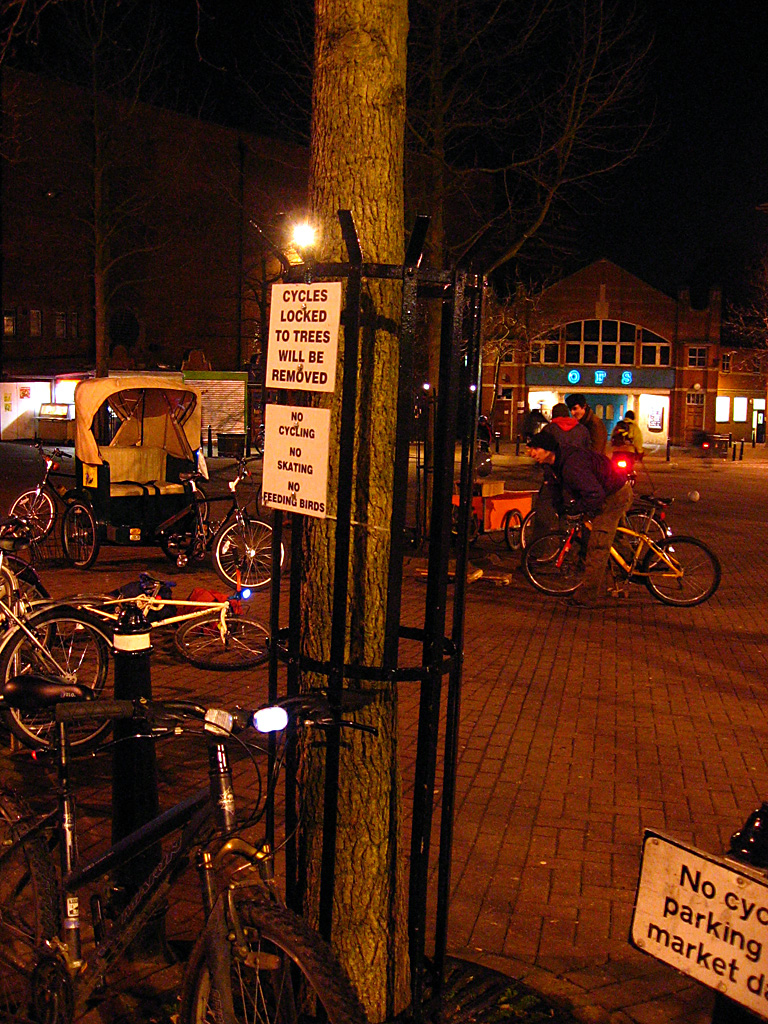
Critical Mass ride in Gloucester Green

On the way back from my meeting with Dr. Hurrell, I found myself in the middle of a Critical Mass bike ride: a social gathering where a group of cyclists assemble and ride together through an urban area. A recent dinosaur comic discussed it. There is much about the movement to recommend it: it fosters a sense of community and it raises the visibility of a healthy and sustainable form of transport. It also allowed me the opportunity to try bicycle polo, a somewhat precarious game that was played in Gloucester Green, following the conclusion of the ride.

As an advocacy act, critical mass rides involve some of the same questions as other attempts at altering the behaviour of others. Examples would also include those who tout the merits of a religion or lifestyle choice. While nobody appreciates an overzealous approach to acquiring converts, you can hardly feel strongly about the moral superiority of something and not at least gently prod others towards thinking as you do. Excessive deference to pre-existing beliefs – whether political, ethical, or religious – risks fostering a bland and unthinking society.

Agency assistance in the job search

One option I am considering for my ongoing job search is employment agencies. They are appealing because they have expertise in matching people to jobs, and because they will be able to do some of the searching ‘in the background’ while I am working on other things. With the need to finish a thesis, the papers for the international law course, and exams, that has considerable appeal. Given that the fees tend to be assigned to the employers doing the searching, there seems to be very little to lose in submitting my information to a few agencies and seeing what kind of options they turn up.

Does anyone have experience with such agencies in the United States or Canada? I’ve found one in the UK that is somehow connected to Oxford’s Career Services, but remaining here would not be my top choice, barring the availability of a much more desirable place of employment in the UK than is on offer in North America or elsewhere.

Leaving time for the possibility of a viva exam, I should be free to work starting at the beginning of July.

Cyril Foster lecture

Brick wall

Speaking of elitism, tonight I attended the annual Cyril Foster Lecture, delivered by Jack Straw, Leader of the House of Commons, Former British Home and Foreign Secretary. His talk was a reasonably generic discussion about the importance of identity in international politics. The most interesting point was when he was heckled by five young men in pinstriped suits, singing in barbershop quartet style. This was when he was trying to answer a question about how democratic it was to launch the war in Iraq. The tune was that of Rockabye Baby, the sole lyric “nonsense.” All told, it was so gracefully and effectively done that both the speaker and the Chancellor of Oxford (former Chairman of the Conservative Party and Governor of Hong Kong) thanked ‘the choir’ in their closing remarks.

People joke about how civil public discourse in the United Kingdom is, but this was a demonstration of exactly that humour, good taste, and effectiveness. To be fair, Mr. Straw also demonstrated the extent to which senior British public officials seem to be invariably excellent public speakers.

At the reception afterwards, I spoke with Mr. Straw about identity politics in profoundly divided states such as Iraq and the Former Yugoslavia. I also met Avi Shlaim, a man whose books on the middle east I have been reading since first year, and which I assigned to virtually all of my students over the summer. Anyone wishing to comment intelligently on the middle east should at least read his concise and informative War and Peace in the Middle East. I told my students to buy it, for reference and lending purposes.

Executive pay

This week’s Economist features a survey on executive pay that basically argues that, while there have been excesses, executive pay is generally awarded in a fair and legal way. The crux of the matter, as presented, is that executives earn less in pay than they add to the value of the company. More specifically, they add more than the most qualified person willing to work for less could.

At one point, the article holds up Robert Nardelli from Home Depot as an example. When he left the company, he got a severance package of $200 million. Even if his performance did earn more than that from the company, I think a case can be made that it is fundamentally unjust for one human being to have that much money. It enormously outstrips the needs a person could possibly have, and it is awarded in a world where millions domestically and billions around the world live in poverty. While emotionally satisfying, that argument may be fallacious: poverty alleviation is not the alternative usage for this money, and there isn’t a fixed amount of the money in the world to be distributed to one thing or another. It is at least logically possible that the economic contributions of chief executives do generate societal benefits.

Is the marginal value versus marginal cost perspective really the right way to evaluate executive pay? The degree to which the public tends to view such people as little better than venomous snakes suggests that the idea clashes with general moral intuitions. (Personally, I don’t think that venomous snakes belong in the category of things to which moral judgments can be applied; they are like large falling stones.) Of course, that doesn’t advance argument very far on the matter of what could or should be done about it. As discussed before, the problem is not that inequality is inherently morally problematic, but rather that it seems impossible that the differences between one human being and another could justify such excessive differences in payment. Furthermore, the reasons for which any such differences might exist are largely the product of chance.

International law and the environment

Morning walkers, South Parks Road

Next Wednesday, I have volunteered to give a presentation to my international law seminar on the following questions:

  1. Why has the regulation of CFCs been a success while the Kyoto Protocol has failed?
  2. Should the USA join the Kyoto Protocol, and if so, why?
  3. What roles have been played by Governments, NGOs and international organizations in the development of international environmental law? What is the basis of their authority in this field?

Substitute persistent organic pollutants (POPs) for Chlorofluorocarbons (CFCs), and it is a very good match for my thesis.

To give very short answers:

  1. Because there were substitutes readily available, the science was strong, and the cost of dealing with the problem reasonable, in the case of CFCs. Climate change is more difficult on all counts. (See the paper I wrote on the Stockholm Convention for my First Nations politics class in 4th year.)
  2. Yes, because it is a first step on the way to an agreement or collection of agreements that will stabilize GHG emissions, in the medium term. Ultimately, doing so will be much cheaper than suffering climate change, and will not carry the same terrible social and ecological costs.
  3. Their authority is based on expertise and legitimacy. See my thesis, in 88 days’ time for a more comprehensive answer.

Reading some more of the international law involved should be both interesting and useful. This is probably the first time the environment has been specifically addressed in any course that I have taken at Oxford.

PS. Much as I hate to reveal a fact that I might later win bets with friends about, I feel compelled to tell one that I learned earlier today from Kate. The polar bear (Ursus maritimus), has black skin: a feature that helps it to absorb energy from the sun, and thus keep the bear warm.

Ever upwards

WordPress Upgrade Chain:

Report bugs. Upgrades like this always make me nervous.

Papa Fly Productions and the nsn section should change over during the next couple of days, once I have kicked the tires here a bit.

[Update: 29 Jan 2007, 5:00pm] nsn portion upgraded to 2.1

[Update: 29 Jan 2007, 6:00pm] Papa Fly Films upgraded to 2.1. I was nervous about theme compatibility, so I made a full backup of the 2.0.7 install beforehand.

Progressive day

Moon on a chilly night

Today was almost as productive as tonight is chilly: I finished quite a bit of thesis reading, some thesis writing, and a funding application.While that’s not enough to reverse the tide of ever more emails in need of response, and ever fewer days in which to finish so many things, I did better than break even.

During the rest of the evening, I will read one more thesis: this one on the use of science in drafting the EC Biomass Action Plan. Amazing how these things only take a couple of hours to read carefully, but require hundreds of hours of work and thousands of hours of angst to produce.

Sometimes, I really wish there was at least one other person studying environmental politics with whom I could speak on a regular basis.

Categorizing thesis sources

I am splitting the literature review chapter for my thesis into two sections: the first about general materials relating to the role of science in environmental policy, and the second about the specific case studies. This bit is for the beginning of the general section, intended both to demonstrate the scope of appropriate materials and put them into a kind of comprehensible framework:

Within the realm of the general scholarship about expertise, legitimacy, and the application of science to the development of political solutions to environmental problems, there is a spectrum of discussion. At one end is the work most explicitly and restrictively concerned with questions within science itself. The deliberations of Popper, Kuhn, and their colleagues are frequently of this nature. The next band in the spectrum is work that relates to the social roles of scientists, within a broader social context. Here, the work of Haas on epistemic communities is particularly important. So too are deliberations within the scientific community itself over what it means to be a scientist. At a still-lengthening wavelength are explicit discussions about the political role that scientists should play: how, for instance, they should present their findings to policy makers, and whether it is appropriate to adopt political stances. Next come discussions about the same question, only from the political – rather than the scientific – point of view. How do politicians and political theorists view the process of delegation to scientists and scientific bodies? Finally, there are the most explicitly political and philosophical questions about things like the nature of international justice and the relationship between humanity and nature. In the following extended discussion, I will employ this organizational structure: moving from the high energy, short-wavelength considerations of science from within to the long wave questions of abstract political theory, keeping in mind the reality that these discussions are entangled with one another at many points.

What do you think of the metaphor? Too simplistic for a work of this sort, or useful as a means of categorizing? If I had to place myself on this spectrum, I would probably be in the yellow band: closer to red than to green. Most of the reading I have been doing – and a lot of what interests me most – is in the blue to violet range, though blaring red is not without appeal.

Also, it should be noted that I have far more sources of the first kind (general) than of the second (case study specific). This has a lot to do with how people keep suggesting the former and not the latter. Anyone who knows of any especially good writing on either the Stockholm Convention on POPs or the Kyoto Protocol is strongly encouraged to let me know about it. The library resources at Oxford, especially on Stockholm, are a bit patchy.