Day three of illness

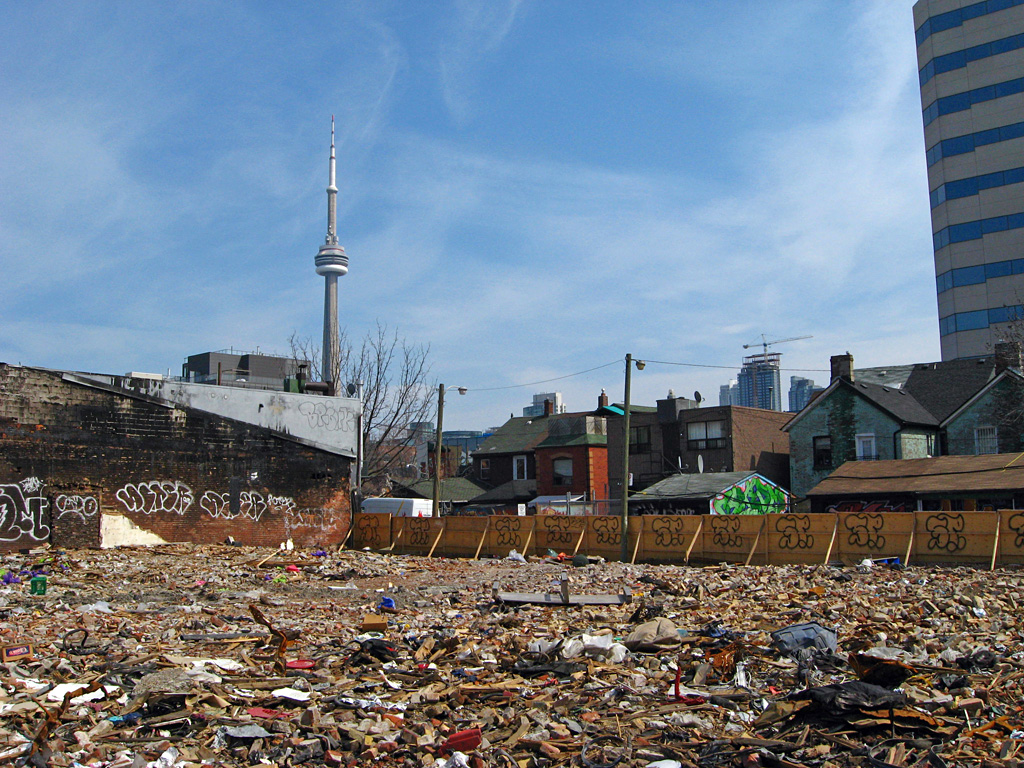
Rubble and the CN Tower

Sorry to have nothing interesting to say this morning. Unfortunately, I have been laid low by some bug with a fondness for the cells in my larynx. This seems to be the season for upper respiratory tract infections. Half my floor at work has become an impromptu orchestra of hacking coughs. The situation is similar with my neighbors.

The worst thing about all this is just how draining the illness is: demanding twelve hours of fitful attempts at sleep per day, yet still leaving you exhausted whenever you are up and about. The curious oscillations between only being comfortable when wrapped in several layers of wool and blankets and feeling hot when sitting around at room temperature in ordinary clothing are also notable. Falling asleep is also made challenging by the constant headache and joint pain. Even when one has managed to fall asleep for a few minutes, either a bout of coughing or a perceived temperature swing is sure to end that before long.

I am very much hoping that a weekend spent tossing and turning in bed will vanquish this bug.

Odds guessing results

Thanks in a large part to Zoom (of Knitnut.net), I have received 54 valid responses to my odds guessing experiment. As those who read the explanation already know, the point of the experiment was to assess how people assess the relative risks of a vague but more probable outcomes versus a concrete but less likely one. The vague result (1,000 deaths from flooding somewhere in the United States this year) was assigned to ‘heads.’ The precise result (1,000 deaths from Florida hurricane induced flooding) was assigned ‘tails.’

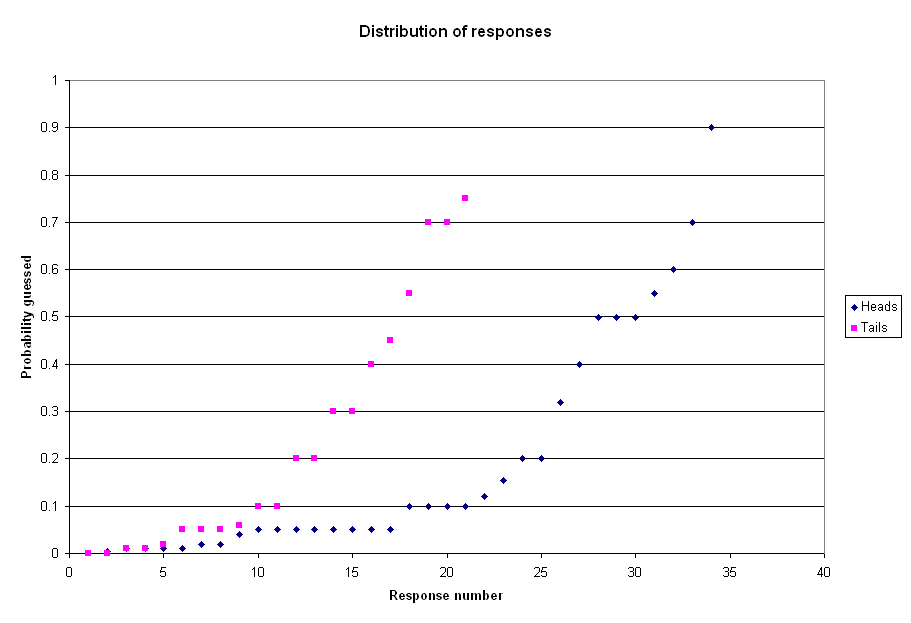
The first result to note is the very wide disparity of answers. Responses for ‘heads’ ranged from 0.005% all the way up to 90%. Responses for ‘tails’ ran from 0% to 75%. Given that there has been no flood in American history that killed 1,000 people, it seems fair to say that most guesses are overestimates. That said, the point of the experiment was to judge the relative responses in the two cases, not the absolute accuracy of the responses. This scatterplot shows the complete set of responses for both questions.

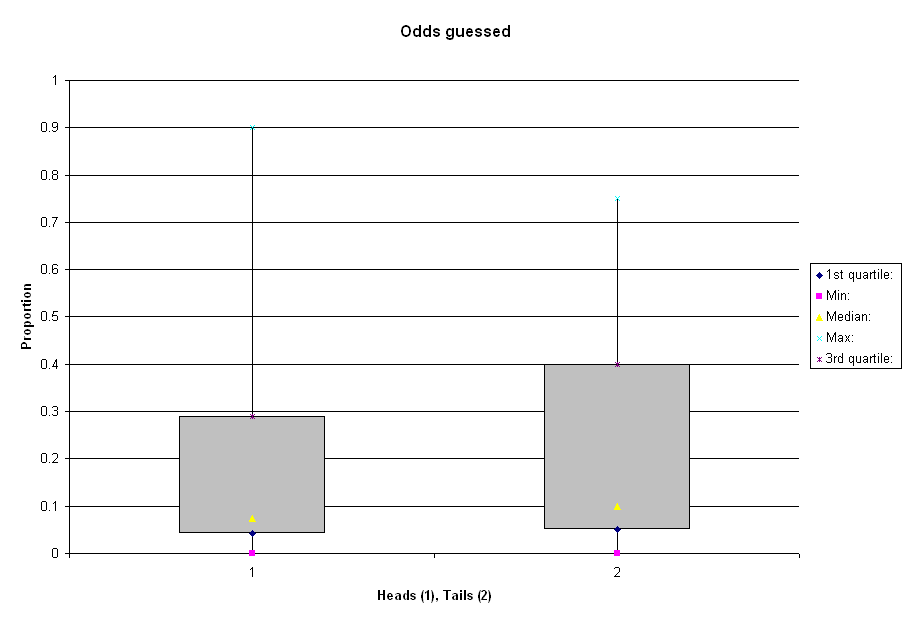
The mean probability estimate for ‘heads’ was 19.3%, while that for ‘tails’ was 23.8%. Because there were a large number of very high and very low guesses, it is probably better to look at descriptive statistics that aren’t influenced by outliers. This boxplot shows the mean, first and third quartile, maximum, and minimum results for each. To understand box plots, imagine that all the people who guessed are made to stand in a line, ranked from highest to lowest guess. Each of the numbers described previously (quartiles, etc) correspond to a position in the line. To find something like the median, you locate the person in the very middle of the line, then take their guess as your number. The advantage of doing this is that it prevents people who guessed very high from dragging the estimate up (as happens with the mean, or average), and doing the same with those who guessed very low.

The yellow triangle is the median. For ‘heads’ the median was 7.5%, compared to 10% for tails. The gray boxes show the range of guesses made by half the sample. At the top is the guess made by the person 3/4 of the way up the line, and at the bottom is the one made by the person 3/4 of the way down the line. As you can see, the bottom half ot the range looks pretty similar. Half of people estimate that the risk of both the ‘heads’ and ‘tails’ outcome is between about 10% and about 0%. What differs most about the two distributions is the upper portion of the grey boxes. Whereas 75% of respondents thought the ‘heads’ option was less than 30% probable, that value was more like 40% for the ‘tails’ option.

A couple of problems exist with this experimental design. Among the 54 ‘coin tosses,’ 63% seem to have come up heads. While it is entirely possible that this is the result of fair throws, I think there is at least some chance that people just chose ‘randomly’ in their heads, in a way that favoured heads over tails. Another problem is that some people might have looked at the comments made by others before guessing, or may even have searched online for information about flooding probabilities.

In conclusion, I would say the experiment provides weak support for my hypothesis. It is undeniably the case that the ‘heads’ option is more likely than the ‘tails’ option, and yet both the mean and median probability assigned to ‘tails’ is higher. There are also significantly more people who assigned ‘tails’ a risk of over 10%.

Those wanting to do some tinkering of their own can download the data in an Excel spreadsheet.

[Update: 28 April 2008] There has been some debate about the point above about the slight heads-bias in the results. I am told that the odds of this outcome are one in 26.3. Whether random chance or a systemic bias better explains that, I will leave to the interpretation of readers. In any event, it only really matters if the ‘heads’ group and ‘tails’ group differed in terms of their natural perception of risk.

Romm’s fourteen wedges

Red spraypaint

Joseph Romm, whose book I reviewed previously, has a new blog post up outlining what would be necessary to stabilize global concentrations of greenhouse gasses below 450 parts per million of CO2 equivalent. It is explained in terms of ‘stabilization wedges’ – each of which represents a reduction of one gigatonne (billion tonnes) below business as usual projections. In total, he says 14 are necessary by 2050 and suggests the following list:

  1. One wedge of vehicle efficiency — all cars getting 60 mpg, with no increase in miles traveled per vehicle.
  2. One of wind for power — one million large (2 MW peak) wind turbines.
  3. One of wind for vehicles — another 2000 GW wind. Most cars must be plug-in hybrids or pure electric vehicles.
  4. Three of concentrated solar thermal — about 5000 GW peak.
  5. Three of efficiency — one each for buildings, industry, and cogeneration/heat-recovery for a total of 15 to 20 million gwh.
  6. One of coal with carbon capture and storage — 800 GW of coal with CCS.
  7. One of nuclear power — 700 GW plus 10 Yucca mountains for storage.
  8. One of solar photovoltaics — 2000 GW peak (or less PV and some geothermal, tidal, and ocean thermal).
  9. One of cellulosic biofuels — using one-sixth of the world’s cropland (or less land if yields significantly increase or algae-to-biofuels proves commercial at large scale).
  10. Two of forestry — End all tropical deforestation. Plant new trees over an area the size of the continental U.S.
  11. One of soils — Apply no-till farming to all existing croplands.

No government anywhere has this level of ambition today. Just providing the nuclear wedge would require building 26 new plants a year, as well as ten geological repositories the size of Yucca Mountain. Providing the carbon capture wedge will require building a quantity of infrastructure capable of putting the same volume of CO2 into the ground as we are presently removing, when it comes to oil.

Romm does an excellent job of showing what a huge and civilizational challenge climate change really is. At the same time, while there is no technical reason for which fourteen wedges is impossible, one certainly doesn’t have the sense that anything like the necessary level of political will exists today. President Bush’s ludicrous announcement that the US will try to stop emissions growth by 2025 is closer to the mainstream of thinking in most places. At least a few people would rather doom future generations to an inhospitable planet than buckle down and make these changes.

Once again, we are left with the question of what might convince people to change. If fourteen wedges are what’s required, it seems virtually impossible that the rosy ‘it will all pay for itself’ possibility will play out. It is hard to imagine anything short of a catastrophe providing the necessary motive force, and it will take a catastrophe that unites the world in common effort, rather than divides it in fear or suspicion.

In short, the situation does not leave a person feeling optimistic.

Pollan on climate change

Michael Pollan (whose books I have previously reviewed: 1, 2), has an article in the New York Times about climate change. Essentially, the piece is about the need to change lifestyles in a way that goes far beyond making a few trivial gestures and waiting for technology to save us:

Here’s the point: Cheap energy, which gives us climate change, fosters precisely the mentality that makes dealing with climate change in our own lives seem impossibly difficult. Specialists ourselves, we can no longer imagine anyone but an expert, or anything but a new technology or law, solving our problems. Al Gore asks us to change the light bulbs because he probably can’t imagine us doing anything much more challenging, like, say, growing some portion of our own food. We can’t imagine it, either, which is probably why we prefer to cross our fingers and talk about the promise of ethanol and nuclear power — new liquids and electrons to power the same old cars and houses and lives.

It is refreshing to see someone else getting the big picture and accepting the reality that global emissions absolutely need to peak in the next 10-15 years, if we are not to live in a world transformed.

The whole article is well worth reading, though Pollan’s argument that growing a vegetable garden can significantly change a person’s outlook doesn’t strike me as hugely plausible. That said, it is not something I have ever tried.

Apartment hunting redux

Bookstore readers

The lease on my apartment expires in August and I intend to spend a portion of the time between now and then looking for a superior option. For the most part, this place has been quite good. Located near LeBreton, it is very close to work. It also has a very good landlord, a large basement with laundry equipment, and a tolerable though flawed layout.

Important characteristics I am looking for:

  1. Location: either close to work (Gatineau) and reasonably close to somewhere interesting (Elgin Street, Bank Street, etc) or very close to somewhere interesting and close to the transitway.
  2. Relatively quiet, especially in terms of traffic noise.
  3. Offers somewhere secure, covered, and convenient to store a bike.
  4. Well laid out, particularly in terms of offering a good space for parties, as well as space for a few guests to stay over.
  5. Large enough that two people could conceivably live there indefinitely, without driving one another crazy.
  6. Good water pressure.
  7. Ideally, includes one bedroom and one room that will serve as a study (see #5 above).
  8. Ideally, well insulated and otherwise energy efficient.
  9. Ideally, compatible with all of my existing furniture.
  10. Hardwood floors and laundry gear are an advantage.

The price range being considered is about $700-800 a month, though more would be possible for a really excellent place. There was an amazing $850 option I found while searching last summer; unfortunately, it got snapped up by the one couple who saw it before I did.

Your rights as a Canadian photographer

Bullies within private security and police forces are increasingly keen to harass people taking photographs in public places. As such, being aware of the laws relating to photography in your jurisdiction is quite worthwhile. The standard ‘I am not a lawyer / this does not constitute legal advice’ warning applies.

Things you cannot do:

  • Misrepresent someone in a slanderous way through photography or captions accompanying photographs.
  • Photograph people in their homes, or in spaces where they have a ‘reasonable expectation of privacy,’ such as public bathrooms.
  • Trespass, especially at night.
  • Take photos “that could be considered national secrets, interfere with a large number of Canadian’s lives, impair or threaten the Canadian Forces, national security or intelligence.”

Things you can do:

  • Take photos for non-commercial use in nearly any public space.
  • Photograph and publish photos of anyone, aside from young offenders, who are “newsworthy, doing newsworthy things, or are public figures or celebrities.”
  • “It is not against copyright law to take a photo of any architectural work, for example, a building, or a permanent piece of public art.”

The document linked above has a lot more detail, including statutes specific to provinces. It also has some good tips on what to do if you are confronted about taking photographs. As always, remaining calm and polite – but clear and firm about what it is within your rights to do – is the best approach. Deleting your photos in response to a confrontation is probably not a great idea because (a) it reinforces the idea that those confronting you have the right to make you do this (b) when they almost certainly do not (the exemption is the national security case) and (c) you will be destroying evidence that the photos you were taking were legal.

The Black Swan

Dirty machinery

Nassim Nicholas Taleb‘s The Black Swan: The Impact of the Highly Improbable is an unusual, excellent book with broad applicability. In particular, those concerned with finance or the use of mathematics in social disciplines (politics, economics, international relations, etc) should strongly consider reading it. They will probably find it uncomfortable – as it demonstrates how their ‘rigorous’ disciplines are built on sand – but they will be wiser people if they can accept that.

Taleb’s main point is that life is dominated by improbable events of huge consequence. This is obscured to us for a number of reasons: not least, because we are able to look back and construct plausible after-the-fact stories about why things turned out the way they did. Because we fail to appreciate how explosively improbable the world is, we leave ourselves far more vulnerable than our predictions suggest. Indeed, the biggest thing Taleb attacks is the very notion that we can make good predictions about the future. ‘Black Swans’ are those improbable events of massive consequence which we are able to rationalize after the fact, though we could not have predicted them before. They can be negative (the sudden collapse of a bank) or positive (the amazing success of an obscure book). They relate to the way in which the world is skewed towards extremes when it comes to things like income or the importance of a publication.

Taleb’s book consists of an odd combination of anecdote, mathematics, scholarly and literary references, personal history, and diatribes. Throughout, one has the impression of engaging in conversation with an unusually fascinating fellow – albeit one who takes special pleasure in cutting down those who disagree with him (the text ignores no opportunity for mocking and insulting economists and financial analysts, in particular).

The lessons Taleb says one should draw from an appreciation of Black Swans are noteworthy and sensible. First, we should maximize our chances of getting lucky and finding a positive Black Swan. In investment terms, that means making lots of small bets on long shots that might really pay off. In life more generally, it basically means trying new things – visiting the restaurant you never normally would, going on the blind date, seizing the opportunity to meet with the big shot publisher to explain your book idea. Second, we should minimize our exposure to negative Black Swans that can wipe us out. That means definitely avoiding standard financial instruments like mutual funds, distrusting any risk assessment based on the bell curve, and appreciating that blue-chip stocks might collapse despite decades of steady growth. His overall financial prescription is to put whatever you are unwilling to lose in US government bonds, while using the rest to make long-shot speculative bets.

It would be very interesting to see Taleb’s ideas applied directly to International Relations (the capital letters mean ‘IR the discipline’ rather than IR the phenomenon) or climate change. Within IR, there are a few dissenters who appreciate just how inappropriate all the statistics and quantitative methods being trotted out really are. They would find Taleb’s book to be confidence-boosting, whereas the number obsessed IR scholars concentrated in the United States would probably respond to it with as much anger as hedge fund managers.

When it comes to climate change, the Black Swan idea seems relevant in several ways. First, it creates a healthy scepticism about projections: whether they are for economic growth, greenhouse gas emission levels, or greenhouse gas reductions associated with certain policies. Secondly, it reveals how fallacious it is to say: “Humanity muddled through so far, therefore we can handle climate change just like any previous crisis.” Thirdly, it sheds light on scenario planning in the face of possible disastrous outcomes with unknown probabilities attached.

It is safe to say that anybody interested in how history is written or how people try to come to grips with an uncertain future will find something of value in this text. At the very least, the colourful asides provide plenty of mental fodder. At the very most, appreciation for Black Swans might significantly alter how you live your life.

Two Toronto discoveries

My weekend in Toronto yielded knowledge of two new interesting places:

The first is a Louisiana Cajun restaurant called Southern Accent. It is located at 595 Markham Street, near the Honest Ed discount store. Their serving staff are very friendly and accommodating, the decor is pleasantly unusual, and the food is novel and tasty.

The second is an excellent used book store called A Good Read. It is located at 341 Roncesvalles Avenue. It is a boutique-style shop, rather than an encyclopaedic warehouse like Chapters, and it seems to be stocked almost exclusively with the kind of books you would feel lucky to find in a normal used book shop. I picked up a massive tome on the history of cryptography that I mean to work through over the course of many lunch hours.

Experimenting on model brains

Milan and Paul in a diner

While taking the bus back from Toronto last night, I found myself wondering again about the brain-in-a-computer issue. While there are legitimate doubts about whether it would ever actually be possible to build a model akin to a human brain inside a machine, it is already the case that people are building successively better (but still very poor) approximations. Eventually, the models may become good enough for the following ethical question to arise.

What I wondered about, in particular, was the ethics of experimenting on such a thing. I have heard people mention, from time to time, the possibility of a ‘grandmother neuron’ charged specifically with recognizing your grandmother. The idea seems very unlikely, given that neurons die with regularity and people rarely completely and exclusively forget how to see their grandmothers. That being said, there is lots of experimental evidence that brain injuries can produce interesting results. As a consequence, the unfortunate, brain-damaged victims of car crashes sometimes find themselves to be the focus of intense interest among cognitive and behavioural psychologists.

If we did have a model brain (say a semi-realistic model fly or beetle brain), we could experiment by disabling sections of it to model the effects. By extension, the same could be done with rat, monkey, or human brains. The question then becomes: is there an ethical difference between experimenting on a mathematical model that behaves like a human brain and experimenting on a real human brain? Does that distinction lie in the degree to which the model is comprehensive and accurate? For instance, a good model brain might respond with terror and confusion if experimented upon.

This is yet another way of getting at the whole ethical question of whether people are simply their material selves, or whether there is something metaphysical to them. I maintain extremely strong doubts about the latter possibility, but still feel that there is an ethical distinction between experimenting on crude or partial brain models and experimenting on complete ones or real brains. I am much less sure about whether there is a meaningful ethical distinction between the last two options.

Nuclear subsidy simile

Countries that build nuclear reactors are, in some ways, like parents whose children run lemonade stands. The children get the ingredients for free and sell them for less than they are worth. Parents are usually willing to pay the difference, because they like to see their children hard at work. People who actually want lemonade for the lowest possible price would do best to find the kids with the least sense and the most generous parents.