
Hell and High Water

Bridge component

Joseph Romm’s Hell and High Water: Global Warming – the Solution and the Politics – and What We Should Do might be fairly described as an American version of George Monbiot’s Heat. It describes much less intrusive means for responding to the threat of climate change, as well as being more tailored to American politics. It is also less ambitious that Monbiot’s work, since it aims at the stabilization of atmospheric concentrations of greenhouse gasses (GHGs) below 550 parts per million (ppm) rather than 450.

The book is basically divided into two sections: one of which describes the nature and extent of the threat posed by climate change and one talking about solutions. The book is very explicitly focused on what climate change will do to Americans. Romm argues that too much coverage has focused on effects in poor countries, leading Americans to think the impact of climate change on their lives will be minimal.

Romm talks a great deal about how groups opposed to GHG regulation have created and funded a group of irresponsible ‘experts’ trying to convince the general public that major disagreement still exists about the reality and probable impact of climate change. He is very critical of the media, particularly for giving equal attention to the conclusions of a few oil-funded crackpots, compared with those of the enormous majority of scientists and all major scientific assessments.

I have some quibbles with some of Romm’s technological recommendations. I think he is a bit overconfident about the rapidity with which carbon capture and storage and cellulosic ethanol might be deployed. That said, the vast majority of what he says is correct, well defended, and similar to the thinking of others who have considered the questions seriously.

One notable omission from the book is emissions associated with air travel. At no point are they mentioned, either as a problem or an area where policy could yield improvements. As Monbiot effectively highlights, emissions from air travel are among the toughest to address, not least because lots of well-off people who consider themselves environmentalists and support good environmental policies nonetheless want to be able to jet off to South Africa or New Zealand.

Overall, Romm’s book is informative and accessible. He does a good job of bringing the issue home for Americans – de-emphasizing issues like the preservation of nature and international fairness – and emphasizing why they, personally, should be worried. Certainly, the kind of climatic impacts projected by the IPCC for 2030 or so are enough to make any reasonable person extremely nervous. He is right to say that, in a world where GHG concentrations are 650 ppm or more, climate change will be the issue being dealt with by all governments. Equally, he is right to point out that concentrations of that magnitude have a very serious risk of pushing us into a self-reinforcing cycle producing temperature increases of more than 5˚C globally and sea level increases of 25 metres or more. Hell and high water, indeed.

Here come the jellies

What do you get when you combine overfishing with large-scale nutrient runoff from industrial farms into rivers and the sea? Plagues of jellyfish:

The Namibian coast, for instance, used to be “hugely productive in fish,” [UBC fisheries graduate student Lucas Brotz] says, “and now it is entirely dominated by jellyfish. Things appear to be going that way in the Middle East, South Pacific, the Gulf of Mexico and the Mediterranean.”

This is what unlimited fishing with ever-better gear inevitably produces – short term profits for a few years followed by severely degraded ecosystems indefinitely.

“The Environment: A Cleaner, Safer, Healthier America”

Milan Ilnyckyj on the Alexandra Bridge, Ottawa

A book I am reading at present – Joseph Romm‘s Hell and High Water – drew my attention to an essay on climate change written by Frank Luntz, a political consultant who worked to oppose the regulation of greenhouse gasses.

The leaked memo, entitled “The Environment: A Cleaner, Safer, Healthier America,” provides a glimpse into the strategies of climate delayers that is both informative and chilling:

“The scientific debate is closing [against us] but not yet closed. There is still a window of opportunity to challenge the science…

Voters believe that there is no consensus about global warming within the scientific community. Should the public come to believe that the scientific issues are settled, their views about global warming will change accordingly…

Therefore, you need to continue to make the lack of scientific certainty a primary issue in the debate.”

The cynicism of it all is astounding. To see something as vital as climate change treated as a superficial, partisan rhetorical battle is extremely dispiriting.

The actual document is also oddly unavailable online. I had to use the Wayback Machine to find a PDF of the original leaked document. I am hosting it on my own server to aid people in locating it in the future. Clearly, I cannot vouch for its veracity personally. That said, articles in The Guardian and on George Monbiot’s site accept the document as genuine.

Small change

The New Yorker has an interesting article on American coinage. It focuses particularly on the question of what should be done with small denomination coins, given the ever-higher prices of metals like zinc, copper, and nickel.

It also includes a lot of interesting asides: such as how the American nickel was designed to have a mass of one gram per cent of value, at a time when the American government was flirting with the metric system. The article also features an amusing example of how industry sets us shell groups of ‘concerned citizens’ who are keen to block changes to the law that would be disadvantageous to them. In this case, a major supplier of zinc to the U.S. Mint founded Americans for Common Cents in order to resist moves to eliminate the diminutive coin.

Personally, I think that scrapping the penny is an act long overdue. For years now, I have been picking them out of the change I get back from purchases in order to reduce the mass of stuff being ferried about in my pockets. Even if every price gets increased to the next five cent mark, the benefits from being rid of the bothersome coin will be more substantial.

Back on the bike

As I had hoped, I got to do my first bike ride of the spring today: 25km along some of my favourite paths. It is intensely satisfying to feel tired and hungry as the result of exertion, rather than just because of the basic, boring work of keeping alive. Similarly, it was great fun to have the speed and maneuverability of a cyclist again, avoiding puddles and pedestrians while crossing ground with pleasing rapidity.

If I am to spend much more time in Ottawa, I am really going to need to find a winter sport.

Faith and evolution

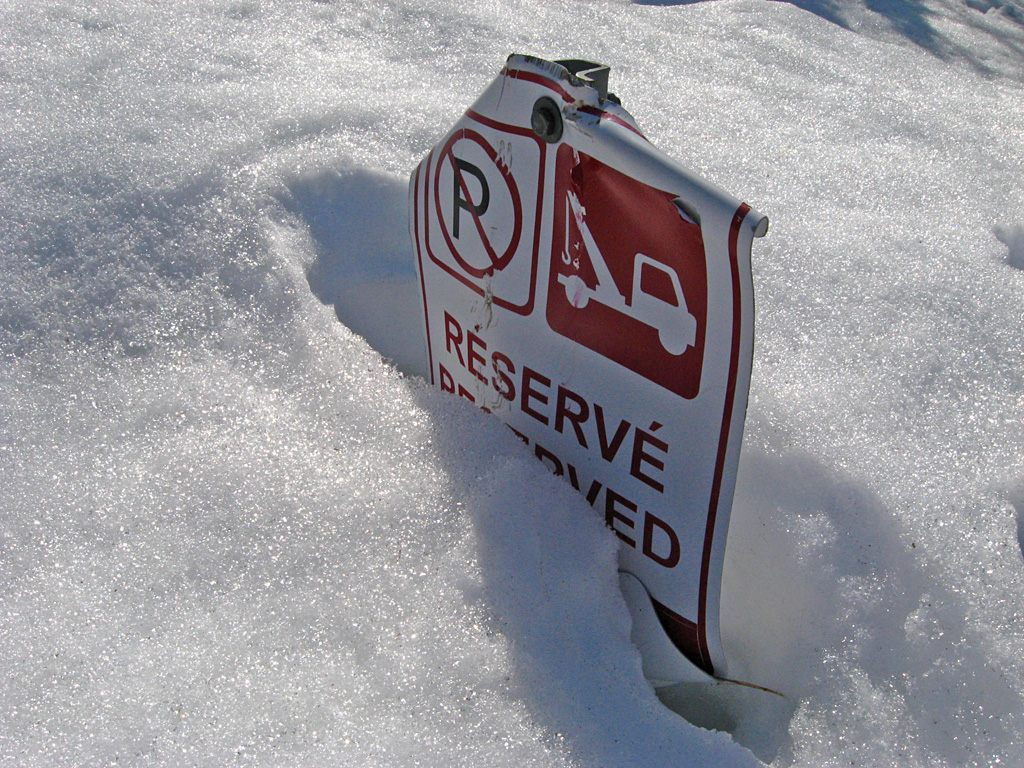
Parking sign buried in snow, Ottawa

An article in a recent issue of The Economist discusses the evolutionary basis for religious belief. The hypothesis being evaluated is that being religious confers some kind of advantage upon those with the trait, explaining the degree to which the trait is widespread. The hypothesis is not an entirely implausible one, and several studies suggesting some degree of validity are listed.

The thing the studies made me wonder was: “If you believed both that being religious would make you more healthy or successful, but you also believed that the religion had no basis in fact, would you practice nonetheless?” This would be akin to adopting Islamic dietary restrictions and fasting requirements because scientists had shown they conferred benefits for cardiovascular health. Such behaviour might achieve the aims that these scientists claim are embedded beneath religious behaviours, but they would clearly deviate from the stated principles of most faiths.

Another possibility acknowledged is that religiosity doesn’t confer direct benefits on individuals. Rather, it just makes them more fertile. There certainly seems to be an inverse correlation between the degree of secularism in a society and birth rates. Genes that promote religious faith may thus be doing so in order to increase the number of offspring who later carry them. The beliefs themselves may lack a basis in fact, but, if they contribute meaningfully to the propagation of selfish genes, part of the near-ubiquity of faith might be explained.

Le printemps

Four months after the onset of winter, we had our first day that felt like spring. There is still plenty of snow around and the river is still largely ice-covered, but it was bright and reasonably warm. People were sitting out on patios in the Market and young woman in tank tops and shorts could be seen throwing snowballs at one another in front of Parliament.

Tomorrow, I may exhume my bike from the basement. Hopefully, the relatively heavy snowfall we experienced yesterday will not re-emerge.

New nuclear plants, new nuclear waste

These days, nuclear energy is frequently spoken of as being in the midst of a ‘rebirth’ or renaissance, largely because of high oil prices and concerns about climate change. Those concerned about greenhouse gas (GHG) emissions do need to give the technology some credit as a mechanism for producing large amounts of power with relatively limited climatic effects. That is no reason to ignore the problems with the technology – from water use to nuclear waste to long lead times – but it does compel the formulation of a considered response.

One possibility I came up with would be to require firms building new nuclear plants to build geological sequestration facilities for the nuclear waste the plant will produce over its lifetime before the plant can begin operation. That would probably further delay the deployment of the technology, but it would avoid boondoggles like the ongoing conflicts about Yucca Mountain. It would also be a step away from the “act now and worry about the consequences later” mentality that has infected so much of energy and environmental policy.

The response to such a demand, on the part of industry, might offer a better glimpse into what the true costs of nuclear power really are.

A Madman Dreams of Turing Machines

Branches over Dow\'s Lake, Ottawa

Janna Levin’s book is an odd one: written about two mathematicians, focused on mathematical ideas, but with virtually no specific mathematical discussion. The book dances elegantly around the real meat of the lives of Alan Turing and Kurt Godel, but shows it all from the perspective of an outsider focused on emotions. This is freely admitted in the concluding notes:

The depth and magnitude of both Turing and Godel’s ideas are only barely touched upon here.

While this is a novel and not a reference work, one nonetheless feels that Godel and Turing would think it captures mostly what was not essential about their lives.

Putting words and thoughts into fictitious forms of historical figures is always a dangerous business, because it carries with it the false precision of reasoned invention. The danger that the speculation could be wrong is constant, so the book takes on the feeling of a friend-of-a-friend story, while maintaining the trappings of an omniscient direct account. The book also fixates far too much on apples, in an attempt to set up the story of Turing’s suicide.

The book’s strength lies in conveying the tragedy and isolation that seems to be the burden of most of the greatest mathematicians. The contrast between being able to perform mental feats beyond the capacity of almost everyone, while being largely unable to perform the basic actions of a normal life, has long been rich material for writers. In this sense, Turing comes off much stronger; by the end, the account of Godel’s life is both pathetic and pitiable. At least Turing is driven to suicide by the homophobic cruelty of others – Godel just stumbles into it through deepening paranoia.

While the book made for satisfying reading, I much prefer the math-related non-fiction works of Simon Singh. His Code Book includes an admirable description of the breaking of Enigma. In Fermat’s Last Theorem Singh also does a good job of telling about the lives of mathematicians, without ignoring the math. Something comparable on Godel’s incompleteness theorem would make more satisfying reading than this novel.

GHG-intensive industries and regulation

As mentioned in a recent Charlemagne column, certain industries produce so much carbon dioxide that it can be more in their interests to relocate than to face an effective national carbon pricing policy. At least, that is what they commonly argue. Examples of such industries include fertilizer, chemicals, steel, aluminium, and cement. Frequently, they have threatened to relocate if they are required to pay carbon taxes or buy permits for their emissions. While there is some reason to doubt how valid the threats are – it would be very expensive to relocate production facilities and personnel just to escape a new carbon regulatory regime – there is good reason to think about how various forms of regulation would affect such firms.

One mechanism through which such threats might be countered is by reaching agreements among major producers in as many states as possible. A Dutch chemical company will be more willing to accept carbon regulation if it knows that its American and Japanese competitors face similar requirements. This is an approach that worked well in dealing with ozone-depleting CFCs and could work similarly well in GHG-intensive industries that (a) involve a relatively small number of firms (b) located in countries with strong regulatory capacity (c) which have some political willingness to take action on climate change.

One feature many of these industries share is that a high proportion of their emissions are what are called ‘process’ emissions. This means that the greenhouse gasses are released not as a side-effect of energy production, but as a side-effect of the production of whatever it is the industry makes. As discussed before, cement has high process emissions and limited prospects for carbon capture. The situation is similar for at least some of the processes employed in the other listed industries.

One slightly counterintuitive aspect of ‘intensity-based’ cap-and-trade systems (in which firms are obliged to reduce the quantity of emissions they produce per unit of output, rather than in absolute terms) is that they are absolutely brutal for firms with predominantly process related emissions. If a cement company actually cannot do anything to reduce GHG emissions per tonne of cement, the only option under an intensity-based system is to buy 100% of its obligations from firms that have done better than their target or close down. Under a cap-and-trade system with 100% auctioning, or a carbon tax regime, such firms would basically be encouraged to contract while the economy finds less GHG intensive alternatives to what it produces. While that is a very politically difficult thing to call for, it must be remembered that all the years of unregulated emissions were, in effect, an undeserved gift from the general public in this and future generations to those firms. Discontinuing such unearned benefits is a necessary part of curbing climate change.

If we are serious about dealing with climate change, it needs to be acknowledged that not all industries are likely to find technological fixes during an acceptable timeframe. Some will simply need to shut down or be sharply scaled back. Looking across the past 100 years, it is clear that the fates of whole industries have risen and fallen in response to societal forces. The impetus for them to do so now is enormously greater, as nothing less than the future habitability of the planet is potentially at stake.