Winter party

Vancouver friends: make sure your calendars are clear for the night of Saturday, December 29th. I will be throwing a party: to feature sushi, curry, much wine and merriment, and the probable playing of mandolins. Meet new and interesting people – or perpetuate long-running arguments that have spanned several of these tragically infrequent gatherings. Directions available upon request. The same is probably true for crash space and permission to invite guests of your own. The bringing of food and/or beverages is always encouraged.

No matter how many of these gatherings you have attended, there should still be a surprise or two.

Precise winter solstice

Emily Horn in Yogi’s, on Commercial Drive

This very minute, the Earth’s axis in the northern hemisphere is tilted as far away from the sun as it will be all year: the moment of the winter solstice. Since there is lag built into the annual cycle of temperatures, we still have much of the cold to endure. Even so, our progression through the orbit will expose this hemisphere to ever more sunlight over the course of the next six months.

Provided travel plans are being implemented smoothly, I should find myself in the air on the way to Vancouver when this post is published. It is excellent to have the chance to spend twelve days visiting family and friends, even if the (offset) greenhouse gas emissions from the flight are a source of guilt and evidence of hypocrisy.

It is likely that posts between now and January 2nd will be less frequent and substantial than the norm. After traveling all the way to Vancouver, it makes sense to spend every possible minute with those who are normally distant.

Copper indium gallium selenide solar cells

Nanosolar, a company supported by Larry Page and Sergey Brin (the founders of Google), has announced that it will be selling thin-film solar cells profitably for $1 a watt. Apparently, the cells are printed with copper indium gallium selenide – an alternative to silicon. Cells based on the material can convert solar radiation to electricity with 19.5% efficiency. In theory, this material can applied to foil, plastic, glass or cement – producing electricity generating surfaces. It can also be made into more conventional panels of the sort Nanosolar is starting to sell.

In the 1950s, solar cells cost about $200 per watt. By 2004 they were down to $2.70. Further reductions could make solar power cost competitive with fossil fuels, potentially even in the absence of carbon pricing. Combined with either better storage (to moderate light/dark and sunny/cloudy cycles locally) or better inter-regional transmission (the sun is always shining somewhere), such cells could eventually make a big difference in the overall energy balance. Solar has been discussed here previously.

Shopping season

Stepping into any shop these days is a simultaneous reminder of many things: the insipidness of holiday music, our society’s unfettered embrace of mass consumerism, and the deadweight losses associated with gift-giving (as discussed previously). In many cases, gifts cost more to the giver than they are worth to the receiver. Even in cases where that isn’t true, the products received are often unnecessary. Arguably, the expectation of gift giving perpetuates harmful expectations about the nature of friendship, romance, and family.

Anyone feeling inclined to give me a gift is encouraged to make a donation to Médecins Sans Frontières or Amnesty International. In my own life, I focus primarily on efforts to improve the world through incremental regulatory change. It is also good to support the people doing good work actively and immediately, addressing suffering and injustice at the point where they exist.

On watching empty vans roll by

In most cities, there are corridors through in which virtually every vehicle that enters at one specific point leaves at another. Examples include:

  • Vancouver: the causeway through Stanley Park and across the Lions Gate Bridge
  • Ottawa: Booth street between LeBreton and Eddy

In both of these places, I have spent long periods of time with large groups of people waiting for buses. Meanwhile, thousands of cars containing single invididuals have streamed past.Is there any way spontaneous mass hitchhiking could be made to arise in such circumstances? What are the barriers to that happening? Are there any places in the world where it would happen already?

It just seems spectacularly inefficient for thousands of empty seats – powered by powerful engines and emitting fumes for the enjoyment of those waiting – would stream pass crowds of cold, or wet, or even perfectly comfortable people waiting to pay for a spot (probably standing) in a publicly owned vehicle.

Milan’s Ottawa

Last winter, I made a map of the parts of Oxford in which I would be likely to find myself over the course of a week.

Here is my approximate Ottawa map:

Map of the parts of Ottawa where Milan Ilnyckyj spends time

It is basically defined by three corridors, leading from my home to work, the grocery store, and the Rideau Centre. During the summer, it would certainly have a few more tendrils. That said, it is a safe estimate that 50% of my time is spent within the tiny (unmarked) rectangles of my cubicle and bedroom.

Rejecting Canada’s new copyright act

As a student, I was constantly being called upon to support various causes, through means ranging from making donations to attending rallies. Usually, such activities have a very indirect effect; sometimes, they cannot be reasonably expected to have any effect at all. Not so, recent protest activities around Canada’s new copyright act: a draconian piece of legislation that would have criminalized all sorts of things that people have legitimate rights to do, such as copying a CD they own onto an iPod they own.

Defending the fair use of intellectual property has become a rallying point for those who don’t want to see the best fruits of the information revolution destroyed by corporate greed or ham-fisted lawmaking in the vein of the much-derided American Digital Millennium Copyright Act. At their most controversial, such acts criminalize even talking about ways to circumvent copyright-enforcement technology, even when such technology is being mistakenly applied to non-copyrighted sources: such as those covered by the excellent Creative Commons initiative or those where fair use is permissive for consumers. Watching a DVD you own using a non-approved operating system (like Linux) could become a criminal offence.

For now, the protests seem to have been successful. Of course, the temptation for anyone trying to pass a controversial law is to hold off until attention dissipates, then pass it when relatively few people are watching. Hopefully, that will not prove the ultimate consequence of this welcome tactical victory for consumer rights.

Related prior posts:

Feel free to link other related matter in comments.

Geminid meteor shower

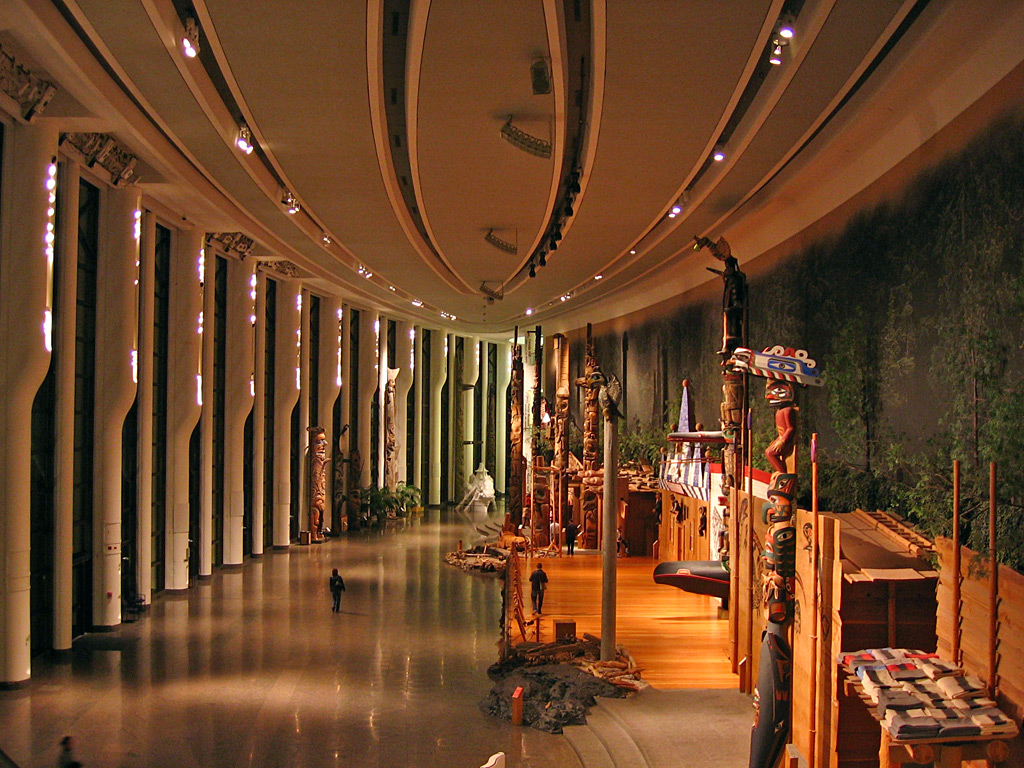
Main hall, Canadian Museum of Civilization

Those of you with clear skies should make a point of peering at them tonight. The shower – produced by debris from a near-Earth asteroid called 3200 Phaethon – should become increasingly intense throughout the night, peaking in intensity around dawn. According to NASA, this should be the best meteor shower of the year. It may well be worth getting up before dawn (or staying up especially late) and looking to the western sky.

3200 Phaethon is thought to be a former comet, dust from which began intercepting Earth’s orbit annually during the American Civil War. The object is about 5 kilometres wide and misses the earth by only 2 million kilometres. If you have access to a decent telescope (many university observatories are open to the public some nights), you can observer Phaethon in the constellation Virgo. It only has the brightness of a 14th magnitude star, so neither the naked eye nor binoculars are sufficient to pick it out.

Statements with no content whatsoever

Bare branches and sky

There may be nothing more frustrating in the world than being unable to convince somebody that something is a tautology. You try as hard as you can to convince them that something is true by definition, but they persist in failing to see how you have designed the terms of the statement to be indistinguishable from the conclusion. Saying “Dogs are dogs therefore dogs are dogs” and having someone say, “Ah, but there are many kinds of dogs” is enough to drive one batty, if it happens often enough. Essentially, this is because the supposed point of contention is nothing of the kind – it is just a non sequitur that the other conversant thinks is some kind of rebuttal.

For some reason, training courses seem to spawn these sorts of logically agonizing discussions.

iBook dead

After running a routine maintenance script, my iBook has decided that it no longer wishes to perform any of the functions traditionally associated with a computer. It will probably be a few days before I am up and running again, during which time I will be unable to check my personal email.

Given that I will probably have to wipe my hard drive and start over, it makes sense to pick up a copy of the new release of Mac OS before I do so.

Back in a few days.

[Update: 2:37am] After $100 and seven hours of backing up, formatting, and installation, the computer is healthy enough to access the web – and running Leopard to boot. The lengthy task of bringing back all my data and applications will need to wait for a later time.

[Update: 12 December 2007] It seems having byte-for-byte backups of data held in Apple software is not terribly useful. I can import my 14,000 image files back into iPhoto easily enough (though it takes six hours), but they lose all the information I have spent dozens of hours entering: locations where they were taken, who is in them, whether they have been used as blog photos, etc. This whole recovery process has me tearing out my hair in frustration, while spending six hours or more each night working on it.