Renewables in Germany

Germany may be the developed country doing the most to expand the share of renewable energy it uses for electricity generation. Partly as a consequence of feed-in tariffs (where power distributors are obliged to buy energy from renewable facilities at set prices), renewables now represent about 15% of Germany’s electricity supply, much of that from wind. Since 2008, the quantity of solar energy employed in Germany has doubled.

Unfortunately, budgetary concerns may lead to the scaling back of the initiative. While it is fair enough to say that there are cheaper ways to fight greenhouse gas emissions than putting solar cells in Germany, it is also meaningful to highlight that the whole world will eventually need to transition to the use of renewable forms of energy. By helping to determine the political and technical measures necessary to do that, pioneers like Germany are doing a favour for those who will follow after.

For instance, feed-in tariffs are an important part of Ontario’s Green Energy Act.

Media from the anti-prorogation protests

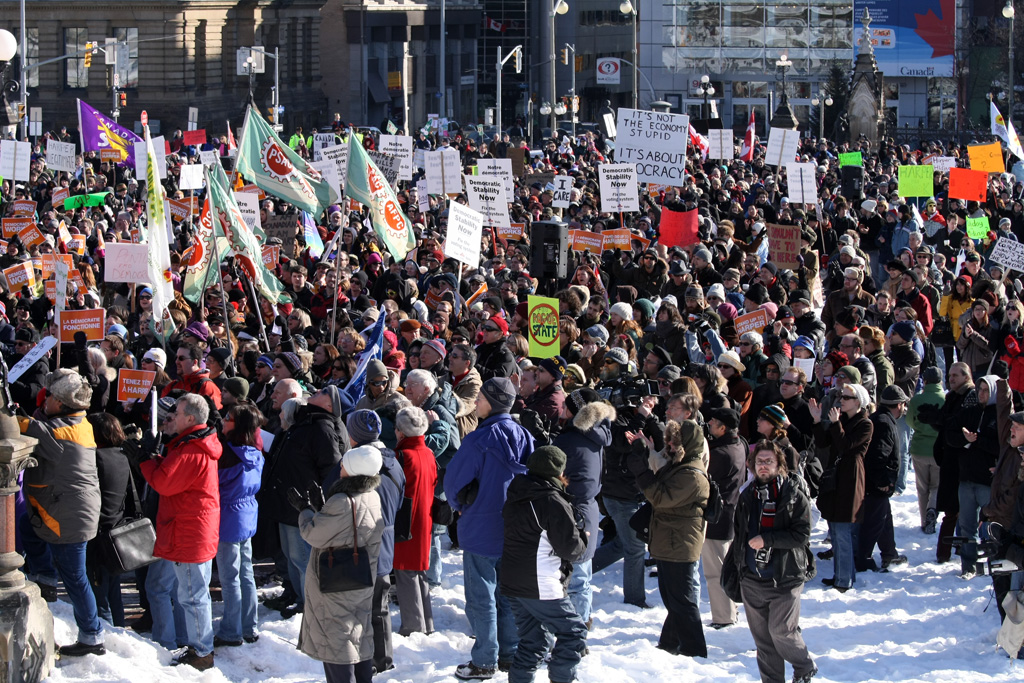
Today’s Ottawa protest against the prorogation of Parliament drew fewer people than the Fill The Hill climate protest, though it enjoyed much nicer weather.

Here is a slideshow of all of my photos from today. Higher resolution versions are available on request.

One of the more entertaining parts of today’s rally was Trevor Strong‘s song “The Wild Proroguer.” This member of the Arrogant Worms modified a traditional song to include lyrics about Canada’s second prorogation in about a year. The MP3 is on his website; I uploaded a video of the performance on Parliament Hill to YouTube.

This might be the funniest sign I saw today. The owner will never need to make another one, regardless of how many protests or counter-protests they decide to attend.

Note: all this content is covered by a Creative Commons license. Feel free to use it for non-commercial purposes, with attribution.

[Update: 24 January 2010] Other Ottawa bloggers also attended the event: Zoom, Watawa Life, and Coyote.

CES Franks on democracy in Canada

CES Franks, of Queen’s University, has written an interesting essay describing the state of parliamentary democracy in Canada: “The Functioning of the Present-Day Canadian House of Commons: a paper prepared for the conference in honour of Peter Aucoin.” It focuses to a considerable extent on the reality of minority governments in Canada today, though also considers broader factors and long-term trends. For instance, the number of days per year in which Parliament is sitting has fallen by a third since the 1950s and the proportion of government bills eventually receiving Royal Assent has fallen from over 90% to just over 50%.

Franks also highlights the drift towards a bigger role for the provinces, with fewer national strategies and initiatives:

[M]y findings leave me with a sense of slight unease, and I am prepared to argue that the role of Parliament has diminished in recent decades and is continuing to diminish, to the detriment of good government in Canada. Further, much of the reason for this diminished role does not lie in the fact that we now have a Pizza Parliament with four parties and a likelihood of continuing minority parliaments. The causes lie elsewhere, and many are beyond the control of Parliament and government. They lie in fundamental changes in recent decades in the political economy of the Canadian Federation, in the increasing role of provincial governments as compared to the federal government, and in the unwillingness, rightly or wrongly, for better or worse, of recent federal governments to establish national programmes, policies, and national standards for the services Canadians expect from their governments.

In some ways, wider variation between the provinces doesn’t seem problematic. After all, there is nothing objectionable about populations with different perspectives being governed under differing rules, selected through democratic processes in which they participate. At the same time, there does seem to be reason for concern about the possible diminishing of the entity that is Canada. For one thing, there are major cross-cutting challenges that all provinces need to address, and it makes sense to do so in a cooperative way. For another, the temptations to make policy with only an eye turned towards the short-term consequences might be even greater for individual regions than they are for the confederation as a whole.

The full Word document is online, and linked from the Macleans website.

The 2035 glacier claim and the IPCC

Previously, I described an asymmetry between the approach of climate change deniers and climate scientists, with the latter unwilling to retract any claims no matter how poorly justified or effectively rebutted. I think the instance with the IPCC and ‘poorly substantiated’ Himalayan glacier data is illustrative.

A failure to properly vet some information has come to light, and the IPCC has responded in an open and honest way:

In drafting the paragraph in question, the clear and well-established standards of evidence, required by the IPCC procedures, were not applied properly…

The Chair, Vice-Chair, and Co-Chairs of the IPCC regret the poor application of well-established IPCC procedures in this instance. This episode demonstrates that the quality of the assessment depends on absolute adherence to the IPCC standards, including thorough review of ‘the quality and validity of each source before incorporating results from the source in an IPCC report.

Climate deniers have jumped on all this to argue that it undermines the overall conclusions reached by the IPCC. Far from calling into question the overall scientific consensus, this willingness to concede errors demonstrates one of the reasons for which it is robust, namely a willingness to accept and respond to valid criticism. By contrast, deniers of various stripes tend to rub along well with one another, even when they have wildly different positions: that climate change isn’t happening, that it is actually beneficial, that it is caused by something other than greenhouse gases, etc.

The MSC and BCs sockeye salmon

I have written before about how the certification of a fishery by the Marine Stewardship Council is not sufficient cause to think it is genuinely sustainable (even before factors other than fish numbers, such as fossil fuel use by ships, are taken into account). More evidence for this has been forthcoming recently. Now, they have decided to certify the British Columbia sockeye salmon fishery, despite how the fish numbers are dwindling and subject to an ongoing inquiry. Last year’s run on the Fraser river was less than 10% of what had been expected. The recent history of salmon in BC is a catalog of failure. The decision to certify regardless certainly doesn’t leave the MSC looking very credible. Their decision doesn’t become official until a 15-day complaint period has concluded, and people will hopefully be able to persuade them to think differently during that span.

For those who really care about environmental issues and are willing to make personal choices to reflect that, I recommend avoiding fish (and other sorts of meat) entirely. Keeping fishing activity at a sustainable level just seems to require more political integrity and long-term thinking than any of the world’s governments can muster. It’s so much easier to grab a haul now, earn a bundle, and leave the mess for those who will come later.

Surviving climate change

The failure of Copenhagen and other climate change setbacks raise the real possibility that the world will continue to obsess over trivialities, missing the big picture until it is too late to prevent radical change. As such, we need to at least contemplate the possibility of seeing more than 4˚C of mean global temperature rise within our lifetimes, with all the radical effects that might accompany that.

As individuals, what kind of strategies could permit that? Warming is likely to be far more pronounced in the higher latitudes than in more temperate ones. Sea levels are likely to rise significantly, while summer snowpack and glaciers are likely to vanish. Crops that have been well suited to regions for all of human history may no longer grow where they used to. How can someone with no intention of having children maximize their odds of living decently in a world we are so actively undermining? What should those who have reproduced (or are considering doing so) take into consideration, above and beyond that?

For the sake of this planning exercise, it is worth considering outcomes that are plausible and serious, even if they are more unlikely than likely. After all, there are a lot of powerful feedback mechanisms that haven’t yet been incorporated into climate models. It is also worth remembering that even business-as-usual projections, based on emissions continuing to grow at the present rate, involve projected warming of over 5˚C by the end of the century, making the planet far hotter than at any time in human history.

Note that this has been partly discussed here before.

Waiting on Massachusetts

It seems as though there are an absurd series of magnifying glasses over top of the Massachusetts senate race. If Scott Brown, the Republican candidate, takes over the senate seat of the late Ted Kennedy there is a good chance health care reform will die. If that happens, it seems certain that climate change will become even less of a priority in the United States. Also, it would probably increase the chances of a big swing towards the Republicans in the upcoming mid-term elections. If they lose their supermajority in the senate, the chances of either a domestic cap-and-trade strategy or the ratification of an international climate change treaty with binding targets will become very remote indeed.

All this at a time when global emissions need to peak in the next 1-10 years, if we are going to have a decent chance of avoiding more than 2°C of temperature increase. Note that that is a global peak; to accommodate continuing growth in poorer countries, places like Canada and the US will need to cut faster and deeper than average.

Of course, just because there is a plausible connection between a Republican win in this senate race and eventual failure to address climate change, the logic of failure cannot be flipped around to produce a template for success. To get the kind of action we need on climate change, a lot more things will need to go right.

Emissions drop from Canada’s biggest GHG polluters

One curious thing about those who are determined to avoid the emergence of effective climate change policies is how they argue that climate science is far too uncertain to serve as the basis for decision-making, while simultaneously claiming that their economic models prove that going low-carbon will produce certain economic ruin. That claim is especially poorly defended over the long-term, given that economic models cannot effectively incorporate the consequences of technology and capital changes across a span of decades. Also, the idea that fossil fuel based prosperity will be everlasting faces a fundamental challenge from the scarcity of those fuels, and the political volatility of many of the regions in which they are found.

Near-term data also suggests that Canadian companies can cut emissions without suffering economic ruin. According to Tyler Hamilton’s blog:

[Canada’s] Top 10 industrial CO2 emitters reduced their greenhouse gas emissions by 9 per cent in 2008 compared to 2007. At the same time, the Canadian economy grew by 0.5 per cent. Given that the impacts of the economic downturn were felt mostly in 2009, an even greater drop is expected this year. Canada’s Top 350 emitters reduced greenhouse gas emissions by nearly 6 per cent during the same period.

Of course, that does not prove, in and of itself, that effective climate change policies would be painless in terms of costs or jobs. Still, just as the onus must be on climate scientists to both refine their models and acknowledge their limitations, those who assert that good climate policies will be economically ruinous must address both evidence and arguments that suggest that this may not be so.

Rapier’s insights into blogging

Over on his energy blog, Robert Rapier has written a summary of what he has learned, blogging about energy issues. The points seem pretty broadly applicable to those writing about technical and politically contentious topics. For those thinking of giving serious blogging a whirl, a couple of his points seem especially pertinent and well matched to my own experience. In particular, you won’t be able to predict which posts are popular and produce discussion, and which will not. Also, you shouldn’t expect to make any significant amount of money, and you should expect to be plagued by spambots trying to do so.

At its worst, blogging on substantive issues just produces a discordant echo chamber of people yelling at one another, continuing to use discredited arguments, and generally not advancing the state of discourse. That being said, I do think blogs have a lot of societal and pedagogic value. By forcing the author and commenters to defend their views in the face of criticism, they provide a valuable mechanism for sharpening thinking. Here’s hoping that helps to address the world’s grave problems, over the long term.

Haiti, crises, and the international community

Haiti’s terrible earthquake has given the international community an opportunity to demonstrate where it is capable of effective response. International organizations, national militaries, the media, and non-governmental organizations are all familiar with the business of short-term post-crisis response. The issues at stake are immediate, acute, and highly visible. The cost of making a commitment is fairly clear from the outset: whether you are evacuating people, digging through rubble, providing emergency shelter, or what have you. The response is also essentially apolitical: there is no blame to be assigned after such a natural disaster, and there are no clear partisan divisions in terms of what our response ought to be. Certainly, the international assistance is laudable and valuable. Predictions that a second wave of death would follow the Asian tsunami (on account of hunger, disease, etc) were partly defied as a consequence of energetic international aid efforts.

Of course, while a crisis illustrates what the international community is reasonably good at, it indirectly highlights areas in which responses are far more hesitant and ineffective. While the movement of tectonic plates is not a political phenomenon, the question of why Port-au-Prince was so vulnerable has political implications. The 1995 earthquake in Kobe, Japan was similarly powerful, but killed fewer people: about 6,500 compared with 40,000 plus in Haiti. Surely, construction standards and overall levels of societal wealth are part of the explanation for that. Comparisons can also be drawn to disasters that lack the features that make this one so politically simple: those that exist for an extended period, require uncertain and potentially large commitments of resources and political capital, and which lack the ability to create an immediate emotional response in the voting and tax-paying public.

While Haiti will provide incremental experience in acute crisis management, it is worth asking whether it can show the international community anything about longer-term risk management. In an increasingly interdependent world, the capabilities of the international community arguably need to expand beyond just sweeping up the broken glass, though doing so calls into question issues like sovereignty and the ‘responsibility to protect’ doctrine that seems to have become an unexpected casualty of the second Iraq war. Certainly, the U.N. cannot create seismic standards and hope they will be enforced in poor countries; at best, the U.N. and other such international organizations might be able to get a better handle on transboundary issues, which can only become more acute as the world is ever more densely populated, and the total material withdrawals and waste deposits from humanity into the biosphere continue to grow.