Why the Allies Won

Vancouver grafitti, in an alley off Seymour Street

Among the hundreds of books I read at Oxford, Richard Overy’s Why the Allies Won stood out as an especially engaging piece of historical argumentation. It is one of a handful of books I was determined to re-read when I had more time available. Given the fundamental importance of the Second World War in the establishment of the contemporary international system, the question is a rather important one. Overy’s explanation is well-argued, convincing, and consistently interesting.

This complex book has a number of general themes, each of which is based around a necessary but insufficient cause for the victory of Britain, the United States, and the Soviet Union over Germany, Italy, and Japan. Overy goes into detail on the Battle of the Atlantic – particularly the importance of American supplies for Britain, the U-boat menace, and the tactics that turned the tide in that theatre. He likewise covers the war on the eastern front: from early German successes to the battles at Stalingrad and Kursk that marked the watershed point of the war. In the Pacific theatre, he does an excellent job of explaining the significance of the Battle of Midway, including the considerable role luck played in the victory. The outcome was largely decided by ten bombs in ten minutes that struck Japanese aircraft carriers while they were refueling their air wings.

An entire chapter is devoted to the cross-channel invasion from Britain into occupied France. Of particular interest is the role played by intelligence, a subject Overy arguably neglects to some extent in other circumstances. The ways in which the Allies kept German defences spread out through misdirection make for especially interesting reading.

Overy also covers more thematic reasons for the Allied victory: mass production, especially in the United States and Soviet Union; technology, especially air power; the surprising unity between the Allies; and the moral contest between the Allied and Axis states. Unlike many historians, he highlights Allied bombing as an effective military strategy. He remains ambiguous about whether the military utility justified the bombing of German and Japanese civilians, but argues relatively persuasively that attacks on oil facilities and other key bits of industrial infrastructure served an important strategic purpose.

Midway is not the only example of good fortune Overy highlights – partially in an attempt to undermine the argument that the war could only have ended the way it did. Adding external fuel tanks to the fighters escorting bombers into German airspace dramatically reduced losses, substantially bolstering the effectiveness of the strategic bombing campaign. Likewise, equipping a few aircraft to close a small ‘Atlantic gap’ helped secure the end of the U-boat threat. Even the devastating trap sprung by the Soviets upon the German supply lines approaching Stalingrad could not have succeeded without the incredible success of a few thousand isolated troops occupying the entire German 6th army.

This book is enthusiastically recommended to anyone with an interest in military history generally or the Second World War in particular. It is also a good general disproof of the idea that the outcome of wars is decided by basic material facts like the relative sizes of economies, or the idea that there aren’t decisive turning points in history where the world is pressed along one path as another is closed off.

The implied right to pollute

In today’s news, there is some talk about the new report from the National Round Table on the Environment and the Economy. Much of it has surrounded the possibility of a carbon tax as a vehicle for assisting the with reduction of Canadian greenhouse gas emissions. One comment from the CBC struck me as especially wrong-headed. In relation to a carbon tax, a person being interviewed said that it “would specifically impact western oil producers who might have to carry the brunt of such attacks.”

The fallacy here is that western oil producers have the right to emit as many greenhouse gasses as they like, for free. If your neighbour was running a pulp mill in his back yard, allowing toxic chemicals to ooze throughout the neighbourhood, nobody would call it an ‘attack’ when he was made to stop. Arguments implying that industry or private individuals have the right to impose ecological harms upon others need to be challenged in terms of fairness and ethics. Otherwise, they obscure the true character of the situation and help to perpetuate the status quo.

A grand solar plan for the United States

Sign in Sophie’s Cosmic Cafe

The latest issue of Scientific American features an article about a ‘grand solar plan.’ The idea is to install massive solar arrays in the American southwest, then use high voltage direct current transmission lines to transfer the energy to populated areas. The intention is to build 3,000 gigawatts of generating capacity by 2050 – a quantity that would require 30,000 square miles of photovoltaic arrays. This would cost about $400 billion and produce 69% of all American electricity and 35% of all energy used in transport (including electric cars and plug-in hybrids). The plan depends upon storing pressurized air in caverns to balance electricity supply and demand. The authors anticipate that full implementation of the plan would cut American greenhouse gas emissions to 62% below 2005 levels by 2050, even assuming a 1% annual increase in total energy usage.

The authors stress that the plan requires only modest and incremental improvements in solar technology. For instance, the efficiency of solar cells must be increased from the present level of about 10% to 14%. The pressurized cavern approach must also be tested and developed, and a very extensive new system of long-distance transmission lines would need to be built. While the infrastructure requirements are daunting, the total cost anticipated by the authors seems manageable. As they stress, it would cost less per year than existing agricultural subsidy programs.

Depending on solar exclusively is probably not socially or economically optimal. The authors implicitly acknowledge this when they advocate combining the solar system with wind, biomass, and geothermal sources in order to generate 100% of American electricity needs and 90% of total energy needs by 2100. Whether this particular grand plan is technically, economically, and politically viable or not, such publications do play a useful role in establishing the parameters of the debate. Given the ongoing American election – and the potential for the next administration to strike out boldly along a new course – such ideas are especially worthy of examination and debate. It is well worth reading the entire article.

Energy security and climate change

Climate change and energy security

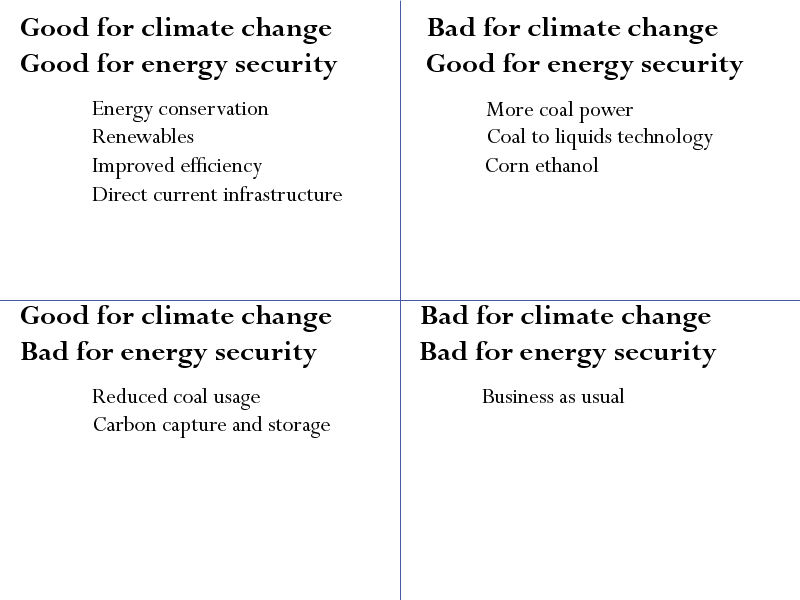
If you listen to the speeches being made by presidential candidates in the United States, you constantly hear two ideas equated that are really quite independent: ‘energy security’ and climate change mitigation. The former has to do with being able to access different kinds of energy (natural gas, transportation fuels, electricity) in a manner consistent with the national interest of a particular state. The latter is about reducing the amount of greenhouse gasses emitted in the course of generating and using that energy.

Some policies do achieve both goals: most notably, building renewable energy systems and the infrastructure that supports them. When the United Kingdom builds offshore wind farms, it serves both to reduce dependence on hydrocarbon imports from Russia and elsewhere and to reduce the link between British energy production and greenhouse gasses. Arguably, building new nuclear plants also serves both aims (though it has other associated problems).

There are plenty of policies that serve energy security without helping the problem of climate change at all. Indeed, many probably exacerbate it. A key example is Canada’s oil sands: they reduce North American dependence on oil imports, but at a very considerable climatic and ecological cost. Corn ethanol is probably an example of the same phenomenon, given all the emissions associated with intensive and mechanized modern farming. A third example can be found in efforts to convert coal to liquid fuel – a policy adopted during the Second World War by Germany and Japan when their access to imported oil was curtailed, but also an approach with huge associated greenhouse gas emissions.

Finally, it is possible to envision policies that help with climate change but do not serve energy security purposes. A key example is carbon capture and storage (CCS). Building power plants and factories that sequester emissions actually requires more energy, since it takes power to separate the greenhouse gasses from other emissions and pump them underground. If CCS technology allows the exploitation of domestic coal reserves without significant greenhouse gas emissions, both goals would be achieved, but CCS on its own contributes nothing to energy security.

The biggest danger in all of this is the unjustified muddling of two issues that are related but certainly not identical. It is simply not enough for developed states to ensure reliable and affordable access to fuels and power – they must do so in a way that helps to bring total global emissions in line with what the planet can absorb without suffering additional increases in mean temperature. Governments and private enterprises must not be allowed to pass off energy security policies with harmful climatic effects as ‘green.’

Three climatic binaries

Statue in North Vancouver

One way to think about the issue of mitigating climate change is to consider three binary variables:

  1. Cooperation
  2. Expense
  3. Disaster

By these I mean:

  1. Is there a perception that all major emitters are making a fair contribution to addressing the problem?
  2. Is mitigation to a sustainable level highly expensive?
  3. Are obvious and unambiguous climatic disasters occurring?

These interact in a few different ways.

It is possible to imagine moderate levels of spending (1-5% of GDP) provided the first condition is satisfied. Especially important is the perception within industry that competitors elsewhere aren’t being given an advantage. Reduced opposition from business is probably necessary for a non-ideological all-party consensus to emerge about the need to stabilize greenhouse concentrations through greatly reduced emissions and the enhancement of carbon sinks.

It is likewise possible to imagine medium to high levels of spending in response to obvious climatically induced disasters. For instance, if we were to see 1m or more of sea level rise over the span of decades, causing serious disruption in developed and developing states alike. Such disasters would make the issue of climatic damage much more immediate: not something that may befall our descendants, but something violently inflicted upon the world in the present day.

Of course, if things get too bad, the prospects for cooperation are liable to collapse. Governments facing threats to their immediate security are unlikely to prioritize greenhouse gas emission reductions or cooperation to that end with other states.

We must hope that political leaders and populations will have the foresight to make cooperation work. It may also be hoped that the cost of mitigation will prove to be relatively modest. The issue of disasters is more ambiguous. It is probably better to have a relatively minor disaster obviously attributable to climate change, if it induces serious action, than the alternative of serious consequences being delayed until it is too late to stop abrupt or runaway change.

Drought subsidies

Pier in North Vancouver

The Australian government is working on plans to revise drought payments to farmers. This is in response to the drought that has persisted for the last six years – long enough that people are wondering whether this is actually a ‘drought’ in the sense of a discrete and temporary event, or simply a reflection of the kind of future climate Australia can expect. Already, production of water-intensive cotton is down 66% from 2002 levels. The reduction in Australian agricultural productivity is also contributing to record increases in world food prices.

One question raised by all this is when governments should accept that an industry has become untenable. This has certainly occurred already in many fisheries, including the cod fishery in Canada’s Atlantic waters. Farming could become similarly untenable in many areas due to climate change or the increased need for water elsewhere. Politically, it is extremely difficult to tell people that their livelihood can no longer be sustained through public assistance. That said, such cutoffs are eventually required if public funds are to be spent efficiently on adaptation, rather than simply trying to perpetuate the status quo against worsening conditions.

Electoral guessing game

With the start of 2008, we have entered the final year of the Bush presidency. The election in eleven months may prove to be the most interesting in recent memory, with a variety of candidates on both sides, no incumbent running, the country still deeply divided, and such important issues to be addressed.

Let this be an opportunity for readers to make bold predictions about the answer to the following questions:

  1. Which Democrat and which Republican will win the primary in Iowa?
  2. Which Democrat and which Republican will win the primary in New Hampshire?
  3. Who will win the Democratic nomination?
  4. Who will win the Republican nomination?
  5. Will Michael Bloomberg run as an independent?
  6. Who will win the 2008 presidential election?

If someone manages to guess all six within the next few weeks, they can spend next December rejoicing in their political savvy and living as an inspiration to their blog-reading peers.

[Update: 3 January 2007] The Iowa winners have been announced: Obama and Huckabee. It looks like the Intrade market got it right this time.

[Update: 9 January 2008] It looks like Clinton and McCain won in New Hampshire.

[Update: 7 June 2008] Clinton has left the race and endorsed Obama. It is now Obama and McCain in the general election.

History in the news

North Vancouver ducks

The Bhutto assassination and the ongoing instability in Pakistan provides one of those situations where we see history unfurling hour by hour in front of us. At one level, it sharpens one’s appreciation for how one action or one individual in one situation can alter outcomes. At another, it reminds one of how dynamic history is, in broad sweeps.

Inheriting the world and beginning to understand it is one thing – having the imagination to anticipate the ways in which whole societies and groups of nations will evolve and interact is quite another.

An idea for reducing electoral fraud

Sasha Ilnyckyj, Mica Prazak, Alena Prazak, Oleh Ilnyckyj, and Milan Ilnyckyj

When it comes to elections, there are a number of different kinds of attacks against the voting process that should concern us. Excluding things like bribing and threatening voters, we need to worry about votes not getting counted, votes getting changed, and votes being inappropriately added. In the first case, an unpopular government may remove opposition supporting ballots from ballot boxes in marginal constituencies. In the second, they might alter or replace ballots, converting opposition votes to government ones. In the third, they might simply add more ballots that support the government.

A relatively simple measure could protect against the first two possible attacks. When a person votes, they could be given a random string of characters. One copy would get printed on their ballot, another would be theirs to keep. Then, once the ballots had been tabulated, a list could be posted on the internet. Sorted by electoral district, it would list the various options people could have chosen, the total number of people who chose each, and a list of the random strings that each person brought home. The importance of the random string is that it preserves the integrity of the secret ballot. Because each string is generated using a random number generator, no string can be tied to an individual. Only the copy given to the voter allows them to check that their vote was properly counted.

Under this system, if I voted for Candidate A and got the string “GHYDMLKNDLHFL,” I could check the list under Candidate A on the website and ensure that my vote was counted for the right person. If my vote hadn’t been counted, my string wouldn’t be anywhere on the list. If it had been miscounted, it would appear in the wrong place. People who found themselves in that situation could complain to the electoral authority, the media, and foreign observers.

The system remains vulnerable to an attacker adding new ballots in support of their candidate, but only to a certain degree. Provided there are some independent observers watching the polling station, the approximate number of people who voted can be pretty easily determined. If the number of votes listed on the website is well in excess of that number, it can be concluded that fraud has occurred.

None of this is any good against a government truly committed to rigging an election; they will always be able to brush off complaints from foreigners and the media, and they will rig the electoral authority. At the same time, it would make rigging more difficult and increase public confidence in the electoral system in any state that implements it. Being able to see your vote listed in the appropriate place may also make elections feel more concrete and personal.

The system does create some new risks. Attackers might force voters to share their random string. If they did so, they could determine who an individual voted for: a worrisome prospect in situations where people could be threatened to vote in one way or another. Likewise, having confirmation that a vote went one way or the other could make vote-selling a bigger problem. With a standard ballot, there is no way to know whether a paid voter actually voted the way they were paid to vote. These additional risks should be borne in mind in the context of any particular election or state. In some cases, they could make the dangers of this approach outweigh its benefits. In most places, however, I suspect it would be beneficial and relatively inexpensive.

Some previous posts on electoral security:

Concrete’s climatic consequences

The tragic electrocution of Emily Horn

While aviation and ground transport get lots of well-deserved attention, in terms of their climate change impact, the concrete industry seems to get a lot less scrutiny. In a way, this is unsurprising; concrete is hardly glamorous stuff. At the same time, concrete production accounts for about 5% of all greenhouse gas emissions: mostly from the process of manufacturing clinker by heating limestone and clay. This is usually done using coal. The average tonne of concrete produced generates about 800kg of carbon dioxide: both as a result of the coal burning and the product of the chemical reaction involved (CaCO3 -> CaO and CO2, ignoring silicates). This figure does not include emissions relating to quarrying rock or transport.

Cement manufacture can be incrementally improved in three ways: by reducing the ratio of clinker to other additives, by making kilns more efficient, and by using fuels other than coal for the heating. All of these can make contributions, to a certain degree, but only a complete shift to biomass heating could have a terribly significant effect on greenhouse gas emissions (and that effect could be moderated by the emissions from transporting the biomass).

Demand for cement is growing at about 5% a year, and is partially driven by the construction of new hydroelectric dams and nuclear power plants. At present, the rate of demand increase exceeds the rate of efficiency improvements. As such, greenhouse gas emissions associated with concrete are increasing every year. The average North American home uses about 25 tonnes of concrete, mostly in the foundation.

George Monbiot discusses concrete in his book, focusing on geopolymeric cements as a solution. Carbon capture and storage (CCS) is theoretically possible, but with an added problem. Concrete plants must be sited near limestone quarries. These are not necessarily near the salt domes or aquifers where CCS can probably be most effectively deployed. Geopolymeric cements are similar to the pozzolan cement used by the Romans to build the roof of the Pantheon. They are made from clay, certain kinds of sedimentary rock, and industrial wastes. Producing them generates 80-90% less carbon dioxide. This is because they require a lot less heating and the chemical reaction that produces them does not generate CO2 directly.

The modern version of this material was only developed in the 1970s and has yet to be widely adopted. Partly, that is because of the cost of refitting existing cement works or building new ones. Partly, it reflects the hesitation of the construction industry to use new materials. Such objections can probably be most efficiently addressed through carbon pricing. If the concrete and construction industries were paying for those 800kg of CO2, the incentives they face would probably change decisively and fast.