What Toronto350.org is up to

We are quite busy this summer. We are working on finalizing our brief to the University of Toronto, making the case for why they should divest from fossil fuels. We could definitely use some expert assistance for some of the legal and financial sections, so if you know any lawyers or financial professionals who would be willing to have a look for us and make some suggestions, it would be much appreciated.

We are also taking part in the National Energy Board process on the reversal of the Enbridge Line 9 pipeline to carry diluted bitumen east. We have been accepted as a commenter, and will be providing written evidence in early August.

With the sponsorship of Toronto’s Pure+ Simple spas, we are also holding a massive screening of the film Do the Math on October 9th. It will be at the Bloor Cinema, which seats 700, and there will be two shows at 6:30pm and 8:30pm respectively. We are working to line up some exciting speakers, as well as food and beverage sponsors.

Finally, we are gearing up for a big recruitment drive at the beginning of the school year in September. We will be working to get the 300 endorsements we need for the completed brief, as well as swelling our ranks of supporters and volunteers.
Divest McGill arguments rejected

A committee formed by the administration of McGill University has rejected the argument from Divest McGill that the school should sell its stock in “corporations involved with the production, refining, transport and sale of fossil fuels” and “financial institutions which have not adopted a policy of making no further loans to corporations that produce, refine, transport of sell fossil fuels”.

Rather startlingly, the committee concluded that: “Since the Committee is not satisfied that ‘social injury’ has occurred, no action was considered or is recommended.”

Given that climate change is the ‘greatest market failure the world has ever seen’ the case that fossil fuel companies are doing social harm is very strong. While the committee’s decision is disappointing, it is useful for Toronto350.org insofar as it shows what sort of things the committee that will eventually be formed here is likely to focus on. For instance, no discussion of science and a strong emphasis on law. Knowledge that we derive from this response will help us make our own brief stronger.

We are also calling for a different set of actions from the University of Toronto, which I think will make it easier to establish our case. Specifically:

  • Make an immediate statement of principle, expressing its intention to divest its holdings in fossil fuel companies within five years,
  • Immediately stop making new investments in the industry,
  • Instruct its investment managers to wind down the university’s existing holdings in the fossil fuel industry over five years, and
  • Divest from Royal Dutch Shell by the end of 2013.

This seems easier than asking a Canadian university to divest from all financial institutions which invest in fossil fuel companies, which probably includes all those in Canada.

The McGill committee never got to questions of practicality or financial impact on the university, since they rejected the basic claim that fossil fuel companies are doing social harm. If we are able to establish the second point to the satisfaction of the University of Toronto, we will still need to address concerns in the first two areas.

Our brief still requires a lot of work, so if you know anyone in Toronto who would be willing to help, please encourage them to get in touch with us. We could especially benefit from anyone with expertise in law or finance.

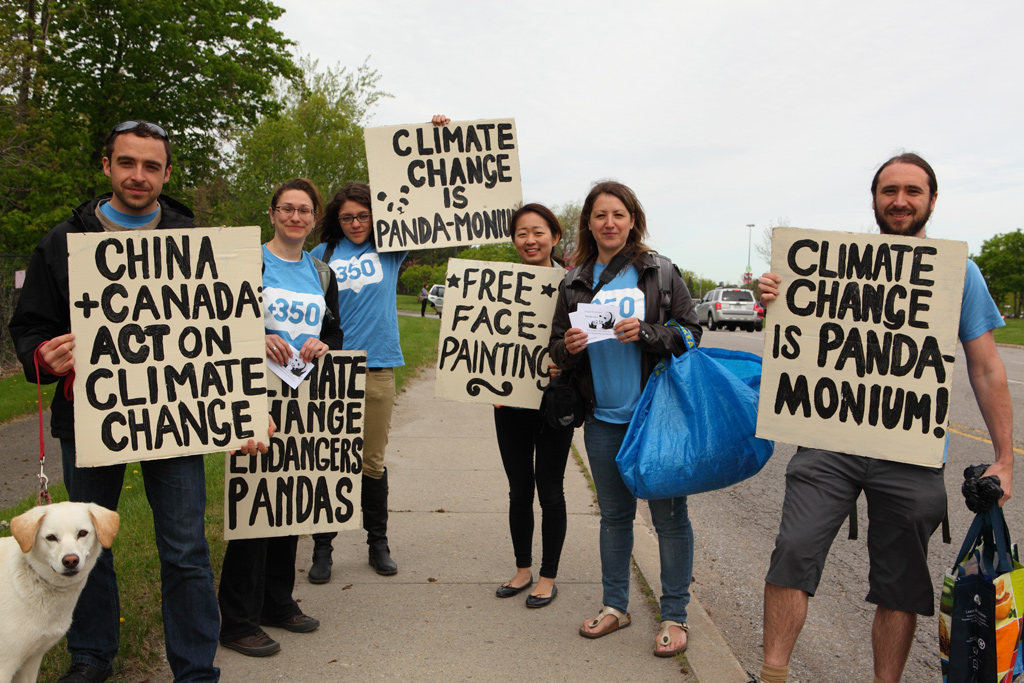
Toronto350.org highlights climate risk to giant pandas

Climate activists at the Toronto Zoo panda opening day

Toronto350.org visited the Toronto Zoo to raise public awareness about the threat climate change poses to pandas and other endangered species. We also circulated a petition to the Chinese Ambassador to Canada and Canada’s Prime Minister, calling on both countries to do more to combat climate change and protect endangered species.

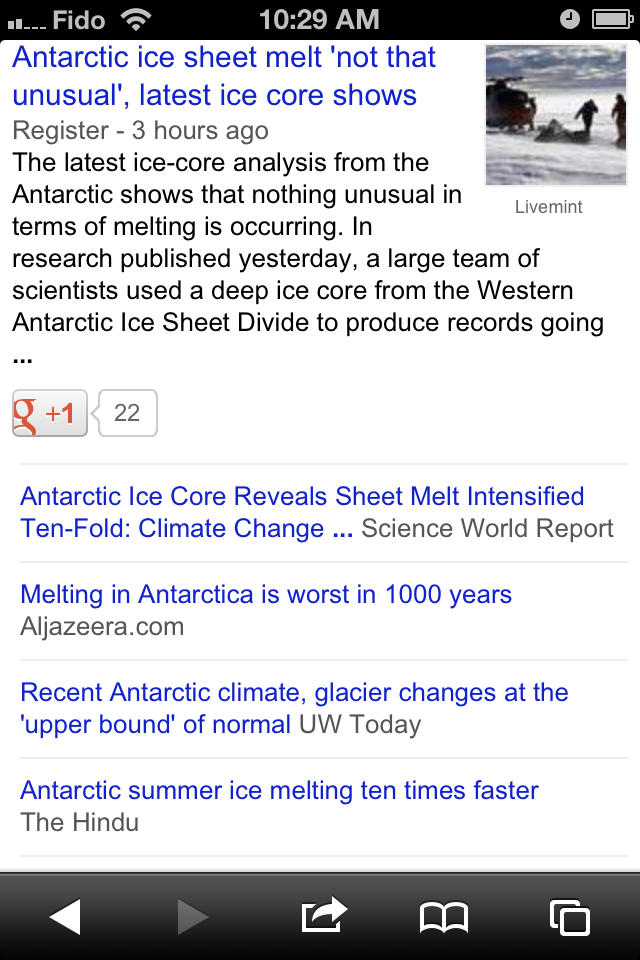
Different journalistic interpretations of the same scientific study

Google News stories about antarctic melting 2013-04-15

Here’s the actual abstract from “Acceleration of snow melt in an Antarctic Peninsula ice core during the twentieth century“, published in Nature Geoscience:

“Over the past 50 years, warming of the Antarctic Peninsula has been accompanied by accelerating glacier mass loss and the retreat and collapse of ice shelves. A key driver of ice loss is summer melting; however, it is not usually possible to specifically reconstruct the summer conditions that are critical for determining ice melt in Antarctic. Here we reconstruct changes in ice-melt intensity and mean temperature on the northern Antarctic Peninsula since AD 1000 based on the identification of visible melt layers in the James Ross Island ice core and local mean annual temperature estimates from the deuterium content of the ice. During the past millennium, the coolest conditions and lowest melt occurred from about AD 1410 to 1460, when mean temperature was 1.6 °C lower than that of 1981–2000. Since the late 1400s, there has been a nearly tenfold increase in melt intensity from 0.5 to 4.9%. The warming has occurred in progressive phases since about AD 1460, but intensification of melt is nonlinear, and has largely occurred since the mid-twentieth century. Summer melting is now at a level that is unprecedented over the past 1,000 years. We conclude that ice on the Antarctic Peninsula is now particularly susceptible to rapid increases in melting and loss in response to relatively small increases in mean temperature.”

From the full text: “The nonlinearity of melt observed in the JRI ice-core record also highlights the particular vulnerability of areas in the polar regions where daily maximum temperatures in summer are close to 0˚C and/or where summer isotherms are widely spaced, such as along the east and west coasts of the Antarctic Peninsula. In these places even modest future increases in mean atmospheric temperature could translate into rapid increases in the intensity of summer melt and in the poleward extension of areas where glaciers and ice shelves are undergoing decay caused by atmospheric-driven melting.”

Two James Hansen updates

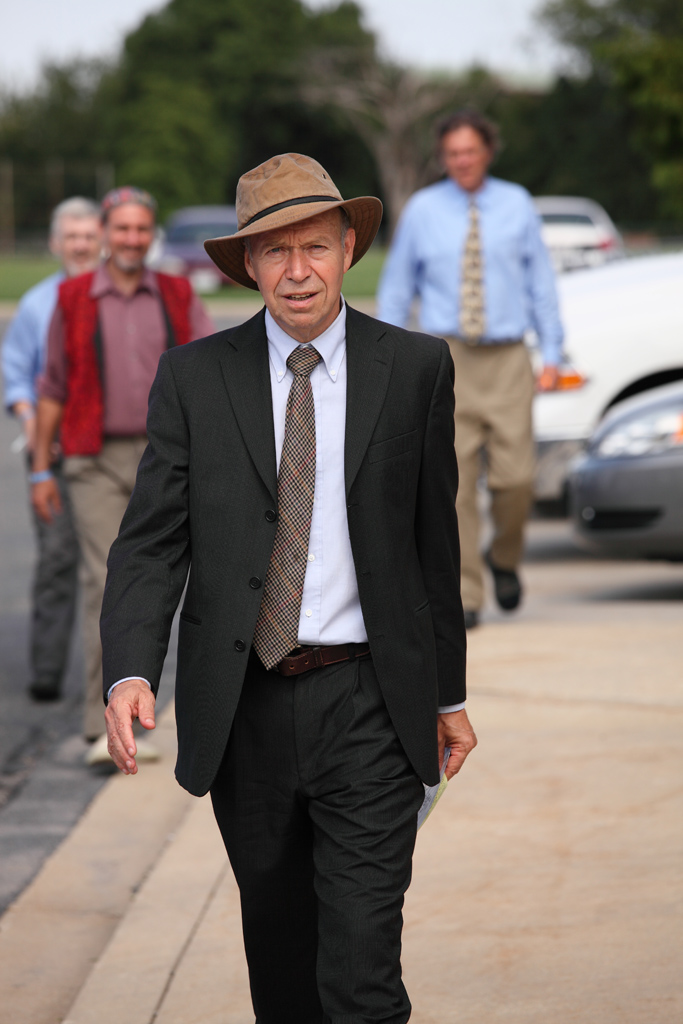
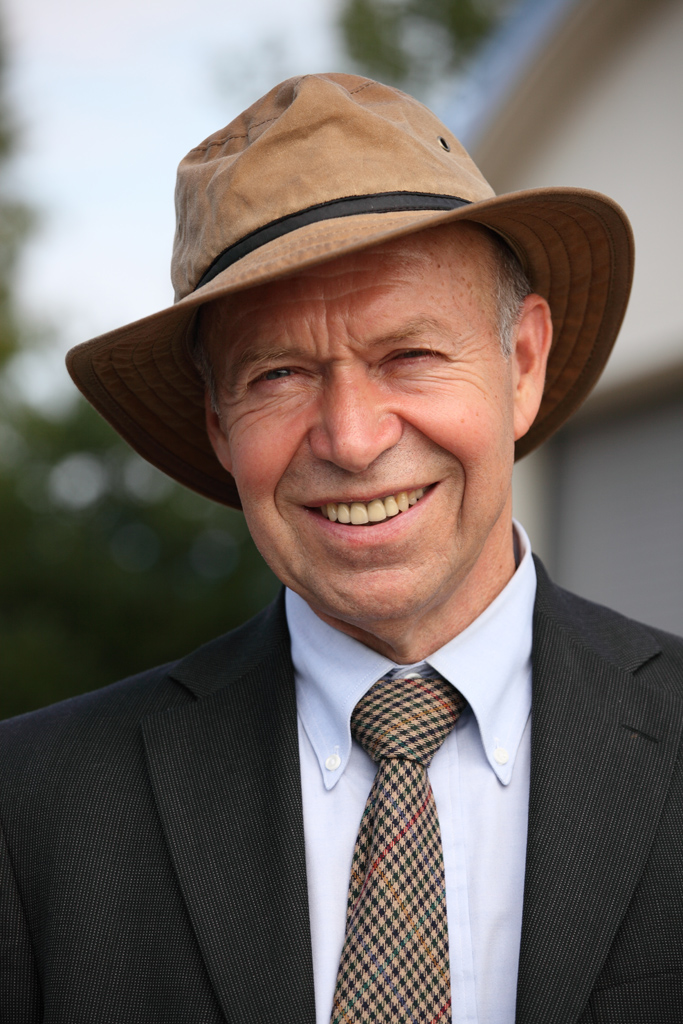
James Hansen getting arrested at an August 2011 protest against the Keystone XL pipeline outside the White House
James Hansen after getting released from Anacostia jail, 2011-08-29

NASA climatologist James Hansen

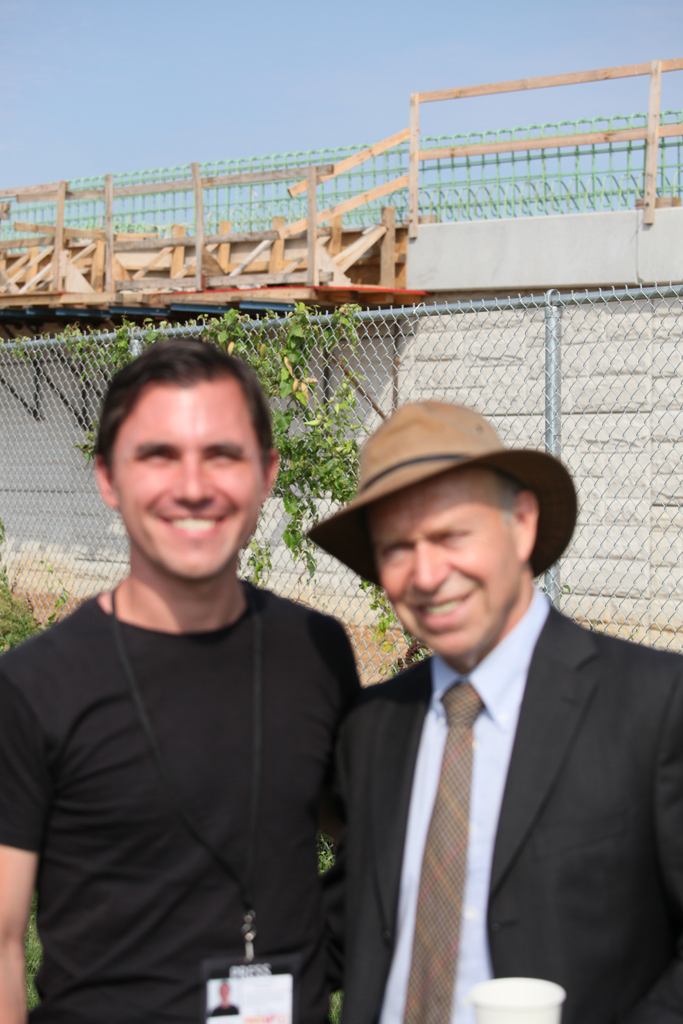
Bonus: a demonstration of why I can’t just hand my camera to passers-by to take a picture

After 32 years as the head of NASA’s Goddard Institute for Space Studies, climatologist James Hansen is retiring (New York Times, Nature). He now intends to devote more of his time and energy to pushing for action on climate change.

One recent publication of Hansen’s: “Prevented Mortality and Greenhouse Gas Emissions from Historical and Projected Nuclear Power” in Environmental Science and Technology. From the abstract:

Using historical production data, we calculate that global nuclear power has prevented an average of 1.84 million air pollution-related deaths and 64 gigatonnes of CO2-equivalent (GtCO2-eq) greenhouse gas (GHG) emissions that would have resulted from fossil fuel burning. On the basis of global projection data that take into account the effects of the Fukushima accident, we find that nuclear power could additionally prevent an average of 420 000–7.04 million deaths and 80–240 GtCO2-eq emissions due to fossil fuels by midcentury, depending on which fuel it replaces.

Related:

Memory and motivation

“The human solution to the problem of sampling is motivation. We are always engaged with the environment – are always “being-in-the-world” – and are never dispassionate observers. We are always pursuing the limited goals we construe as valuable, from our particular idiosyncratic perspectives. We pay attention to, and remember, those events we construe as relevant, with regards to those goals. We do not and cannot strive for comprehensive, “objective” coverage. This process of motivated engagement allows us to extract out and remember a world of productive predictability from the ongoing complex chaos of being.”

Peterson, Jordan. ”You Can Neither Remember Nor Forget What You Do Not Understand.” Religion & Public Life (in press)

“Star Wars civilization”

Humanity today is like a waking dreamer, caught between the fantasies of sleep and the chaos of the real world. The mind seeks but cannot find the precise place and hour. We have created a Star Wars civilization, with Stone Age emotions, medieval institutions, and god-like technology. We thrash about. We are terribly confused by the mere fact of our existence, and a danger to ourselves and the rest of life.

Wilson, Edward O. The Social Conquest of Earth. (New York: W.W. Norton, 2012) p.7 (hardcover)

Climate change and democratic legitimacy

I have finished my final assignment for the term, the essay for my Global Environmental Politics course. It is about climate change and democratic legitimacy:

Many of these ideas are likely to find their way into my PhD thesis, so I would definitely appreciate feedback.

“Chasing Ice”

I saw “Chasing Ice” with some Toronto350.org people tonight. The film has a lot of visual appeal and contains some useful information. It’s definitely worth seeing.

One interesting thing about it for me is what is suggests about human reasoning. From a scientific standpoint, all this photographic and videographic documentation of melting glaciers is probably less useful than RADAR images shot by satellites. Yet the process of collecting the videos and photos, and the human drama involved in the endeavour, seems to significantly increase the salience of the message for people. After the film ended, most of the people in the theatre were happy to sign the Toronto350.org divestment petition.

Emotional salience may be what we really need at this point. We’re at a moment in history where most people accept that the climate is changing in dangerous ways because of human activity, and that something should probably be done about it. The trick will be getting people, firms, and governments to do enough quickly enough to prevent the worst things that could happen.

The film will be playing at Toronto’s TIFF Lightbox until December 13th.