2010 Arctic sea ice

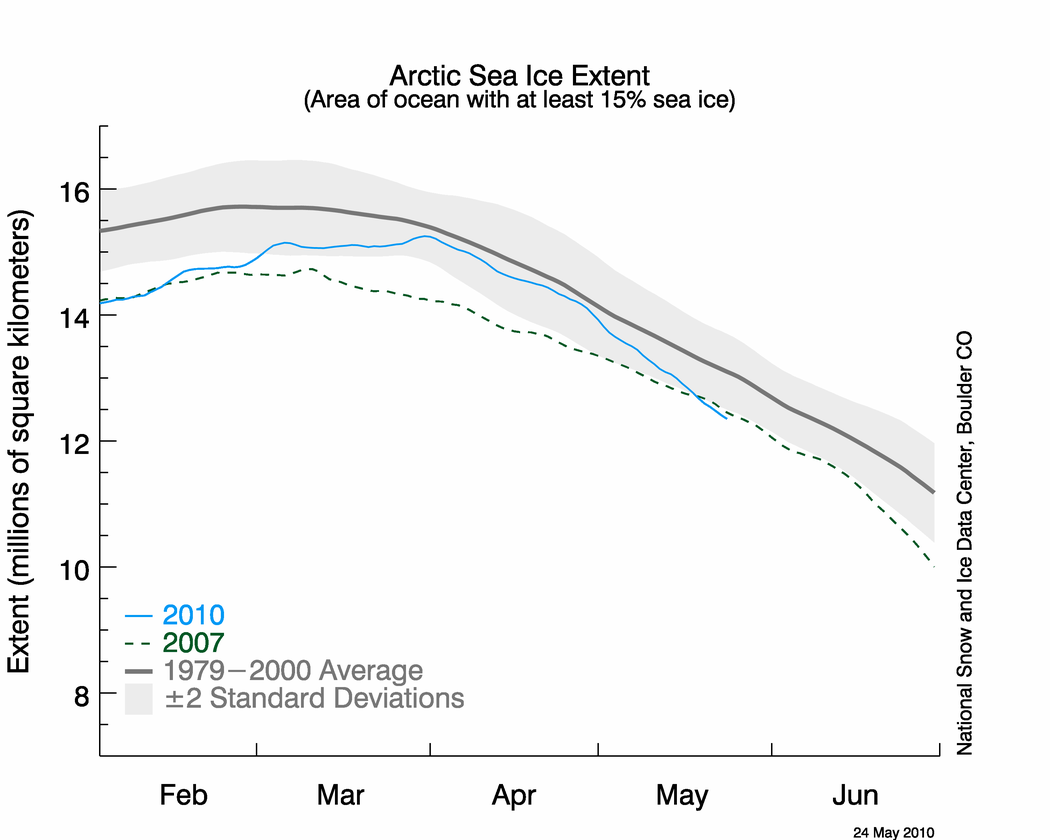
The extent of Arctic sea ice has dipped below where it was at this time of year in 2007, the worst year recorded for sea ice. Within the next few months, we will see whether it goes on to set a new record low. If so, perhaps it could be the sort of dramatic event that drives people to take climate change more seriously.

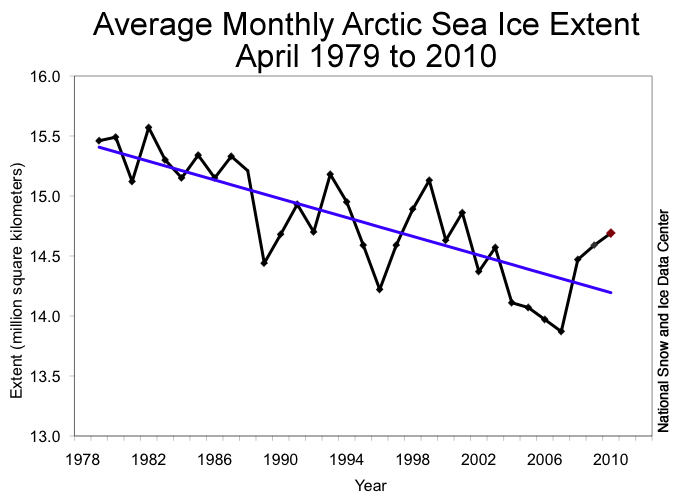
It is important to understand that the maximum extent of sea ice during the winter is a less important climatic indicator than the minimum extent in summer. The Arctic is always going to be cold and dark in the winter, when it is hardly receiving any sunlight. As a result, at least a thin layer of ice will form, establishing a large extent of frozen ocean. What is vanishing is the multi-year ice, which endures from year to year. Climate deniers trumpeted how the maximum extent of ice this year was close to the 1979 to 2000 average, yet the major trend in ice extent and volume is ever downwards.

If the Arctic ends up ice-free in the summer, there will be numerous consequences. Species that depend on sea ice – including narwhals, seals, and polar bears – will be threatened. Also, migration between the Pacific and Atlantic will likely allow the emergence of invasive species. Because losing summer sea ice means losing a big white sheet that reflects sunlight back into space, it would also cause further warming.

Consequences of coal in China

The issue of how much China is really doing to fight climate change has arisen here before. One section from Barbara Freese’s book on coal provides some information pertinent to that discussion. She argues that the Chinese government has made great efforts to improve energy efficiency. Between 1996 and 1999, the Chinese economy grew by a startling 36%, while total energy use fell by 17% and greenhouse gas emissions fell by 14%.

One motivation for an official shift towards reduced coal usage is the sheer number of deaths from air pollution. While coal-fired power plants in the United States probably kill a few tens of thousands of people per year, those in China likely kill around one million. Indeed, it is estimated that one in eight deaths in China is the consequence of coal use – whether from particulate emissions, sulfur dioxide, reduced indoor air quality, mercury toxicity, or other factors.

That said, Freese acknowledges that continued economic growth is likely to reverse that trend, unless China commits itself aggressively to a low-carbon approach to development. That choice is very important to human welfare around the world and needs to be made soon. There are coal plants in the United States that have been operating since the 1920s. The world cannot afford for China to continue to deploy coal-fired power plants that cause such climatic damage, and which may prove equally enduring.

The nature of addiction

Over on XUP’s blog, there is an interesting discussion on addiction. It is certainly a difficult topic on which to get good information: the academic literature is complicated and conflicting.

Perhaps it is a topic about which our understanding will improve considerably as we delve deeper into cognitive and behavioural psychology, as well as into the relationships between complex dynamic systems like genetics and cognition.

On this site, I have repeatedly argued that the best public policy approach to addictive drugs is legalization, regulation, and the treatment of addiction as a medical problem. Bad as it is to be addicted to legal drugs, at least those thus afflicted don’t need to worry about being poisoned or surprised by a major change in the concentration of active ingredients, since those drugs are manufactured by reputable companies and regulated. Those people also don’t need to worry about the pitfalls of production and supply chains that are dominated by organized criminal groups. Paradoxically, addicts may have the most to gain from drug legalization.

In addition, society at large doesn’t need to worry about the violent and harmful side-effects that arise from that criminal economy. The links between drug criminalization, organized crime, and political corruption are both self-evident and demonstrated by numerous historical examples, from alcohol prohibition in the United States to the largely pointless attempts to stamp out poppy growing in Afghanistan now.

Perhaps an important corollary to the legalize, regulate, and treat approach is to hold producers responsible to some extent for the inevitable addictions to their products that will exist in society. They could, for instance, be required to pay part of the cost for treatment, counseling, and rehabilitation programs.

Call for action from American scientific organizations

Four American national scientific academies have just released three reports on climate change, and called for a price to be put on emissions through either a carbon tax or a cap-and-trade scheme: the National Academy of Sciences, National Academy of Engineering, Institute of Medicine, and National Research Council. There is one report on climate science, one on mitigation, and one on adaptation. The reports were requested by Congress and is funded by the National Oceanic and Atmospheric Administration. They endorsed emissions reductions in the range of 57% to 83% by 2050, for the United States.

Hopefully, this will restore a bit of life to the wheezing efforts ongoing in the US Congress to produce climate legislation.

Are high speed trains good for the climate?

High speed rail is often held up as a model transport option for a carbon constrained world. By offering speed and convenience, the idea is that such trains will displace flights and thus lead to lower emissions. Of course, running a train at high speed requires using more energy to get up to speed and to combat air resistance. In a recent column, George Monbiot points out this and other issues with high speed trains as a cimate change solution:

Throughout the recent government documents there’s an assumption that the new railway will be sustainable because it will draw people out of planes. But buried on page 162 of the report on which the department has based its case, published in March 2010, are the figures which derail this assumption. Of the passengers expected to use the new railway, 57% would otherwise have travelled by conventional train, 27% wouldn’t have travelled at all, 8% would have gone by car and 8% by air. In other words, 92% of its customers are expected to switch to high speed rail from less polluting alternatives. Yet the same report contains a table (page 179) suggesting that the savings from flights not taken outweigh the entire carbon costs of the railway. It provides neither source nor justification.

The 2007 report shows that even if everyone flying between London and Manchester switched to the train, the savings wouldn’t compensate for the extra emissions a new line would cause. “There is no potential carbon benefit in building a new line on the London to Manchester route over the 60 year appraisal period.” A switch from plane to train could even increase emissions. Unless the landing slots currently used by domestic flights are withdrawn by the government, they are likely to be used instead for international flights. The government has no plan for reducing total airport space.

I do think there are situations where high speed rail could provide environmental benefits. In particular, it could be good to connecting major urban centres that are not too far apart, and where zero carbon forms of electricity are available. Many such connections could be made between cities on the east and west coasts of North America.

Try f/8

The relative aperture of a photographic lens is really important, when it comes to the quality of the photos that arise in most situations.

If you have the sort of camera where you can specify an aperture – as is possible on all film SLR camera, all digital SLR cameras, and many point and shoot digital cameras – try taking some photos using f/8. Almost regardless of the lens being used, this will often generate rather lovely images.

If the shutter speed your camera picks when you set the aperture to f/8 is slower than one over the focal length of your lens, do something to keep the camera still. That is to say, if you are using a 50mm lens with a shutter speed of less than 1/50th of a second, you are likely to end up with a blurred shot. To avoid that, you can brace against something solid if you are just a bit below. If you are looking at really long exposures – say, more than half a second – either put your camera on a tripod or rest it on something solid and use a countdown timer.

f/8 is usually beautiful. It excludes stray photons that are problematic, and it doesn’t usually cause diffraction. Please give it a try.

Sustainability as an intergenerational project

I think this quotation from Richard Feynman is rather wonderful:

We are at the very beginning of time for the human race. It is not unreasonable that we grapple with problems. But there are tens of thousands of years in the future. Our responsibility is to do what we can, learn what we can, improve the solutions, and pass them on.

It would be a splendid thing for humanity to have tens of thousands more years of history. In order to accomplish that, however, we need to find ways to keep from snuffing ourselves out, or pushing ourselves back down below the level of ‘civilization.’

Accomplishing that seems to require a process similar to the one Feynman outlines for scientific advancement. We must learn what we can about truly sustainable human societies, implement that knowledge, and then pass along that combination of learning and physical achievements to be carried forward by those who will come after.

I can’t help feeling that if Feynman was still alive, our societal discussion about climate change would be a bit more sophisticated and productive.

Unscrupulous climate graph

This post on A Few Things Ill Considered is a great demonstration of how graphs and statistics can be abused. Show CO2 and temperature data from a short stretch of time, with misleading axes, and you can produce the impression that they are unrelated. Present the information in a fair way, and the correlation between the two looks very plausible.

Combine that with the theoretical framework about greenhouse gases trapping energy (in the form of longwave radiation) within the planet system, and you have a hypothesis that is defensible on both theoretical and empirical grounds.

Disasters and environmental awareness

Every day, I find myself thinking about the huge risks associated with unchecked climate change, as well as the reality of how little humanity is doing overall to counter them. One odd consequence of this is ambiguous feelings about disasters like the British Petroleum oil spill in the Gulf of Mexico. On the one hand, it is a human and ecological catastrophe. At the same time, part of me hopes that each of these catastrophes gives a bit more of a psychological push to the population as a whole to deal with our major energy and climate problems. We are driving straight towards the edge of a cliff, and perhaps it is bumps like these that will convince the population at large that we would be wise to slow down.

The same goes for things like summer Arctic sea ice minimums. On the one hand, I know that vanishing ice is a positive feedback, and that warming in the Arctic risks causing massive methane release. On the other, every time the decline of sea ice seems to slacken, climate change deniers and delayers make hay from it, and use public confusion to further delay effective climate policies.

The really worrisome thing is that by the time there is massive evidence of just how dangerous climate change is, it will be too late to prevent truly catastrophic outcomes. Having global emissions peak soon is essential, if we are not to pass along an utterly transformed world to those who will come after us. If some moderately sized environmental catastrophes help that outcome to occur, perhaps we should be grateful for them in the final analysis.

I have speculated before that perhaps only perceived crises can generate real change.

State of the climate video

Last night, I gave a short talk outlining my current thinking on climate change.

I am interested to know which things people think I am wrong about. Also, about which things seemed to be effectively expressed, and which poorly expressed.

An improved version may be worthy of being recorded in a more aesthetically appealing manner.