Democracy as constraint

One common view of the nature of democracy is a system wherein a populace seeks to advance the common interest, either through direct participation in decision-making that affects everyone or through the election of representatives to do so. This view posits the existence of a universal interest that is beyond the sum of individual interests; the aim of government is to help to pull the reality of life closer to the kind of life that would be established through the realization of that universal good.

One major problem with this view is the possibility that, with a few exceptions, no such universal interest exists. We have a universal interest in not being exterminated, but it’s not clear that there is any such thing in the realm of social policy. An alternative view of the nature of democracy highlights its procedural characteristics, two of which I consider to be the most important: the division of power and oversight.

Democracy, viewed in this way, is a system of rules designed to limit the collection and arbitrary usage of power by individuals and groups. It recognizes the fundamental difficulty of this struggle, derived from the way in which most people given the opportunity to rule will try to use that power to perpetuate their influence. It likewise recognizes that authority in the absence of oversight leads inevitably to abuse, whether by corrupt politicians, unaccountable police, or an unconstrained army. The most important institutions within a democracy, then, are things like the rule of law, courts, regulatory bodies, a free press, and elections. The last of these serve less to select a group of representatives who have the right ideas about the universal good and more to rotate people often enough that they cannot escape the shackles that democracy is meant to impose upon them. When rulers do wriggle out of those bonds, the results are corruption, incompetence, and tyranny.

A procedural view of democracy does not assume the existence of a universal good – it just acknowledges that people have life projects of their own and, unconstrained, most are happy to trample all over the plans of others. The basic idea derives from the expression: “My right to swing my fist ends where your nose begins.” Unfortunately, plenty of people are happy to swing regardless. Only by constraining individuals in some ways – especially those in positions of power – can we have any hope of living our lives unmolested.

What, then, of social programs and all the efforts government makes to cajole and convince the populace of things? It is certainly possible that such cajoling can serve worthwhile ends, such as making people aware of previously unknown dangers. It can also serve far less universal ends: the promotion of the interests of one group through a devious appeal to a universal good. Arguably, much of politics is jostling between groups with narrow interests, seeking both to gain access to power and represent their personal interests as universal. This is exactly the kind of conduct a procedural democracy is meant to check: marrying empowerment within the sphere of individual agency with constraint in realms of inappropriate interference.

I am not willing to wholly disregard the possibility that democracies can develop projects based on the universal good, and perhaps even carry them out more effectively than other systems of government. What I am arguing is that such endeavours are a potentially valuable benefit of democracy, rather than its foundational justification. The aim is less to achieve the ‘best’ – a mode of thinking perhaps best suited to fascist states – but to moderate and avoid the worst. As such, when we abandon the principles of oversight and divided power, whether out of ambition or fear, we sacrifice a critical aspect of what it means to live in a democratic society.

Foregoing WEP and WPA

Bruce Schneier, the security guru and internet sensation, has been suggesting that people unlock their wireless networks. Given the constant and well-justified anxiety that exists about computer security, it is unconventional advice. That said, he argues effectively that the risks are fairly limited and that it is a neighbourly thing to do. Who hasn’t benefitted once or twice from the availability of an open wireless network? They were invaluable during my early weeks in Ottawa: allowing me to access Craiglist, Google Maps, and other vital apartment-hunting data while I was out there searching.

I am going to try leaving my wireless network open for a couple of weeks. If it doesn’t seem likely to burst my 200GB monthly bandwidth cap, I will leave it that way indefinitely. Hopefully, it will transpire that others have done the same when I start hunting around for a quieter flat in a more interesting neighbourhood this spring.

More Diebold problems

The myriad problems of electronic voting machines have been mentioned here before. Given that 80% of electoral districts in New Hampshire use electronic voting machines – and ones made by the infamous Diebold, at that – it’s not surprising that talk of fraud is circulating in relation to the latest primary. Some commenters are arguing that: “In machine counted precincts, Clinton beat Obama by almost 5%. In hand counted precincts, Obama beat Clinton by over 4%, which closely matches the scientific polls that were conducted leading up to the election” and alleging that this proves either unintentional bugs in the voting system or fraud.

The issue is less the outcome of that particular contest and more the way in which electronic voting machines diminish the perceived validity of elections. Given how they have been proven insecure again and again, and given how straightforward and manageable counting paper ballots is, there really isn’t much reason for anyone to use these machines. Hopefully, the world will finally figure this out soon.

Related prior posts:

Why the Allies Won

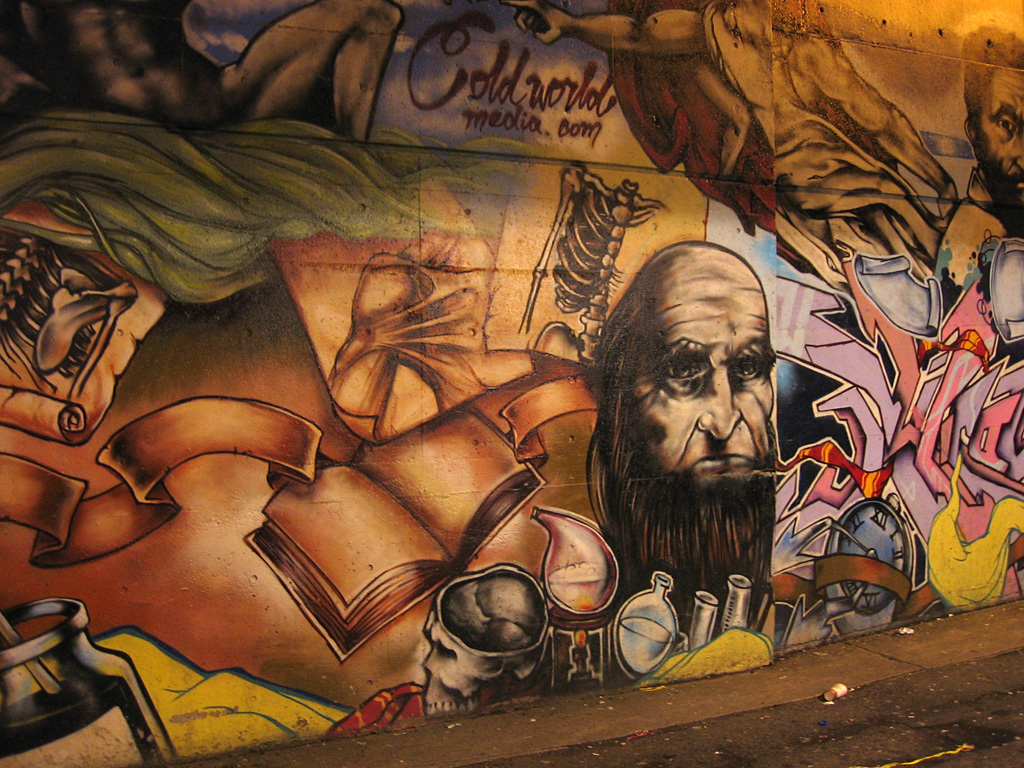
Vancouver grafitti, in an alley off Seymour Street

Among the hundreds of books I read at Oxford, Richard Overy’s Why the Allies Won stood out as an especially engaging piece of historical argumentation. It is one of a handful of books I was determined to re-read when I had more time available. Given the fundamental importance of the Second World War in the establishment of the contemporary international system, the question is a rather important one. Overy’s explanation is well-argued, convincing, and consistently interesting.

This complex book has a number of general themes, each of which is based around a necessary but insufficient cause for the victory of Britain, the United States, and the Soviet Union over Germany, Italy, and Japan. Overy goes into detail on the Battle of the Atlantic – particularly the importance of American supplies for Britain, the U-boat menace, and the tactics that turned the tide in that theatre. He likewise covers the war on the eastern front: from early German successes to the battles at Stalingrad and Kursk that marked the watershed point of the war. In the Pacific theatre, he does an excellent job of explaining the significance of the Battle of Midway, including the considerable role luck played in the victory. The outcome was largely decided by ten bombs in ten minutes that struck Japanese aircraft carriers while they were refueling their air wings.

An entire chapter is devoted to the cross-channel invasion from Britain into occupied France. Of particular interest is the role played by intelligence, a subject Overy arguably neglects to some extent in other circumstances. The ways in which the Allies kept German defences spread out through misdirection make for especially interesting reading.

Overy also covers more thematic reasons for the Allied victory: mass production, especially in the United States and Soviet Union; technology, especially air power; the surprising unity between the Allies; and the moral contest between the Allied and Axis states. Unlike many historians, he highlights Allied bombing as an effective military strategy. He remains ambiguous about whether the military utility justified the bombing of German and Japanese civilians, but argues relatively persuasively that attacks on oil facilities and other key bits of industrial infrastructure served an important strategic purpose.

Midway is not the only example of good fortune Overy highlights – partially in an attempt to undermine the argument that the war could only have ended the way it did. Adding external fuel tanks to the fighters escorting bombers into German airspace dramatically reduced losses, substantially bolstering the effectiveness of the strategic bombing campaign. Likewise, equipping a few aircraft to close a small ‘Atlantic gap’ helped secure the end of the U-boat threat. Even the devastating trap sprung by the Soviets upon the German supply lines approaching Stalingrad could not have succeeded without the incredible success of a few thousand isolated troops occupying the entire German 6th army.

This book is enthusiastically recommended to anyone with an interest in military history generally or the Second World War in particular. It is also a good general disproof of the idea that the outcome of wars is decided by basic material facts like the relative sizes of economies, or the idea that there aren’t decisive turning points in history where the world is pressed along one path as another is closed off.

Mifare RFID tags reverse engineered

I have written before about security weaknesses in pin-and-tumbler mechanical locks. I suggested that electronic token based systems have a greater capacity to be secure, since they do not rely upon mechanical parts that can be manipulated.

Of course, poorly designed electronic systems can also be breached easily. That was demonstrated in September, in relation to the KeeLoq system used for keyless entry in many cars. Now, another brand (Mifare) of RFID tags have been reverse engineered and found wanting. As is usually the case on matters of physical security, I saw this story first on blackbag.

Three climatic binaries

Statue in North Vancouver

One way to think about the issue of mitigating climate change is to consider three binary variables:

  1. Cooperation
  2. Expense
  3. Disaster

By these I mean:

  1. Is there a perception that all major emitters are making a fair contribution to addressing the problem?
  2. Is mitigation to a sustainable level highly expensive?
  3. Are obvious and unambiguous climatic disasters occurring?

These interact in a few different ways.

It is possible to imagine moderate levels of spending (1-5% of GDP) provided the first condition is satisfied. Especially important is the perception within industry that competitors elsewhere aren’t being given an advantage. Reduced opposition from business is probably necessary for a non-ideological all-party consensus to emerge about the need to stabilize greenhouse concentrations through greatly reduced emissions and the enhancement of carbon sinks.

It is likewise possible to imagine medium to high levels of spending in response to obvious climatically induced disasters. For instance, if we were to see 1m or more of sea level rise over the span of decades, causing serious disruption in developed and developing states alike. Such disasters would make the issue of climatic damage much more immediate: not something that may befall our descendants, but something violently inflicted upon the world in the present day.

Of course, if things get too bad, the prospects for cooperation are liable to collapse. Governments facing threats to their immediate security are unlikely to prioritize greenhouse gas emission reductions or cooperation to that end with other states.

We must hope that political leaders and populations will have the foresight to make cooperation work. It may also be hoped that the cost of mitigation will prove to be relatively modest. The issue of disasters is more ambiguous. It is probably better to have a relatively minor disaster obviously attributable to climate change, if it induces serious action, than the alternative of serious consequences being delayed until it is too late to stop abrupt or runaway change.

An idea for reducing electoral fraud

Sasha Ilnyckyj, Mica Prazak, Alena Prazak, Oleh Ilnyckyj, and Milan Ilnyckyj

When it comes to elections, there are a number of different kinds of attacks against the voting process that should concern us. Excluding things like bribing and threatening voters, we need to worry about votes not getting counted, votes getting changed, and votes being inappropriately added. In the first case, an unpopular government may remove opposition supporting ballots from ballot boxes in marginal constituencies. In the second, they might alter or replace ballots, converting opposition votes to government ones. In the third, they might simply add more ballots that support the government.

A relatively simple measure could protect against the first two possible attacks. When a person votes, they could be given a random string of characters. One copy would get printed on their ballot, another would be theirs to keep. Then, once the ballots had been tabulated, a list could be posted on the internet. Sorted by electoral district, it would list the various options people could have chosen, the total number of people who chose each, and a list of the random strings that each person brought home. The importance of the random string is that it preserves the integrity of the secret ballot. Because each string is generated using a random number generator, no string can be tied to an individual. Only the copy given to the voter allows them to check that their vote was properly counted.

Under this system, if I voted for Candidate A and got the string “GHYDMLKNDLHFL,” I could check the list under Candidate A on the website and ensure that my vote was counted for the right person. If my vote hadn’t been counted, my string wouldn’t be anywhere on the list. If it had been miscounted, it would appear in the wrong place. People who found themselves in that situation could complain to the electoral authority, the media, and foreign observers.

The system remains vulnerable to an attacker adding new ballots in support of their candidate, but only to a certain degree. Provided there are some independent observers watching the polling station, the approximate number of people who voted can be pretty easily determined. If the number of votes listed on the website is well in excess of that number, it can be concluded that fraud has occurred.

None of this is any good against a government truly committed to rigging an election; they will always be able to brush off complaints from foreigners and the media, and they will rig the electoral authority. At the same time, it would make rigging more difficult and increase public confidence in the electoral system in any state that implements it. Being able to see your vote listed in the appropriate place may also make elections feel more concrete and personal.

The system does create some new risks. Attackers might force voters to share their random string. If they did so, they could determine who an individual voted for: a worrisome prospect in situations where people could be threatened to vote in one way or another. Likewise, having confirmation that a vote went one way or the other could make vote-selling a bigger problem. With a standard ballot, there is no way to know whether a paid voter actually voted the way they were paid to vote. These additional risks should be borne in mind in the context of any particular election or state. In some cases, they could make the dangers of this approach outweigh its benefits. In most places, however, I suspect it would be beneficial and relatively inexpensive.

Some previous posts on electoral security:

Conditional support for our troops

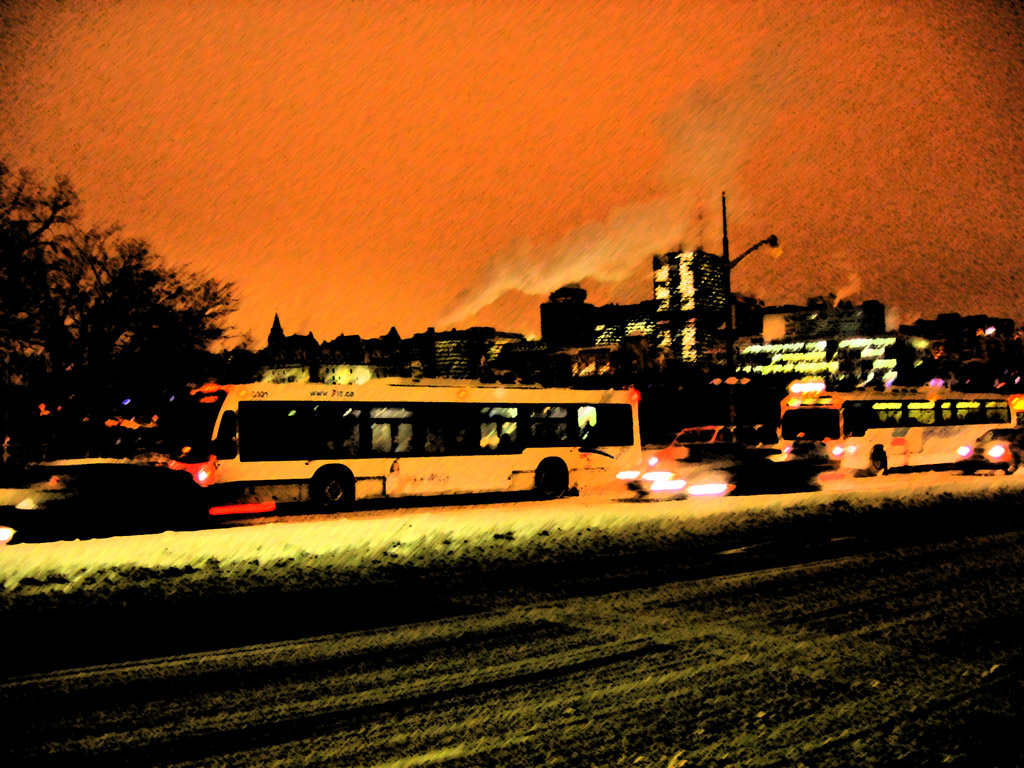
Ottawa commuters in the snow

Walking through the Rideau Centre yesterday, I came upon a cart selling t-shirts with various slogans on them. Beside the silly Che Guevara stuff was one shirt that caught my attention. In white letters on a red background it said “Support our Troops.” Under that were both a maple leaf and the flag of the United Nations.

It struck me as admirably post-nationalistic. We recognize the sacrifices made by members of the armed forces, but also that their conduct needs to be bounded by international law. While the sentiment is admirable, it sits uncomfortably with the reality of how ignorant most Canadians seem to be about what we are doing in Afghanistan. People really think we are mostly building bridges and distributing big bags of rice. The reality of the all-out war in which we are committed is very different.

That is not necessarily to say that we shouldn’t be fighting the Taliban along with our NATO allies; it is simply to highlight that Canadian governments manipulate the perception of Canada as a ‘peacekeeping nation’ to keep people from looking too closely at what our armed forces really do. The degree to which many people seem happy to continue to believe in the peacekeeping myth just because it makes them feel good is also problematic.

A few thoughts on climate justice

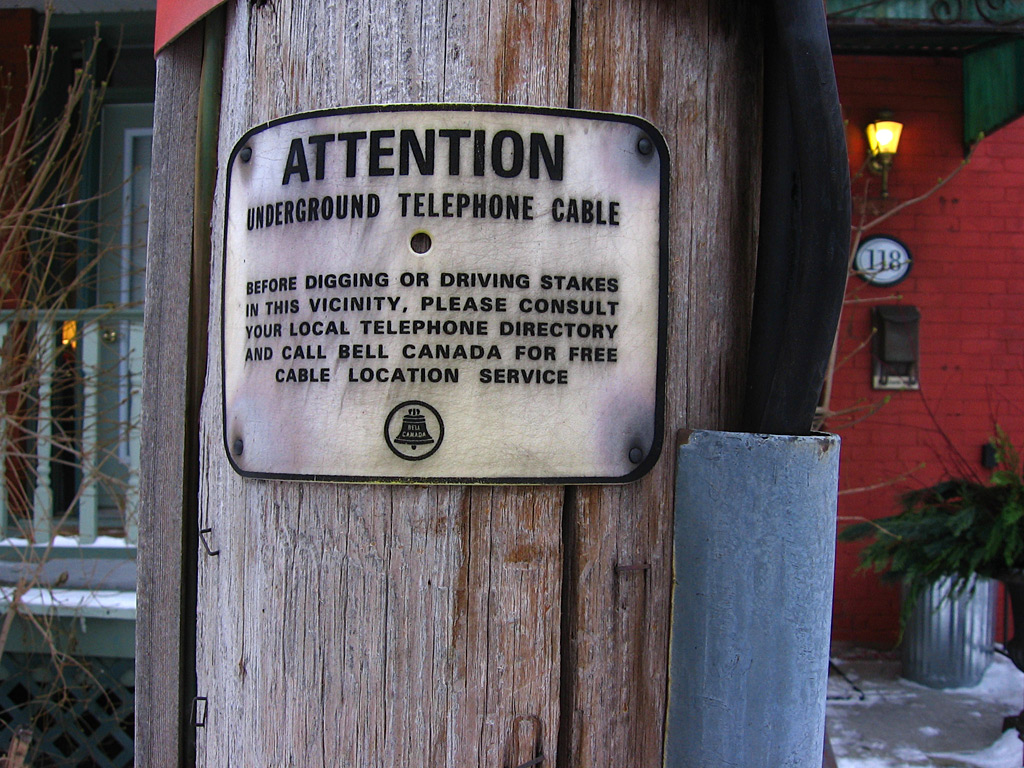
Bell Canada warning sign

A couple of articles at Slate.com address the issue of ‘climate justice.’ This is, in essence, the question of how much mitigation different states are obliged to undertake, as well as what sort of other international transfers should take place in response to climate change. The issue is a tricky one for many reasons – most importantly because anthropogenic greenhouse gas emissions constitute a unique experiment that can only be conducted once. If we choose the wrong collection of policies, all future generations may face a profoundly different world from the one we inherited.

If we accept Stern’s estimate of a five gigatonne level for sustainable global emissions, that works out to about 760kg of carbon dioxide equivalent per person on Earth. Releasing just 36kg of methane would use up an entire year’s allotment, as would just 2.5kg of nitrous oxide. One cow produces about 150kg of methane per year. Right now, Canada’s per-capita emissions are about 24,300kg, when you take into account land use change. American emissions are about 22,900kg while those of India and China are about 1,800kg and 3,900 respectively. Because of deforestation, Belize emits a startling 93,900kg of CO2e per person.

The questions of fairness raised by the situation are profound:

  1. Should states with shrinking populations be rewarded with higher per capita emissions allowances?
  2. Should states with rising populations likewise be punished?
  3. Should developing states be allowed to temporarily overshoot their fair present allotment, as developed states did in the past?
  4. To what extent should rich states pay for emissions reductions in poor ones?
  5. To what extent should rich states pay for climate change adaptation in the developing world?

It may well be that such questions are presently unanswerable, by virtue of the fact that answers that conform with basic notions of ethics clash fundamentally with the realities of economic and political power. We can only hope that those realities will shift before irreversible harmful change occurs. Remember, cutting from 24,600kg to 760kg per person just halts the increase in the atmospheric concentration of CO2. The level of change that will arise from any particular concentration remains uncertain.

Another vital consideration is how any system of international cooperation requires a relatively stable international system. While it is sometimes difficult to imagine countries like China and the United States voluntarily reducing emissions to the levels climatic stability requires on the basis of a negotiated international agreement, it is virtually impossible to imagine it in a world dominated by conflict or mass disruption. It is tragically plausible that the effects of climate change could destroy any chance of addressing it cooperatively, over the span of the next thirty to seventy years.

The eradication of smallpox

On this day in 1979, the World Health Organization certified that smallpox had been eliminated from the wild. It was probably the only intentional extinction in human history, and it was a considerable boon to the human race. The disease is an atrocious one, and it took a heavy toll across history. Notably, it caused much of the death associated with the arrival of Europeans in North America.

The extinction raises a number of questions. One is whether it will ever be repeated. We came close with polio. Very few people would mourn the elimination of tuberculosis, malaria, or AIDS. Worldwide eradication requires global coordination – something very hard to bring about when territories exist outside the control of any state. Think of the tribal areas bordering Pakistan and Afghanistan.

Another issue has to do with smallpox itself. It was horrifically destructive to the First Nations because they lacked any of the immunity conferred by prior exposure. Now, the whole world is in essentially the same boat. An intentional or accidental release of the weaponized smallpox produced by many states could thus cause of devastating global pandemic. It rather makes one wish we had never turned it into a weapon in the first place.