
When thinking about a general trend – such as increasing the usage of renewables for electricity generation – it is often helpful to consider a case study. Wikipedia’s article on renewable energy in Scotland makes for an interesting read.
Category: The environment
Atmosphere, biosphere, lithosphere, hydrosphere, etc – everything about life and the state of this planet
Hydrogen and AAs

At a party this weekend, I had a conversation with someone who believed that the energy needs of the future would be solved by hydrogen. Not hydrogen as the input for nuclear fusion, but hydrogen as a feedstock for fuel cells and combustion engines. It’s not entirely surprising that some people believe this. For years, car companies have been spouting off about hydrogen powered vehicles that will produce only water vapour as emissions. The Chevron game mentioned earlier lets you install ‘hydrogen’ electricity generating capacity. The oversight, of course, is that hydrogen is just an energy carrier. You might as well say that the energy source of the future will be AA batteries.
AA batteries are obviously useful things. They provide 1.5 volts of power that you can carry around with you and use to drive all manner of gadgetry, but they are hardly an energy system unto themselves. The chemicals inside them that create their electrical potential had to be extracted, processed, and combined into a usable form. Inevitably, this process required more energy than is in the batteries at the end. The loss of potential energy is a good trade-off, because we get usable and portable power, but there is no sense in which we can say that AA batteries are an energy system.
A similar trade-off may well eventually be made with hydrogen. We may break down hydrocarbons, sequester the CO2 produced in that process, and use the hydrogen generated as fuel for cars. Alternatively, we might use gobs of electricity to electrolyse water into hydrogen and oxygen. Then, we just need to find a way to store a decent amount of hydrogen safely in a tank small, durable, and affordable enough to put in vehicles; build fleets of vehicles with affordable fuel cells or hydrogen powered internal combustion engines; and develop an infrastructure to distribute hydrogen to all those vehicles.
When you think about it, hydrogen seems less like a solution in itself, and more like the possible end-point of solving a number of prior problems. As far as ground vehicles go, it seems a safer bet to concentrate on improvements to rechargeable battery technology.
Gore’s ten points

Al Gore has recently presented a ten-point plan for the United States to deal with climate change over the course of the next few decades:
- An immediate “carbon freeze” that would cap U.S. CO2 emissions at current levels, followed by a program to generate 90% reductions by 2050.
- Start a long-term tax shift to reduce payroll taxes and increase taxes on CO2 emissions.
- Put aside a portion of carbon tax revenues to help low-income people make the transition.
- Create a strong international treaty by working toward “de facto compliance with Kyoto” and moving up the start date for Kyoto’s successor from 2012 to 2010.
- Implement a moratorium on construction of new coal-fired power plants that are not compatible with carbon capture and sequestration.
- Create an “ELECTRANET” — a smart electricity grid that allows individuals and businesses to feed power back in at prevailing market rates.
- Raise Corporate Average Fuel Economy (CAFE) standards.
- Set a date for a ban on incandescent light bulbs.
- Create “Connie Mae,” a carbon-neutral mortgage association, to help defray the upfront costs of energy-efficient building.
- Have the Securities and Exchange Commission require disclosure of carbon emissions in corporate reporting, as a relevant “material risk.”
A much more detailed discussion of the points can be found on Grist. It is safe to expect considerable elaboration in Gore’s upcoming book: The Path to Survival. It will be available as of Earth Day (April 22nd) of 2008.
It is an interesting – and distinctly American – mix. It seems like number one is the uber-recommendation, while the others are more specific subsidiary policies. Exactly how such a freeze could be implemented – politically, economically, and legally – is a massive question. That said, it is a list that targets many of the major opportunities for domestic emission mitigation. It will be interesting to see whether any of these get the endorsement of Democratic or Republican candidates in the run-up to the 2008 Presidential election. If so, it will make for a big break with past half-hearted and voluntary measures.
PS. Those unfamiliar with the American mortgages will understand number nine better if they read about Fannie Mae and Freddie Mac: America’s huge and bizarrely named quasi-government-backed mortgage corporations.
Passivhaus

There has been a lot of talk lately about compact fluorescent light bulbs. Huge billboards of David Suzuki looking like a genie, with a glowing CF bulb floating above his hand, dot the landscape. While these bulbs are a lot more efficient, they aren’t likely to make a huge difference in the long run. Arguably, it would be better to focus on encouraging the building of passive houses, which require no energy for heating, rather than making marginal improvements in existing dwellings. It may be entirely desirable to do both, but when it comes to finding a symbolic signal issue to rally around as energy conservationists, the latter option is a lot more impressive.
To qualify as a passive house, a building must use less than 15 kWh per square metre per year for heating. That works out to less than $1 per square metre at current energy prices in Ontario. Total primary energy usage for such houses (heating, hot water, and electricity) is not to exceed 120 kWh per square metre per year. The technology to do this isn’t absolutely cutting edge: a passive house has been continuously inhabited in Darmstadt since 1991.
Apparently, building super-insulated houses with the ability to heat and cool themselves using just the ambient light and heat in their surroundings does not cost significantly more than building ordinary houses (though it requires different materials and more expertise). Given how virtually none of them exist in North America, it seems fair to say that consumer demand – even with high energy prices – is not sufficient to drive a large scale shift.
A number of different policies could help boost adoption: municipalities could require that a certain proportion of commercial and residential buildings constructed be passive in this way, subsidies or tax breaks could be given to firms that choose to employ such construction methods, and so forth. At the very least, government could make a concerted effort to do most of its own building in this way.
Masses of additional information is online:
- Information on a passive housing estate in Hannover-Kronsberg
- Germany’s passive house institute
- A similar organization in the UK
- Report of CEPHEUS, a major European study on passive houses
As environmental statements go, building or living in such a house is probably much better than driving a Prius.
Betting on a long shot

While it is unwise to place too much hope in unproven technologies like carbon capture and sequestration or nuclear fusion as mechanisms to address climate change, there is also a good case to be made for expanded research and development in promising areas. As such, it is more than a bit regrettable that Canada withdrew participation from the largest international fusion research effort back in 2003. It may be a long shot and it may take fifty years or more to reach the point of commercial deployment, but fusion does seem to be one possible long-term option.
In addition to providing electrical power, fusion plants could also be used to produce hydrogen for vehicles by means of electrolysis. Depending on their ultimate ability to scale production up and down, they could also be important for peak power management. Even if we accept that 50 years may be an ambitious period for fusion technology to mature, it is possible that the first commercial fusion plants could be coming online just as coal plants built today are reaching the end of their lives.
Betting on a long shot isn’t always a bad idea – especially when it is one strategy among many alternatives.
Chevron’s climate game
Remember when the BBC came up with a climate change game? Well, now Chevron has done so, as well. Apparently, all the data in the game came from the Economist Intelligence Unit. The BBC game suffered a fair bit of well-deserved criticism. I have yet to give the Chevron simulation a comprehensive try, but I am waiting with a fair bit of curiousity for a chance.
You can read a bit more about the Chevron game on R-Squared: a popular energy blog.
[9 September 2007] This game doesn’t really have much to it. By constraining you to the management of a single city over the span of a couple of decades, it excludes both the chronological and geographic scale at which real change needs to take place. Still, it is interesting from a corporate public relations standpoint. Unsurprisingly, the game simply forbids you from using a power balance that excludes petroleum.
Fasting in response to climate change
Today, I am participating in a 24-hour fast in response to climate change. My primary motivation is to gain a more immediate understanding of what climate change is likely to mean for many people: namely, difficulty in securing adequate supplies of food.
International and intergenerational justice are the most difficult elements of the climate change problem to address. While the moral requirements involved are generally fairly clear, the motivation to sacrifice is nearly always absent. Perhaps re-framing the issue can help, to some extent. For instance:
Even in an emergency one pawns the jewelery before selling the blankets. . . . Whatever justice may positively require, it does not permit that poor nations be told to sell their blankets [compromise their development strategies] in order that the rich nations keep their jewelery [continue their unsustainable lifestyles]. (Shue 1992, p. 397; quoted by Grubb 1995, p. 478)
If such arguments become commonly accepted, perhaps the moral unacceptability of inaction – and of recalcitrant and half-hearted action – will become more widely acted upon.
I don’t think I have ever gone 24 hours without eating before, so wish me luck.
[Update: noon] The easy half is done: six hours of sleep and a missed breakfast. This would normally be my lunch break. Now, I have five more hours to get through at work, followed by seven more at home.
[Update: midnight] Based on my original criteria, this has not been terribly successful. It was unpleasant to not eat for 24 hours, but it wasn’t enlightening in any way. I don’t think I am any more or less compelled to help address the problem of climate change than I was before. Hopefully, some kind of deeper memory formed about the connection between abstract causes and concrete consequences.
Shrimponomics

Here is an interesting blog post analyzing theories about why people are eating more shrimp than was previously the case. In short, people without training in economics seem to focus more on the demand side than people with such training.
One response that surprised me was “a rise in the number of vegetarians who will eat shrimp.” Now, if you are a vegetarian because you think it is wrong to kill cows and chickens for food, that may be a sensible position. If you are a vegetarian for general reasons of ecological sustainability, it is a lot less valid. As fisheries go, shrimp is one of the worst when it comes to bycatch. The UN Food and Agriculture Organization says that the present shrimp catch is at least 50% above the maximum sustainable level. Shrimp also tends to be collected through a process called bottom trawling: where large steel rollers smash and kill everything on the ocean floor.
Shrimp aquaculture is arguably even worse. There are all the problems attendant to all agriculture – close quarters, disease, harvesting other creatures unsustainably to turn into feed, antibiotics, etc – and then there is the fact that mangrove swamps are ideal for conversion into shrimp farms. The UN Environment Programme estimates that 1/4 of the total destruction of these important ecosystems has been brought about by shrimp farming.
From an ecological standpoint, vegetarianism (and probably veganism) remains a far preferable option, compared to eating meat.
A closer look at the War Museum controversy
Still pondering the controversy about the display in the Canadian War Museum, I decided to go have a look at it first-hand. On the basis of what I saw, I am even more convinced that the display is fair and balanced, and that it should not be altered in response to pressure from veterans.
Here, you can see the panel in question in its immediate surroundings:

This is one small part of a large area discussing the air component of the Second World War. A shot with a narrower field of view shows the controversial panel itself more clearly:

Here is a large close-up shot of the panel text. Nearby, a more prominent panel stresses the deaths of Canadian aircrew and the degree to which aerial bombing “damaged essential elements of the German war effort.” This alternative panel is located right at the entrance to this section of the museum.
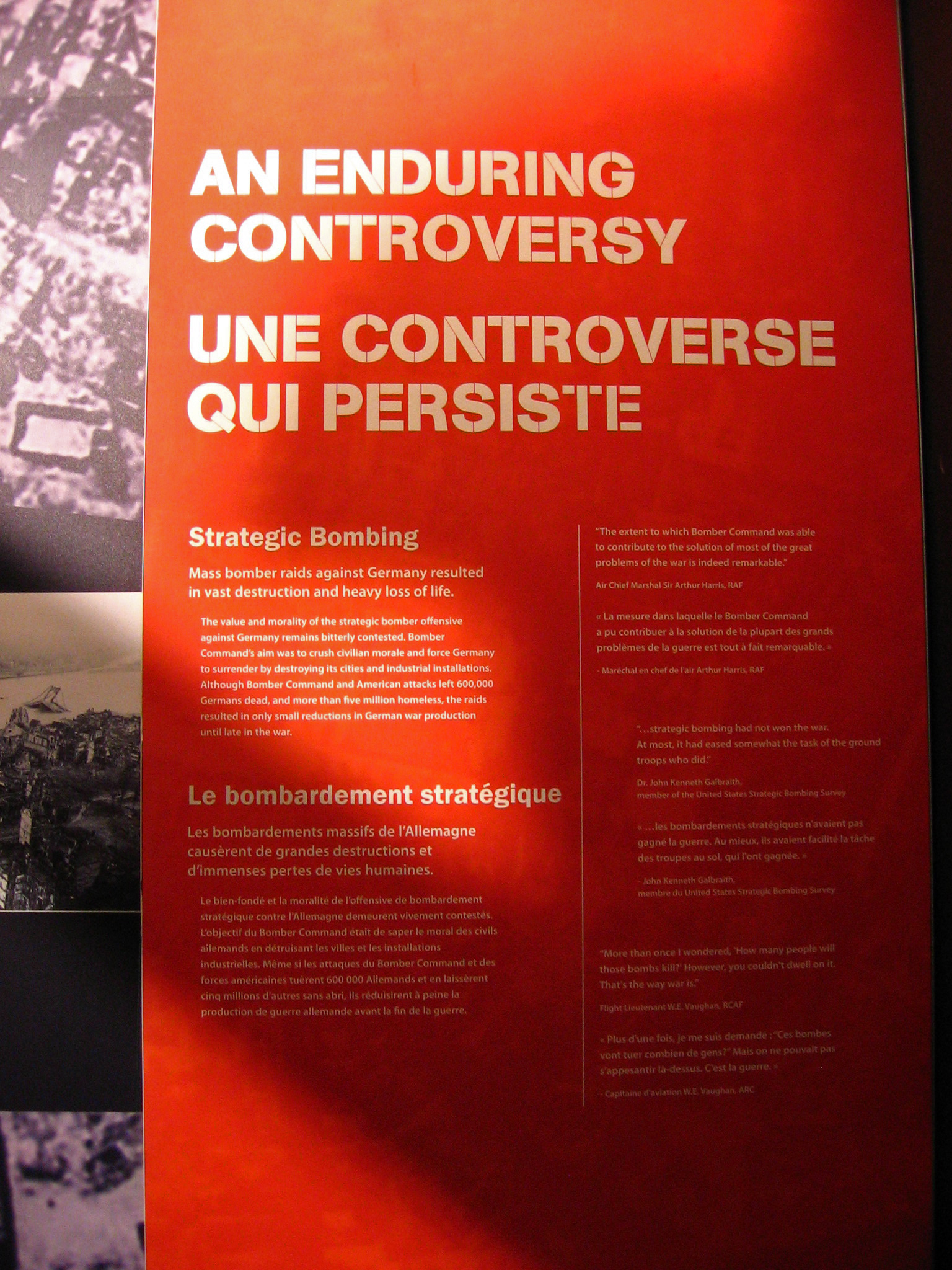

If anyone wishes to comment to the museum staff, I recommend emailing or calling Dr. Victor Rabinovitch, the President and CEO. His contact information, along with that of other members of the museum directorate, is available on this page.
The Climate Emergency Fast
On September 4th, an organization called the U.S. Climate Emergency Council is holding a 24-hour fast meant to further raise awareness about global warming. As such gestures go, it seems like quite an appropriate one. The burdens of climate change are likely to fall most heavily on the poorest people and there is good reason to believe that agriculture will be seriously affected. (See this post on C3 photosynthesis, for instance.) Participating in the fast could provide a visceral approximation of what a changing climate will mean for many people, while highlighting the moral importance of the issue.
As of now, about 800 people have signed up for the fast. It is being discussed – along with the broader context of climate change protest – over at Grist.
[Update: 10:47am] I think I am going to do this. As far as I know, it will be the first time I have ever gone 24 hours without eating anything. I will permit myself water only, though climate change may leave that in short supply also.