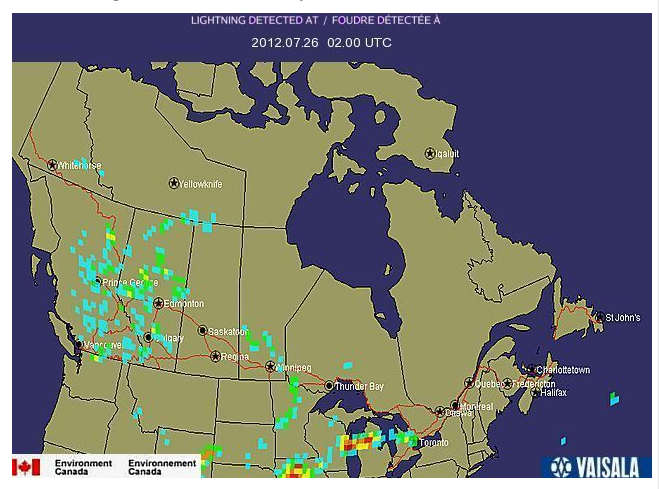
I had had a look at the lightning strike maps for North America, since Toronto has been in the middle of an intense electrical storm for about an hour.
The US and Canadian maps are pretty dramatic:

climate change activist and science communicator; photographer; mapmaker — advocate for a stable global climate, reduced nuclear weapon risks, and safe human-AI interaction

Hiking, camping, canoeing – if it’s an outdoor adventure, it should be under this heading
The World Wildlife Fund has put together a beautiful video showing some of what would be put at risk by the proposed Northern Gateway pipeline:
For more information see: Canadiansforgreatbear.ca
Some helicopter seeds I saw the other day
Can anyone identify the specific plant?
Walking home from the subway, I met an electrical engineering graduate from Ryerson who built himself a six-rotor radio-controlled flying machine:
Each motor puts out about 250 watts, and the machine is strong enough to lift a couple of kilograms.
The body is made mostly of carbon fibre, and it runs on a lithium polymer battery.
In The End of Nature, Middlebury College professor and 350.org founder Bill McKibben makes the case that humanity has put an end to nature by altering the climate, and then goes on to consider the implications. McKibben’s book – first published in 1989 – briefly explains why human activities are increasing the quantity of greenhouse gasses in the atmosphere, and why this will produce change on a planetary scale. His tone is mostly one of lamentation. He expresses sadness about that which is already doomed to destruction, before progressing extensively into the question of what can still be saved, and what means might achieve it. Reading The End of Nature in 2012 is dispiriting. It proves how everything important about climate change was well understood decades ago, including why our political and economic systems have done nothing serious to slow it down. Nonetheless, McKibben’s appeal is a poignant and effective one. By putting humanity’s current activities in context, McKibben conveys the reality that what happens to the Earth now will mostly be a matter of human choices, and that the philosophies we adopt in the decades ahead will affect the prospects of all the life forms that depend upon this planet.
The basic idea of the book is that humanity has no so thoroughly altered the planet that nothing can be considered ‘nature’ in the sense of ‘unpopulated wilderness’ anymore. Climate change is the most important and dramatic change humanity has produced, but our chemical signature is also written in the form of novel isotopes from nuclear tests, changes to the ozone layer, and in the legacy of pollution and pesticides. According to McKibben’s definition, nobody my age has ever seen nature – only nature as modified through human industrial activity.
Along with climate change, McKibben devotes a fair bit of space to talking about genetic engineering. He sees it as a possible way of keeping humanity’s billions alive in a world that is increasingly damaged by our choices. But it is also another step away from ‘nature’. He envisions a world of trees and fish and animals modified to tolerate a changed climate, and modified further to better serve human needs. Reading these passages in 2012, it seems like he over-estimated the importance of genetic engineering, or at least under-estimated how long it would take to arrive. For instance, he imagines custom organisms that draw in nutrients through tubes and produce the parts of chickens many humans enjoy eating. Margaret Atwood’s ‘ChickieNobs’ from the dystopian 2003 novel Oryx and Crake are described in basically identical terms in McKibben’s book, but nothing remotely like them seems to exist in the real world. So far, genetic engineering has been more about experimentation than implementation, and nothing too world-changing seems to have arisen from it. Perhaps that perspective reflects ignorance on my part, especially given the evolving character of the global ‘agribusiness’ and biotechnology industries.
Because I borrowed a copy of the book from a library, rather than buying one, I didn’t take the detailed marginal notes that I usually do when reading a book. I did, however, pick out a few passages that I think are especially evocative and worthy of discussion:
On the habits of humanity
“The problem, in other words, is not simple that burning oil releases carbon dioxide, which happens, by virtue of its molecular structure, to trap the sun’s heat. The problem is that nature, the independent force that has surrounded us since our earliest days, cannot coexist with our numbers and our habits. We may well be able to create a world that can support our numbers and our habits, but it will be an artificial world, a space station.
Or, just possibly, we could change our habits.” (p.144 2006 Random House trade paperback edition)
Timing
“I have tried to explain, though, why [dealing with climate change] cannot be put off any longer. We just happen to be living at the moment when the carbon dioxide has increased to an intolerable level. We just happen to be alive at the moment when if nothing is done before we die the world’s tropical rain forests will become a brown girdle around the planet that will last for millennia. It’s simply our poor luck; it might have been nicer to have been born in 1890 and died in 1960, confident that everything was looking up. We just happen to be living in the decade when genetic engineering is acquiring a momentum that will soon be unstoppable. The comforting idea that we could decide to use such technology to, in the words of Lewis Thomas, cure “most of the unsolved diseases on society’s agenda” and then not use it to straighten trees or grow giant trout seems implausible to me: we’re already doing those things.” (p.165)
On caring for future generations
“We flatter ourselves that we think of the future. Politicians are always talking about our children, our grandchildren, and, as individuals, we do think about them, but in the same way we think about ourselves. We lay aside money for them, or land. But we do not really think of grandchildren in general. “Future generations do not vote; they have no political or financial power; they cannot challenge our decisions,” said a perceptive introduction to the United Nations report on Our Common Future. Future generations depend on us, but not vice versa. “We act as we do because we can get away with it.”” (p.170)
Beyond what one person can deal with
“The inertia of affluence, the push of poverty, the soaring population – these and the other reasons listed earlier make me pessimistic about the changes that we will dramatically alter our ways of thinking and living, that we will turn humble in the face of our troubles.
A purely personal effort is, of course, just a gesture – a good gesture, but a gesture. The greenhouse effect is the first environmental problem we can’t escape by moving to the woods. There are no personal solutions. There is no time to just decide we’ll raise enlightened children and they’ll slowly change the world. (When the problem was that someone might drop the Bomb, it perhaps made sense to bear and raise sane, well-adjusted children in the hope that they’d help prevent the Bomb from being dropped. But the problem now is precisely too many children, well adjusted or otherwise.) We have to be the ones to do it, and simply driving less won’t matter, except as a statement, a way to get other people – many other people – to drive less. Most people have to be persuaded, and persuaded quickly, to change.” (p.174)
So McKibben lays out the challenge that has been occupying some of the most capable and driven people in the world for decades (occupying them, but not yet producing even the beginnings of success) and which seems likely to be the defining activity for humanity as a whole for the decades and centuries ahead.
Since 2007, McKibben has been an important organizer of environmental campaigns and the founder of 350.org, an organization that aims to keep the atmospheric concentration of carbon dioxide below 350 parts per million. Beyond that level, the sensitivity of the Earth to greenhouse gasses is such that we would likely see the disappearance of nations like the Maldives along with large parts of nations like Bangladesh and the Netherlands, accompanied by profound changes to physical and biological systems around the world. Keeping the level of greenhouse gas pollution in the atmosphere below 350ppm is incredibly ambitious and far beyond what any large country on the planet is meaningfully aiming for now. If implemented globally, Canada’s policies would probably put us more in the territory of 1000ppm by 2100 – territory that involves changes so profound that they might threaten the future of the human species, as well as the future of countless other less resilient species in the ecosystems of the world.
The End of Nature is a reminder of the scale of the fight we have on our hands, as well as of the stakes involved. If we are to have any chance of succeeding, we must be committed, passionate, strategic, self-sacrificing and willing to do what has never been done before.
The coming of spring is an astronomical and biological phenomenon.
The moment of the vernal equinox – the start of spring in the northern hemisphere – is the moment where the length of days is changing fastest. Biologically, spring is characterized by the re-emergence of life. In particular, it is characterized by the resumption of productive photosynthesis as leaf-bearing plants deploy their solar collectors to take advantage of longer days. This process, along with organic decay during the darker months, gives the Keeling Curve its characteristic wiggles.
In a way, each spring is a dawn for renewable energy. Aside from a few chemical-eating bugs in the ocean, pretty much all life on Earth is ultimately powered by sunlight as processed by photosynthetic organisms. Spring shows how the vast energy output of the sun can be used in the service of life.
One of the big reasons for opposing the Enbridge Northern Gateway pipeline is because of how 200 oil tankers a year would threaten the coast of British Columbia.
I think everyone who has seen that coastline understands its beauty and ecological importance. At the same time, I suspect the idea can be made more salient for people by showing them photos and video of the areas that could be affected if the pipeline goes through.
It’s not clear what the most effective approach would be for reminding people about what is at stake. Really there is a spectrum of possibility, ranging from fantastic shots taken by talented photographers on top-notch gear and shown in magazines and galleries to amateur shots taken by visitors and ordinary British Columbians and uploaded to Facebook or Flickr.
In all likelihood, many approaches will be tried simultaneously. For my own part, I have been thinking about a potential photo show that would incorporate photos of the B.C. coast as well as photos from the successful protests against the Keystone XL pipeline, which took place in Washington D.C.. Toronto may not be the most appropriate venue for that, since people here don’t have much of a personal emotional stake in the integrity of west coast ecosystems.
Perhaps I should try and find the time to set up yet another website, where people could contribute photos from B.C. and explain why they oppose the Northern Gateway pipeline…
Finding my way to a new building, it struck me that two major strategies are possible in urban pathfinding. You can try to follow the most efficient path or you can try to minimize your odds of getting lost. Call those the ‘efficiency’ and ‘reduced risk’ approaches.
Each has some level of appeal. Nobody wants to take an unnecessarily circuitous route, when there is a shorter one available. At the same time, it is foolish to take a path that is nominally shorter but which involves much higher risks of getting lost or having other sorts of trouble.
Shortcuts are a classic example. They speak out to the part of us that seeks efficiency, but they carry special risks. When you deviate from the conventional path, you open the possibility of arriving much sooner than you would otherwise, but you also open the possibility of arriving much later or not at all.
Personally, I am willing to trade a fair bit of efficiency in exchange for simplicity. Even if I can conceivably save time by cutting corners, I prefer to stick to simple routes that I can remember and understand. Subways are good for this – they don’t take you as close to your destination as buses often might, but they are easier to understand.
As an aside, the worst ever solution to the risk/efficiency problem is the ‘try and buzz the head waiter’s home island with your cruise ship‘ strategy. In choosing people to captain cruise ships, there should probably some process to screen out those with such reckless tendencies…
