Ontario may remove rent control

Terrifying news: the Ontario government wants to make it easy for landlords to evict tenants at will.

It’s stuff like this that makes the future terrible to contemplate. The system is already horrendously abused by landlords. Housing stress has been one of the worst parts of my life ever since I moved here. Policy choices like these understandably make people afraid about whether they will be able to have a future at all.

The environmental movement and young people’s rage

During my childhood, I remember a book circulating around the house called 50 Simple Things Kids Can Do to Save the Earth.

It included activities like putting a milk carton underneath a dripping tap to measure the rate at which it was dripping, and leaving elastic bands stretched and exposed outside to supposedly measure air pollution.

Much later, I realized how fucked up the implications of the book and its genre are.

The buried premise is that the Earth needs “saving” — which is horrifying and terrifying. The book takes it for granted that the one life-sustaining planet known in the universe is imperiled by human activity. If something needs saving and doesn’t get it, that means it dies or gets destroyed. The book comes right out and takes for granted that all known life is at risk unless humanity changes its conduct and attitudes and that this won’t happen through the existing political, economic, and legal systems.

The next implication is that the appropriate resolution to this, at least in part, depends on kids. It’s up to kids to save the Earth. Furthermore, they need to do it through some sort of resistance to or reform of the political and economic systems which embody and sustain the ecological crisis.

So not only does the book imply that it is the responsibility of kids to save all the life in the universe, but it goes on to give them a series of trivialities as action items: find a way to avoid wasting a carton of water, check the pH of a local stream… It sets up a colossal threat, then gives some arts-and-crafts activities and low-impact personal lifestyle changes as the solutions available.

Of course, my bitterness about this arises from the decades of utter betrayal toward young people which have characterized my life. Given the choice between perks today and not wrecking the Earth, all our leaders choose the former with lip service to the latter. Young people have grown up in a world where they expect catastrophe, and understand that their leaders prefer that outcome to changing the self-serving status quo.

I was part of that youth movement at least from my experiences with LIFE in the mid-1990s until the fossil fuel divestment movement at universities after 2012, and saw how it was systematically patronized, treated in bad faith, and ignored by those who set policy. Adults told kids that it was up to them to save the world, then knowingly and purposefully undermined those efforts in order to protect their own interests, all while portraying themselves as sage decision-makers moderating the unreasonable requests of radical activists. This process is ongoing.

This dynamic has produced a great deal of apathy and political disengagement, but I think there is also an underlying rage arising from young people understanding that they have been put in lifelong peril by a society which systematically disregards their interests — to say nothing about how the prospects for their potential children have been ravaged. It is hard to guess how that rage will manifest, but it seems very implausible that it will be through the sort of long-sighted planetwide cooperation which provides the only path to curtailing the climate crisis.

AI that codes

I had been playing around with using Google’s Gemino 2.5 Pro LLM to make Python scripts for working with GPS files: for instance, adding data on the speed I was traveling at every point along recorded tracks.

The process is a bit awkward. The LLM doesn’t know exactly what system you are implementing the code in, which can lead to a lot of back and forth when commands and the code content aren’t completely right.

The other day, however, I noticed the ‘Build’ tab on the left side menu of Google’s AI Studio web interface. It provides a pretty amazing way to make an app from nothing, without writing any code. As a basic starting point, I asked for an app that can go through a GPX file with hundreds of hikes or bike rides, pull out the titles of all the tracks, and list them along with the dates they were recorded. This could all be done with command-line tools or self-written Python, but it was pretty amazing to watch for a couple of minutes while the LLM coded up a complete web app which produced the output that I wanted.

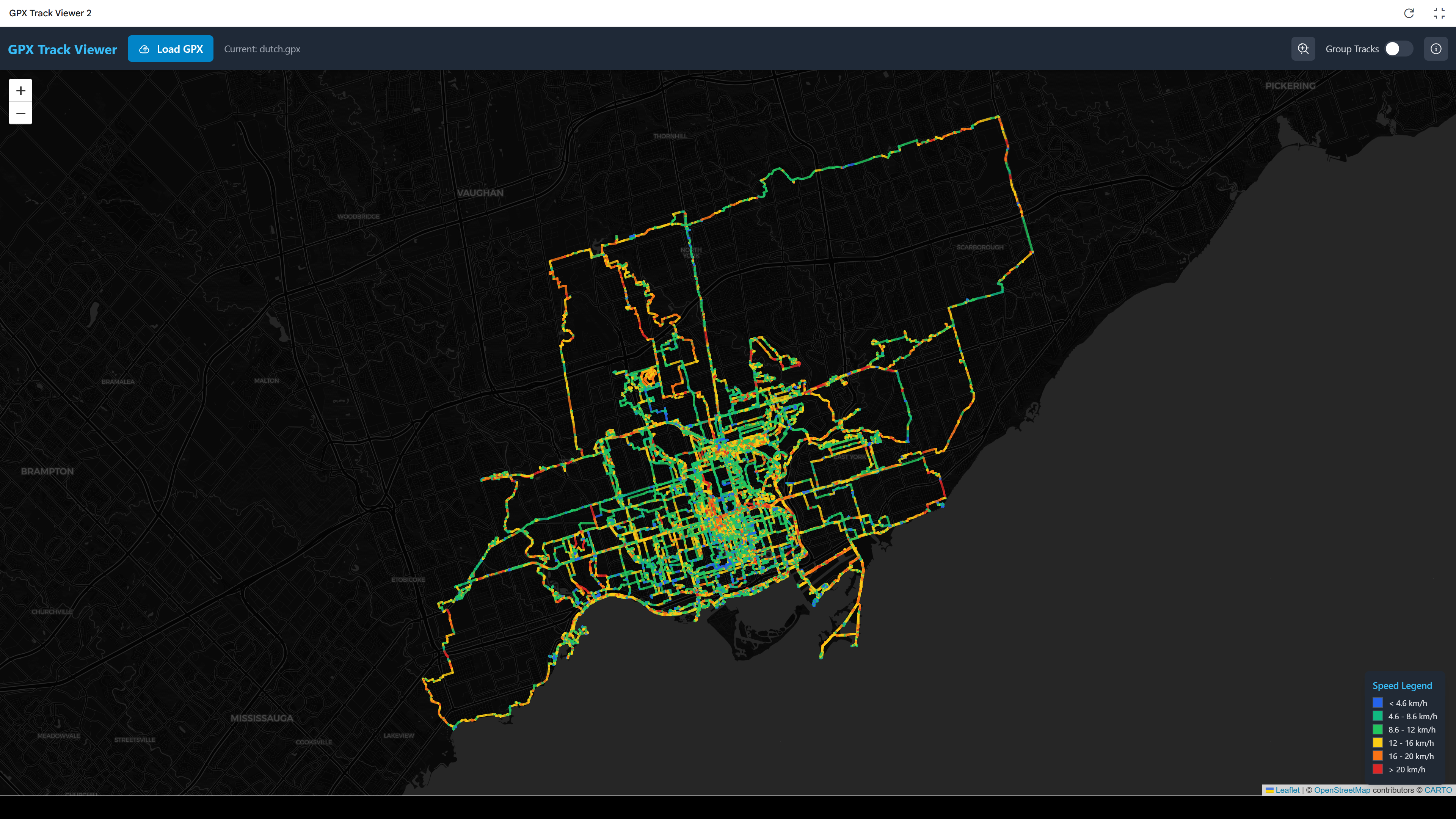
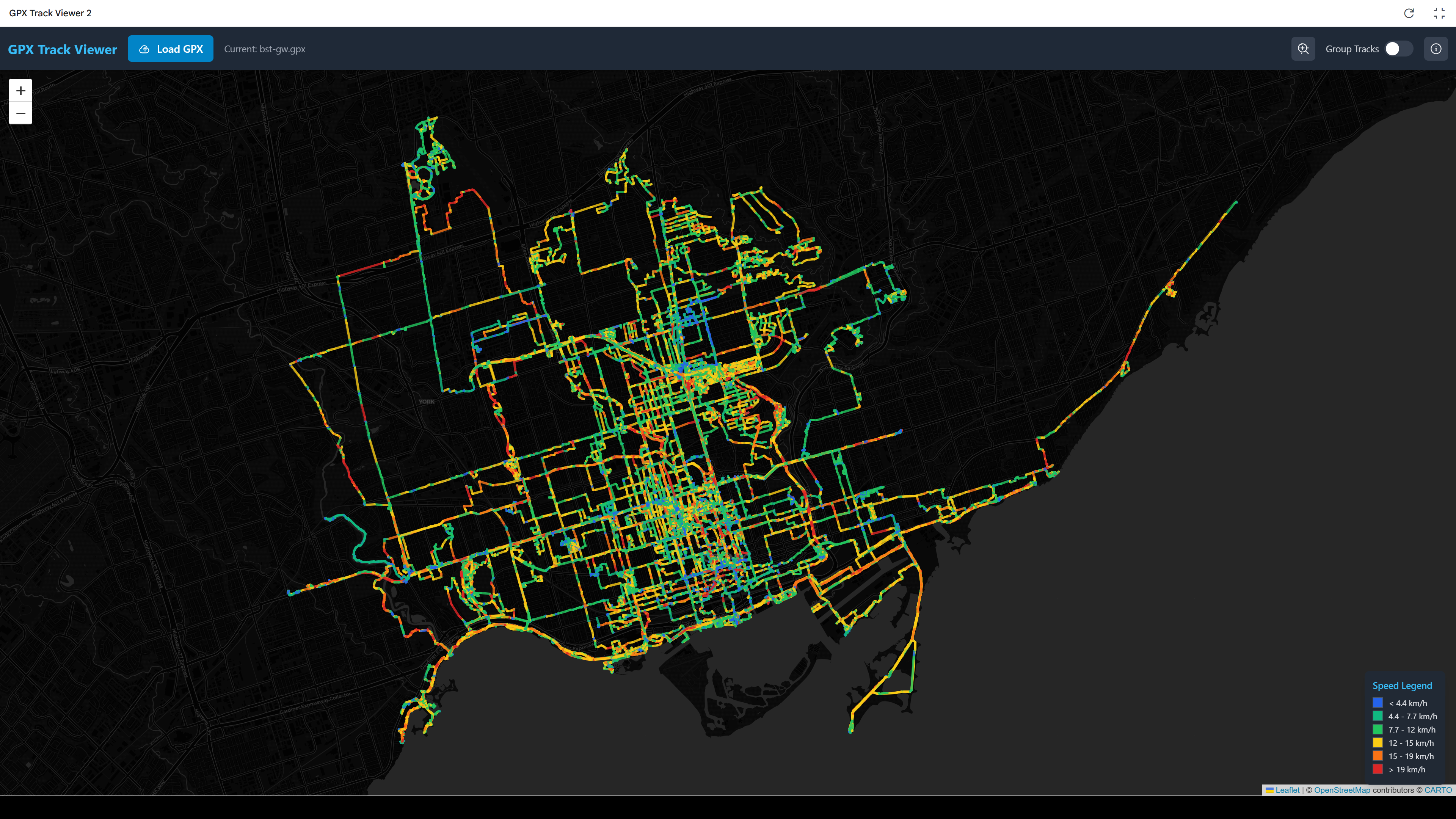
Much of this has been in service of a longstanding goal of adding new kinds of detail to my hike and biking maps, such as slowing the slope or speed at each point using different colours. I stepped up my experiment and asked directly for a web app that would ingest a large GPX and output a map colour coded by speed.

Here are the results for my Dutch bike rides:

And the mechanical Bike Share Toronto bikes:

I would prefer something that looks more like the output from QGIS, but it’s pretty amazing that it’s possible. It also had a remarkable amount of difficulty with the seemingly simple task of adding a button to zoom the extent of the map to show all the tracks, without too much blank space outside.

Perhaps the most surprising part was when at one point I submitted a prompt that the map interface was jittery and awkward. Without any further instructions it made a bunch of automatic code tweaks and suddenly the map worked much better.

It is really far, far from perfect or reliable. It is still very much in the dog-playing-a-violin stage, where it is impressive that it can be done at all, even if not skillfully.

Canada and the ‘Golden Dome’

Canada’s connection to US ballistic missile defence efforts goes back a long way and is interwoven with our shared history of continental air defence.

Now, Trump is proposing a ‘Golden Dome’ to supposedly make America safer from foreign threats, and Canada is part of the discussions.

Recently, the American Physical Society released a detailed free report: “Strategic Ballistic Missile Defense: Challenges to Defending the U.S.

The basic weaknesses of the whole concept are simple to understand: it takes drastically more expense and hardware to (possibly) stop one missile than it does for a challenger to build one more missile. As a result, the technology is inherently likely to fuel arms races, as foreign challengers fear their deterrents will lose credibility.

Related:

See also my 2005 report: “Common Threats, Joint Responses: The Report of the 2005 North American Security Cooperation Assessment Student Tour

Carney on the carbon bubble and stranded assets

By some measures, based on science, the scale of the energy revolution required is staggering.

If we had started in 2000, we could have hit the 1.5°C objective by halving emissions every thirty years. Now, we must halve emissions every ten years. If we wait another four years, the challenge will be to halve emissions every year. If we wait another eight years, our 1.5°C carbon budget will be exhausted.

The entrepreneur and engineer Saul Griffith argues that the carbon-emitting properties of our committed physical capital mean that we are locked in to use up the residual carbon budget, even if no one buys another car with an internal combustion engine, installs a new gas-fired hot-water heater or, at a larger scale, constructs a new coal power plant. That’s because, just as we expect a new car to run for a decade or more, we expect our machines to be used until they are fully depreciated. If the committed emissions of all the machines over their useful lives will largely exhaust the 1.5°C carbon budget, going forward we will need almost all new machines, like cars, to be zero carbon. Currently, electric car sales, despite being one of the hottest segments of the market, are as a percentage in single digits. This implies that, if we are to meet society’s objective, there will be scrappage and stranded assets.

To meet the 1.5°C target, more than 80 per cent of current fossil fuel reserves (including three-quarters of coal, half of gas, one-third of oil) would need to stay in the ground, stranding these assets. The equivalent for less than 2°C is about 60 per cent of fossil fuel assets staying in the ground (where they would no longer be assets).

When I mentioned the prospect of stranded assets in a speech in 2015, it was met with howls of outrage from the industry. That was in part because many had refused to perform the basic reconcilliation between the objectives society had agreed in Paris (keeping temperature increases below 2°C), the carbon budgets science estimated were necessary to achieve them and the consequences this had for fossil fuel extraction. They couldn’t, or wouldn’t, undertake the basic calculations that a teenager, Greta Thunberg, would easily master and powerfully project. Now recognition is growing, even in the oil and gas industry, that some fossil fuel assets will be stranded — although, as we shall see later in the chapter, pricing in financial markets remains wholly inconsistent with the transition.

Carney, Mark. Value(s): Building a Better World for All. Penguin Random House Canada, 2021. p. 273–4, 278

Working on geoengineering and AI briefings

Last Christmas break, I wrote a detailed briefing on the existential risks to humanity from nuclear weapons.

This year I am starting two more: one on the risks from artificial intelligence, and one on the promises and perils of geoengineering, which I increasingly feel is emerging as our default response to climate change.

I have had a few geoengineering books in my book stacks for years, generally buried under the whaling books in the ‘too depressing to read’ zone. AI I have been learning a lot more about recently, including through Nick Bostrom and Toby Ord’s books and Robert Miles’ incredibly helpful YouTube series (based on Amodei et al’s instructive paper).

Related re: geoengineering:

Related re: AI:

Caring and the need to preserve the status quo

It strikes me that recognizing that a great deal of work is not strictly productive but caring, and that there is always a caring aspect even to the most apparently impersonal work, does suggest one reason why it’s so difficult to create a different society with a different set of rules. Even if we don’t like what the world look like, the fact remains that the conscious aim of most of our actions, productive or otherwise, is to do well by others; often, very specific others. Our actions are caught up in relations of caring. But most caring relations require we leave the world more or less as we found it. In the same way that teenage idealists regularly abandon their dreams of creating a better world and come to accept the compromises of adult life at precisely the moment they marry and have children, caring for others, especially over the long term, requires maintaining a world that’s relatively predictable as the grounds on which caring can take place. One cannot save to ensure a college education for one’s children unless one is sure in twenty years there will still be colleges—or for that matter, money. And that, in turns, means that love for others—people, animals, landscapes—regularly requires the maintenance of institutional structures one might otherwise despise.

Graeber, David. Bullshit Jobs : A Theory. New York : Simon & Schuster, 2018. p. 219

Related:

The obligation for cheerful dishonesty in much of working life

Here, though, I want to focus on what students forced into these make-work jobs actually learn from them—lessons that they do not learn from more traditional student occupations and pursuits such as studying for tests, planning parties, and so on. Even judging by Brendan’s and Patrick’s accounts (and I could easily reference many others), I think we can conclude that from these jobs, students learn at least five things:

  1. how to operate under others’ direct supervision;
  2. how to pretend to work even when nothing needs to be done;
  3. that one is not paid money to do things, however useful or important, that one actually enjoys;
  4. that one is paid money to do things that are in no way useful or important and that one does not enjoy; and
  5. that at least in jobs requiring interaction with the public, even when one is being paid to carry out tasks that one does not enjoy, one also has to pretend to be enjoying it.

Yet at the same time, it is precisely the make-believe aspect of their work that student workers like Patrick and Brendan find the most infuriating—indeed, that just about anyone who’s ever had a wage-labor job that was closely supervised finds the most maddening aspect of the job. Working serves a purpose, or is meant to do so. Being forced to pretend to work just for the sake of working is an indignity, since the demand is perceived—rightly—as the pure exercise of power for its own sake. If make-believe play is the purest expression of human freedom, make-believe work imposed by others is the purest expression of lack of freedom. It’s not entirely surprising, then, that the first historical evidence we have for the notion that certain categories of people really ought to be working at all times, even if there’s nothing to do, and that work needs to be made to fill their time, even if there’s nothing that really needs doing, refers to people who are not free: prisoners and slaves, two categories that historically have largely overlapped.

Of course, we learned our lesson: if you’re on the clock, do not be too efficient. You will not be rewarded, not even by a gruff nod of acknowledgement (which is all we were really expecting). Instead, you’ll be punished with meaningless busywork. And being forced to pretend to work, we discovered, was the most absolute indignity—because it was impossible to pretend it was anything but what it was: pure degradation, a sheer exercise of the boss’s power for its own sake. It didn’t matter that we were only pretending to scrub the baseboard. Every moment spent pretending to scour the baseboard felt like some schoolyard bully gloating at us over our shoulders—except, of course, this time, the bully had the full force of law and custom on his side.

Graeber, David. Bullshit Jobs : A Theory. New York : Simon & Schuster, 2018. p. 86, 92, 99

41

While global conditions and humanity’s prospects for the future are disastrous, my own life has become a lot more stable and emotionally tolerable over the course of this past year of employment. The PhD did immense psychological damage to me. After a lifetime in a competitive education system in which I had done exceptionally well, the PhD tended to reinforce the conclusion that everything I did was bad and wrong, and that I had no control over what would happen to my life. I had serious fears about ever finding stable employment after that long and demoralizing time away from the job market (though still always working, to limit the financial damage from those extra years in school). Being out and employed — and even seeing shadows of other possibilities in the future — gives me a sense materially, psychologically, and physiologically of being able to rebuild and endure.

As noted in my pre-US-election post, having a stable home and income makes the disasters around the world seem less like personal catastrophes, though the general population are behaving foolishly when they assume that the 2020–60 period will bear any resemblance to the ‘normality’ of, say, the 1980–2020 period. Of course, there has been no such thing as intergenerational stability or normality since the Industrial Revolution; after centuries where many lives remained broadly similar, the world is now transforming every generation or faster. In the 20th century, much of that change was about technological deployment. In the years ahead, ecological disruption will be a bigger part of the story — along with the technological, sociological, and political convulsions which will accompany the collapse of systems that have supported our civilization for eons.

My own answer to living through a time of catastrophe — in many ways, literally an apocalypse and the end of humanity, as we are all thrown into a post-human future where technology and biology fuse together — is to apply myself in doing my best in everything I undertake, whether that’s photographing a conference, making sandwiches for dinner, or advocating for climate stability and reduced nuclear weapon risks.

None of us can control the world. A huge dark comet could wipe us out tomorrow. A supervolcano or a coronal mass ejection from the sun could abruptly knock us into a nuclear-winter-like world or a world where all our technology gets broken simultaneously, stopping the farm-to-citizens conveyer belt that keeps us alive. There are frighteningly grounded descriptions of how a nuclear war could throw us all into the dark simultaneously, perhaps unable to resume long-distance contact with others for months or years.

It really could happen all of a sudden, with no opportunities for takesies-backsies or improving our resilience after the fact. We live in a world on a precipice, so all we can do is share our gratitude, appreciation, and esteem with those who have enriched our lives while it is possible to do so, while retaining our determination to keep fighting for a better world, despite our species’ manifest inabilities and pathologies.

Struggles in the post-secondary sector

Even before the appalling Trump re-election, there have been deep problems in the post-secondary and university space. COVID was obviously a disruption to everyone, but there are also deeper and longer-term forces changing how universities operate and how students interact with them.

Sadly, the near-to-medium future seems certain to be characterized by further resource conflicts, tough decisions by schools, and continued political contention about higher education. It is particularly worrisome to see cost-saving measures eroding things which likely can never be replaced: when you get rid of the specialist ancient language training that makes history possible, you effectively close down those historical fields by ending the pipeline of new experts. More broadly, universities are full of important fields of work which nonetheless have trouble defending their value to legislators and an angry public.

Ironies abound in a world where knowledge is more important than ever yet education is suffering – where technical knowledge is more indispensable than ever for being politically informed, yet dominant political movements sideline and disparage expertise. Collectively, we have a lot to survive and overcome in the decades ahead and in order to have a fighting chance we need trained and informed minds.