

UK libel laws and global free speech

Rust on white paint

As explained well in an article by Emily MacManus, I don’t think it’s an exaggeration to say that British laws on libel are a threat to free speech around the world. Because they permit frivolous cases that would be far too costly for most people to fight, they give a great deal of power to anyone who is annoyed enough and has the resources to pursue legal action there. Even the threat of such action may be sufficient to make individuals or publishing organizations censor themselves.

The linked article goes further into the peculiarities, which include the characteristics of ‘no-win-no-fee’ litigation and the broad understanding of who constitutes a ‘publisher.’ For instance, if you said something true but commercially harmful about a company on your website, they might go after you, your internet service provider, or the company that runs the server your site is on. Any of them might feel pressured into removing the statements, rather than face litigation. British law also holds that “every time the statement is downloaded or accessed it constitutes a fresh publication,” which could produce especially absurd outcomes for a popular website.

An important first step could be requiring the party bringing the suit to prove that the allegations are untrue, before the court accepts the case. For instance, if I said that Rio Tinto was polluting a river somewhere with mercury, or that Suncor is emitting huge amounts of greenhouse gasses, they would have to prove the opposite in some sort of pre-trial hearing, before they could come after me. It might also make sense to limit which courts can hear a particular case, so as to prevent people from shopping around in random legal jurisdictions to find the one that gives them the strongest hand.

The article suggests that ‘principled deep-pocketed litigants’ might be able to produce some useful new precedents, limiting the damage the existing rules on libel and defamation could have on honest and open public discourse. For now, however, it suggests that “the reaction to libel remains: take it down, take it down quickly, take it down again. And libel tourism means that this habit is likely to spread.”

One thing the article isn’t clear on is what could happen to you if a British court rules against you, in your absence, and you simply ignore them. Perhaps someone with more legal knowledge could explain whether there is any chance of them coming after assets held in another jurisdiction.

Deep packet inspection in Canada

The Office of the Privacy Commissioner has created a new website. In addition to the commissioner’s blog, there is now a website devoted to deep packet inspection, announced here.

Deep packet inspection is quite a profound modification of how the internet works. All information passed across the web goes through a number of machines. In the classic version of this arrangement, they just forward the information to the next link without giving it any consideration. With packet inspection, the datastream can be monitored by those intermediate machines, including the ones at a user’s internet service provider (ISP) between their computer and the rest of the internet. Given that the computers of your ISP see all your traffic, having them implement deep packet inspection raises some especially serious questions. That is especially true given that they may be vulnerable to attack by malicious actors, and may be willing to cooperate with requests from governments, even if those requests are illegal.

The technology could have good uses, like stopping viruses and worms. It could also have many malicious ones. Companies could use it to block competition, by making the internet discriminate against their existing rivals and new startups. It could also be used for data mining, eavesdropping, and censorship. Personally, I would prefer an internet without it, and I am glad to see that it’s something Canada’s official privacy official has been devoting a fair bit of attention towards.

The future of newspapers

In a recent post, Taylor Owen argues that the death of newspapers (if it is happening) is not anti-democratic, because they will likely be replaced by less hierarchical structures. Personally, I think the value of newspapers derives precisely from the resources they have that most websites lack, such as access to powerful figures and the resources required for independent research. While some blogs do have very capable writers and sophisticated analysis, I do think the mainstream media is a very important current flowing into online discussions.

One way or another, I am sure newspapers will survive. They serve too many valuable purposes to be rendered pointless by the internet, and the best of them will eventually develop revenue streams that allow them to keep functioning despite it.

Useful-looking manual flash

Emily Horn in the snow

The LumoPro LP120 manual flash is interesting for two major reasons.

First, it defies the design logic of the big camera companies. They want to sell snazzy proprietary technologies, like through-the-lens (TTL) metering. This flash generally omits them. The big companies also want to exclude low-cost, useful features from cheap products. That way, they can drive people to buy more expensive ones. For instance, Canon doesn’t include a PC-connection on its US$275 430 EX II flash, but it does on the US$400 580 EX II. The LP120 includes a built-in PC connector, hotshoe connector, 1/8″ jack, and an integrated optical slave. It also has output roughly comparable to the 430 EX II, for US$130.

Second, it seems that the flash was designed primarily to serve a single web-based community: the talented and flash-obsessed photographers at Strobist. That seems like the kind of thing that could produce a very clever trend, where like-minded people assemble with specific needs and niche products are developed to accommodate them effectively.

In any case, I am strongly considering getting an LP120 as a second flash. It would let me do more elaborate things than are possible using just a single flash and an umbrella. I have an upcoming photographic project where better portrait capabilities would be a distinct asset.

[Update: 24 March 2009] I got the LP120 flash today. My first impression is that it feels cheap. The battery compartment is finicky, and flash head doesn’t lock in place, and the flash emits a constant high-pitched whine when on. It certainly shows me part of why people shell out money for flashes like the Canon 430EX II.

We will see whether the photographic performance of the flash is better than the build quality.

‘Book club’ idea

If you count the time spent reading, my book review posts are certainly the ones that have the most effort invested in them. Yet, they generally fail to spawn any substantive discussion. Generally, this is because most readers won’t have read most of the books in question. As a result, any discussions are based around things I happen to mention in my post, rather than the overall content of the book in question.

As a solution, I was wondering if anyone would be interested in a monthly non-fiction book club, to be operated through this and other blogs. We would choose a book per month, read it, and then all write posts and/or comments about it. That way, some substantive discussion of the material could take place. I would be most keen about books in subject areas covered on this site, but am not fundamentally averse to trying something more unusual. Even fiction might be considered, provided it is of a practical variety.

Would anyone be interested?

Climate change on the Globe and Mail wiki

The Globe and Mail has an initiative called Policy Wiki, in which they are trying to foster web discussions on public policy issues of interest to Canadians. The third topic they have selected is climate change. The site includes a briefing note by Mark Jaccard, of the Pembina Institute, and an analysis and proposal by David Suzuki.

Some of the sub-questions to be discussed include:

  1. How closely should Canada’s policies be linked to the US?
  2. Should our focus be bilateral or multilateral?
  3. What position should Canada adopt at the Copenhagen conference?
  4. How does the economic crisis impact actions on climate change?
  5. How will this impact Canadian industry?
  6. How many green jobs can Canada create?
  7. What added responsibility does Canada have as an energy superpower?

Most frequent commenters on this site are quite concerned with Canadian climate policy. As such, this might be an opportunity to discuss the issue with a broader audience. I personally plan to contribute, and would be pleased to see readers doing so as well.

Creative Commons ‘zero’ license

It says something about the current climate of intellectual property law that Creative Commons has released a new ‘zero’ license, which strives to do everything legally possible to put a work into the public domain. The new license is meant to be an improvement over their previous public domain dedication service:

The CC0 system works better internationally, is likely more legally valid (since one can not dedicate their works into the public domain in many countries and there are questions about doing so in the U.S.) and, if the icon and meaning becomes recognizable enough, more clear.

It seems a bit remarkable that it is so difficult to choose to give intellectual property away. I can understand the importance of legal protections to ensure that people don’t do so by accident (particularly children), but it does seem as though there should be a straightforward legal mechanism to waive all rights as the creator of a work.

The contents of this site are under a Creative Commons license: specifically, one that allows anyone to copy, distribute and transmit the work, as well as produce adaptations. It requires that the work be attributed to me, that any derivative works be subject to the same rules, and does not grant these rights automatically for commercial purposes. That is to say, if someone wants to use one of my images on a personal site, with attribution, that’s fine; if Visa wants to use it in a commercial, I expect them to pay for the usage rights.

Creative Commons licenses are very valuable because they allow creators of content to establish such regimes without needing to hire lawyers or spend a lot of time and money.

On blog post timing

My current system is to produce two posts a day (sometimes one on weekends or when I am very busy). The first post includes a photo, and is generally the more substantive of the two. One post comes out at a random time between 7:00am and 8:00am Ottawa time. The other, at a random time between 6:00pm and 7:00pm.

Given that almost all the posts are written in advance, these time conventions are arbitrary. Would readers prefer for them to come out at different times? For instance, the first could be released earlier in the morning, for the benefit of those who habitually rise long before me.

Time zones are also a consideration. During the past year, there have been 22,253 visitors from across Canada, 19,789 from the USA, 5,597 from the UK, 1,314 from India, 1,297 from Australia, 642 from Germany, and less than 500 from 165 other states. The times at which posts are released matter most to regular readers, who tend to be in England (GMT), the Toronto-Ottawa area (GMT-5), and the Vancouver area (GMT-8). That means posts come out in Vancouver between 4:00am and 5:00am, as well as between 3:00pm and 4:00pm. In London and Oxford, they come out between noon and 1:00pm, as well as between 11:00pm and midnight.

Also, is the semi-random system preferable to one where they come out at the exact same moment, or would the alternative be better?

The Kindle and electronic books

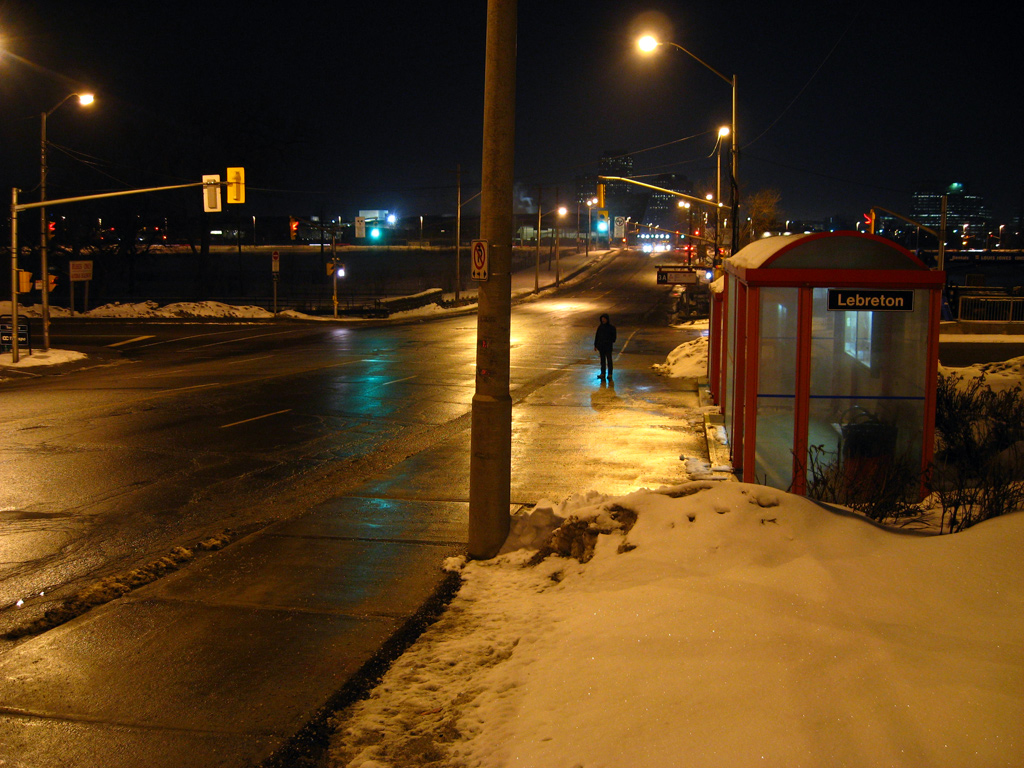
Ottawa bus stop in winter

In a recent article about Amazon’s Kindle e-book reader, The Economist declared that:

It seems likely that, eventually, only books that have value as souvenirs, gifts or artefacts will remain bound in paper.

Despite being a big fan of electronic content delivery systems, I wholeheartedly disagree with this assessment. There are considerable advantages to having a personal library of physical books, and there are big disadvantages to taking your books in electronic format.

Physical books possess the many advantages of immediacy. One can display them and quickly glance through the whole collection. One can take notes in them, mark pages, stack them, pass them to others, and so forth. Collections of books are also physical representations of the reading a person has done. I often find that, when I first find myself in someone’s house, flat, or bedroom, their collection of books is the first thing I scrutinize. There is a reason why the personal libraries of intellectuals and political leaders are objects of interest, and I don’t think they would retain the same importance if they consisted of a bunch of PDF or text files.

Electronic books have the same disadvantages as other electronic media: you can’t be confident that they will be intact and accessible decades from now. Furthermore, they are often hobbled with digital rights management (DRM), which means you can never be sure that you can use them on future devices, or in various ways you might wish to. A library stored on a small device may be easier to transport, but it is a lot less trustworthy, durable, and reliable than one that you need to cart around in a heavy collection of boxes.

Electronic books can certainly complement physical ones. It would, for instance, be very valuable to be able to search electronic copies of books you own. A custom search engine, containing all the books in one’s library and that one has borrowed, would be excellent for tracking down particular passages or conducting general research. Partly for these synergistic reasons, and partly for the reasons listed above, I don’t think physical books are ever likely to become rare.

I do see much more promise for electronic periodicals. Hardly anybody wants to keep physical copies of their newspaper or magazine subscriptions on hand: especially when they are available in an easily searchable form online. If I got a Kindle, it would be for the wireless newspaper and Wikipedia access, not for the $10 book downloads.

Free lectures from top American schools online

As described in this Slate article, a new site called Academic Earth has brought together a large numbers of lecture videos and made them available online for free. Right now, it includes lecturers from Berkeley, Harvard, MIT, Princeton, Stanford, and Yale.

There is a six lecture series on Understanding the Financial Crisis.