

Hayhoe on climate change and differing morals
“How do I talk about this … to my mother, brother-in-law, friend, colleague, elected official?” I’m asked this question nearly everywhere I go.
…
Usually, they’ve already given conversation a try. They’ve boned up on a few alarming scientific facts. They’ve tried to explain how fast the Arctic is melting, or how bees are disappearing, or how carbon dioxide levels are rising. But their attempts have fallen flat. Why? Because the biggest challenge we face isn’t science denial. It’s a combination of tribalism, complacency, and fear. Most don’t think climate change is going to affect them personally, or that we can do anything reasonable to fix it; and why would they, if we never talk about it?
It’s important to understand what’s happening to our world and how it affects us. But bombarding someone with more data, facts, and science only engages their defenses, pushes them into self-justification, and leaves us more divided than when we began. On climate change and other issues with moral implications, we tend to believe that everyone should care for the same self-evident reasons we do. If they don’t, we all too often assume they lack morals. But most people do have morals and are acting according to them; they’re just different from ours. And if we are aware of these differences, we can speak to them.
Hayhoe, Katharine. Saving Us: A Climate Scientist’s Case for Hope and Healing in a Divided World. 2021. p. xi-ii
Related:
AUKUS and nuclear-powered subs for Australia
In September, the US, Australia, and the UK announced the trilateral AUKUS security pact, a key element of which is for the US and UK to provide nuclear propulsion technology for Australian submarines. From an arms race and proliferation perspective, the development is somewhat worrying.
To limit their size and maximize the time period between refuelling, nuclear submarines use highly enriched uranium (HEU) which could be redirected for use in a bomb. It will be important to see whether the US and UK provide the reactors as sealed packages or whether Australia will develop uranium enrichment technology. Either way, providing the submarines would position Australia to be close to being able to build a crude uranium bomb. Especially if HEU is transferred to Australia without strong IAEA safeguards, this sort of technology transfer could end up as a mechanism for placing more countries a few screwdriver turns away from a basic nuclear weapon.
The creation of the pact also seems like a classic example of ‘the security dilemma’: China feels threatened from being surrounded by potentially hostile US allies so they feel justified in a major military build-up; that build-up in turn alarms those neighbours and justifies their own further armament, which closes the cycle and makes China feel threatened and justified in building more arms.
Books in progress — October 2021
Back in the day, I would write some kind of review or response to each book I read, which was useful in several ways. It gave me something short to refer back to in order to refresh my memory, as well as to share with people who might consider reading the book (2 pages on a blog is a much faster read).
It became impossible to continue with at some point in the PhD, either because I had too many books to read or because I didn’t have time to write responses.
Just for fun, here is a list of books I have in progress and how I am generally finding them. These are in no particular order and range from books I received today (Hayhoe) to ones that have been in a pile of reading in progress for several years:
Katharine Hayhoe. Saving Us: A Climate Scientist’s Case for Hope and Healing in a Divided World. 2021: Reading because Hayhoe is a prominent voice in climate education and communication, with a focus on reaching out to groups not naturally aligned to the progressive agenda which saturates most climate activist groups
Allen Dulles. The Craft of Intelligence: America’s Legendary Spy Master on the Fundamentals of Intelligence Gathering for a Free World. 2016: Mentioned/recommended in several International Spy Museum Spycast podcasts and video lectures
John Le Carré. A Most Wanted Man. 2008: I love the 2014 film directed by Anton Corbijn and starring Philip Seymour Hoffman; I think this is Le Carré’s most engaging story because of the diversity of the people involved — they aren’t all just a bunch of grey spooks
Robert L. Jaffe an Washington Taylor. The Physics of Energy. 2018: Many people writing and organizing about climate change don’t know much about energy. This MIT textbook goes too far into the math for me on many occassions, but is an excellent general introduction to how energy works in our society.
Willy Ley. Rockets, Missiles, and Men in Space. 1968: I picked this up used because a few skimmed pages looked promising – turns out to be a highly interesting account of early rocket and space flight
Daniel Kahneman. Thinking Fast and Slow. 2011: A good summary of some of the cognitive science related to environmental and climate politics, but a bit hard to get through when I have seen the main ideas summarized and repeated in so many places already.
Aisha Ahmad. Jihad & Co: Black Markets and Islamist Power. 2017: A great example of scholarly writing well-written and concise enough to be accessible to an interested amateur audience – rich with personal experiences, and providing a very different perspective on what gives rise to Islamist theocratic governments
Herman Melville. Moby Dick. 1851: Recommended as a friend’s favourite — much easier to read than its fearsome reputation as a difficult book made me expect
Andrew Darby. Harpoon: Into the Heart of Whaling. 2008: Informative and well-written, but too depressing to finish. People really are awful
Simon Garfield. On the Map: A Mind-Expanding Exploration of the Way the World Looks. 2013: Not much new information for someone who has already read a bit on the subject, but well-grounded in images and descriptions of real maps
Oliver Morton. The Planet Remade: How Geoengineering Could Change the World. 2015: I loved Eating the Sun, but this one is too depressing to finish
Shi-Ling Hsu. The Case for a Carbon Tax: Getting P{ast Our Hang-Ups to Effective Climate Policy. 2011: Recommended at some point in my PhD research, but covers little new ground for someone who has followed the topic of carbon pricing closely
David Keith. A Case for Climate Engineering. 2013. Reading it to engage with the question of whether geoengineering is sensible to pursue — tiny but too depressing to finish
Diane Vaughan. The Challenger Launch Decision: Risky Technology, Culture, and Deviance at NASA. 1996: Relevant for my Space Shuttle screenplay and also a fascinating analysis of organizational culture — applicable to everyone working on something hard and dangerous
William Perry and Tom Collina. The Button: The New Nuclear Arms Race and Presidential Power from Truman to Trump. 2020: Speaks to my long-term interest in avoiding accidental or unauthorized nuclear weapon use
Seth Klein. A Good War: Mobilizing Canada for the Climate Emergency. 2020: Widely discussed in activist circles, but frustrates me with two persistent types of superficial analysis, basically assuming that because WWII and climate change were big important challenges the effort against the latter can be helpfully modelled on the former, and accepting cost-free notional answers from people who want to come across as good to pollsters as strong evidence for a desire for radical political change
E.H. Carr. What is History? 1961: Read partly to wrestle with questions of disciplinary boundaries and methodological orientation in political science
James R. Hansen. First Man: The Life of Neil A. Armstrong. 2005: I loved the film when I saw it with Holly, and astronaut biographies and autobiographies are one of the best parts of my screenplay research
Those are the ones that I am at least partway into and which I can find readily around the room. I should probably apply more discipline and self-control to not obtaining additional books while these are all still pending.
Workload, timelines, advisors, funding, pressure
A very good blog post on what to expect from a PhD program (and especially what the university itself won’t tell you): So You Want To Go To Grad School (in the Academic Humanities)?
Two paragraphs which are especially informative for people who don’t have recent personal experience in a PhD program:
The most important person in the process is your advisor, who is generally a senior member of the faculty in your department who shares your specialization. I struggle to find words to communicate how important this person will be during your graduate experience.. Graduate study at this level is effectively an apprenticeship system; the advisor is the master and the graduate student is the apprentice and so in theory at least the advisor is going to help guide the student through each stage of this process. To give a sense of the importance of this relationship, it is fairly common to talk about other academics’ advisors as forming a sort of ‘family tree’ (sometimes over multiple ‘generations’). Indeed, the German term for an advisor is a doktorvater, your ‘doctor-father’ (or doktormutter, of course) and this is in common use among English-language academics as well and the notion it suggests, that your advisor is a sort of third parent, isn’t so far from the truth.
If you are considering graduate school with an eye towards continuing in academia who you choose as your advisor will be very important: academia is a snooty, prestige conscious place and your advisor’s name and prestige will travel with you. But there’s more than that: your advisor, because they need to check off on every step of your journey and you will need their effusive letter of recommendation to pursue any kind of academic job has tremendous power over you as a graduate student. You, by contrast, have functionally no power in that relationship; you are reliant on the good graces of your advisor.
Related:
- Mental health and PhD programs
- A PhD program as a platform for doing other things
- The magnitude of the original contribution of a PhD
- U of T grad school statistics
- OSAP and U of T in year seven
- Writing as successive approximation
- Life streams
- Year 2/6 (best case scenario)
- The value of a doctorate
- Who respects fancy degrees?
- On recession and the value of graduate school
- Jokes about thesis stress have a basis in fact
- Changing topics in year 5
Monarch butterflies on lilacs 2/2
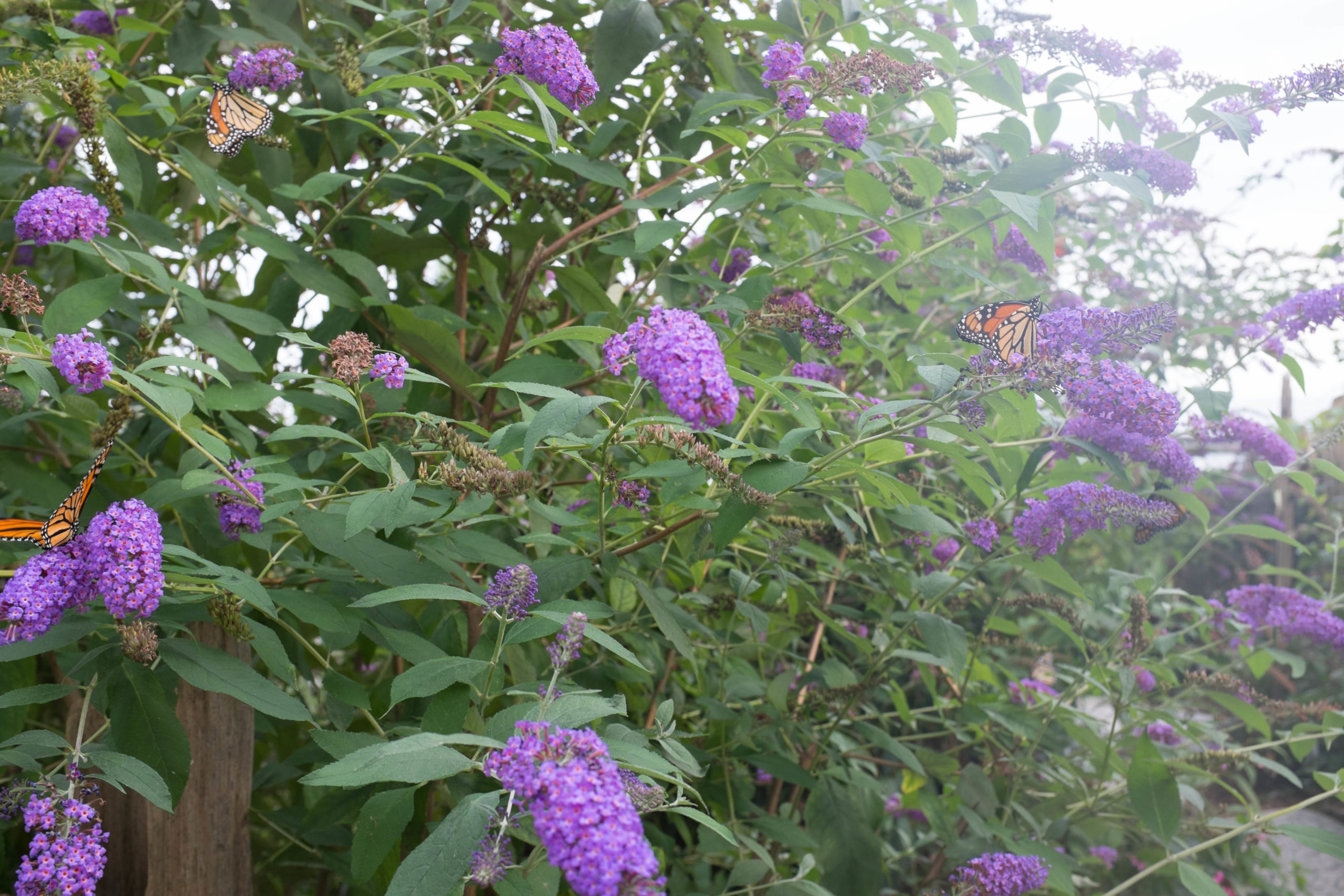
Monarch butterflies on lilacs 1/2

Covid in fall 2021
It has been sad and frustrating to see so many Torontonians putting their personal enjoyment before public health and ahead of suppressing the viral reproduction rate of the pandemic.
A reckless and deluded few are ‘protesting’ by pushing into mall food courts without wearing masks or providing proof of vaccination. Far more are eating unmasked inside restaurants, traveling to and through crowded places for the sake of recreation, abusing staff and public servants who try to enforce the rules, and generally asserting the importance of their own preferences over the public welfare.
Many Torontonians have followed the recommended precautions and gone further. These splits within our society seem demonstrative of a culture that emphasizes individual consumer choice as the chief influence on behaviour and which accepts a huge degree of entitlement about what people are allowed to do regardless of the ongoing conditions or likely consequences. It’s scary to ask whether we have the culture or the sensibilities necessary to overcome the most threatening challenges to humanity as a whole.
Into the fall
My friend Richard’s visit has provided opportunities, at this turning point of seasons, to bring friends together and enjoy multi-person conversations in contexts like distanced outdoor walks. It has been a great reminder of the world beyond the specialized niche of the PhD program, not to mention the sort of pre-pandemic social interactions which we all must value more highly now that we’ve felt and adapted to their absence.
My main task remains the same: finish the PhD and find something worthwhile to do after.
I’m grateful that I have such friends to enrich my life while I’m working.
When memories become stories
I have heard the theory that every time we remember something it is influenced by our thoughts, feelings, and beliefs at the time of remembering. That implies that the memories we think most about are the ones that have been most distorted from their original form.
An exaggerated version is in effect for stories recounted to others. They always need to be selective in detail to make the account manageable in length, and simple tweaks to make it more comprehensible and straightforward have a tendency to persist in later retellings. In particular, I find in myself a tendency to combine the most memorable features of multiple events into a single recollection/story — not, for example, as two or more different parties at distinct semi-remembered places, but one party which sets up a subsequent part of the story.
I suppose the phenomenon demonstrates the value of contemporaneous records and accounts like journaling. Doubtless our interpretations of those records are influenced by subsequent context, but at least the record itself is immutable.
Related: