A good day, and a really excellent evening

Candle warmth on a dark and stormy night

This morning, I was delighted to receive two envelopes that, while lacking a return address, bore the familiar handwriting of Sarah Johnston. As each is marked ‘for your birthday,’ I’ve placed them carefully aside until Monday. Many thanks to her for remembering. Indeed, these last few days have been a wonderful reminder that there are people out there who care about me; I appreciate it a great deal.

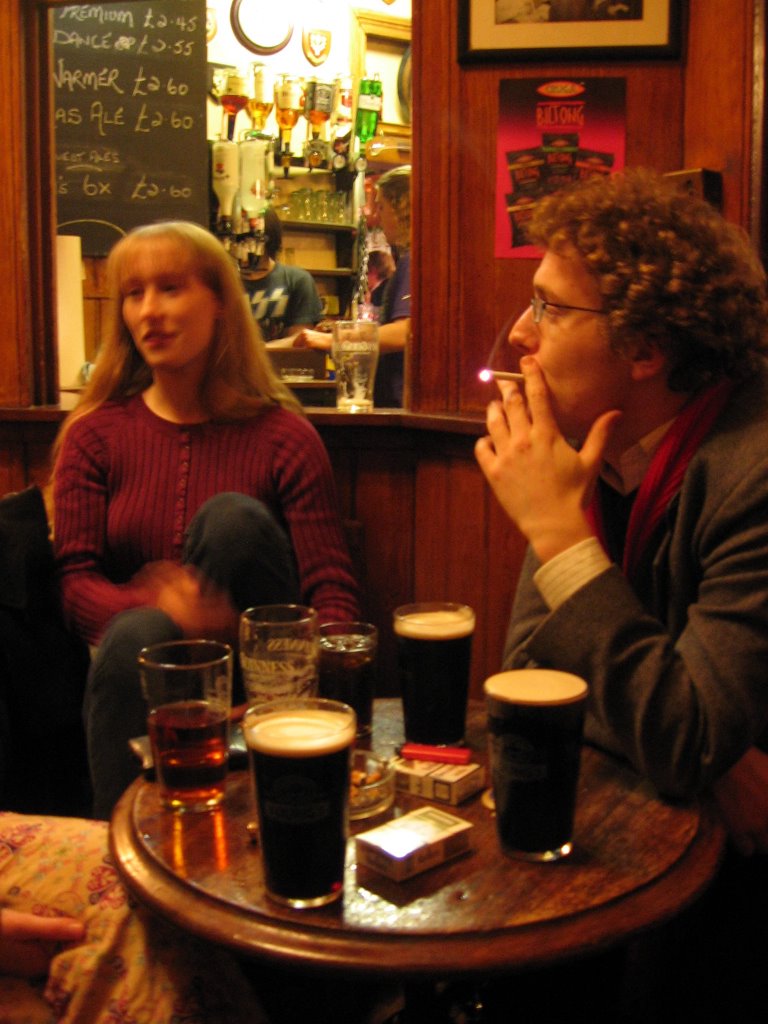
I had quite an excellent time this evening and tonight. Emily, Claire, Nora, Alex, and Margaret all came for dinner at the Moonlight Tandoori Restaurant. Unfortunately, something went wrong with the reservation and they could not give us a table. Luckily, the Kasmir Halal restaurant next door proved available and quite good. I haven’t eaten so much since I arrived in Oxford. I had a tasty bowl of Dall Soup – to combat the cold – followed by papadums, vegetable vindaloo, and garlic naan. The vegetable vindaloo was the hottest curry I have ever been served without specifically requesting that the curry be made hotter. It was wonderful. Also good was the chance to introduce Nora to the delights of Indian food: of which she had not previously partaken.

Along with dinner, we shared two bottles of wine that Margaret kindly picked up at Tesco’s. Perhaps the best thing about the night was conversing with friends from disparate parts of Oxford, and appreciating the fact that they enjoy conversing with one another. One of the things I always enjoyed most about throwing the occasional big party with lots of food and friends from all over was giving them the chance to meet one another. When living in a strange place, it is incredibly empowering to feel like part of a community; tonight, I definitely did.

After dinner, Emily and Alex had to scamper off to do work. Shortly after, Margaret left with a similar determination. Claire, Nora, and I, however, discovered a Jamaican bar on the west side of Cowley Road, no more than a block or two north of the restaurant. Before that, we tried going to the Wychwood Brewery, but it was unpleasantly loud and there was nowhere to sit. By contrast, the Jamaican bar offered plenty of places to sit, nice bass-heavy reggae music, and an enjoyable ambiance. We were also introduced to an excellent cocktail. Called a ‘dark and stormy,’ it consists of Appleton Special Jamaican Rum (dark) and Old Jamaican Ginger Beer. Served in a half pint glass, with ice, it tastes like a more interesting, more Caribbean gin and tonic. It met with universal approval.

Very kindly, Nora furnished me with a travel guide book on Tallinn: A Hedonist’s Guide to Tallinn and the Iain Pears novel An Instance of the Fingerpost as birthday gifts. I look forward very much to reading both during the next while, and making use of the first, during the break. Very generously, Nora, Claire, and Margaret also paid for my excellent birthday dinner. Alex gave me a very kind card, and voucher for the purchase of additional reading material. Emily also gave me a card, but I am fairly certain she means for me to open it on my birthday proper. My profound appreciation goes out to everyone who showed up. You really didn’t need to get me anything, but I am exceedingly pleased that you did. One day, I shall mix up a pitcher of dark and stormy and share it with you all – especially those who didn’t get the chance to try it tonight.


Oxford Blog Listing

[Update 17 May 2006] This listing is no longer being updated, as a blog entry. The latest version will be available at this location, from now on.

I thought I should create a centralized listing of Oxford blogs, as a means of keeping track of the community. Blogs that don’t include enough information to categorize, based on a cursory examination, have been filed under ‘other.’ Blogs are added in the order I discover them. These have all been located through Technorati (a blog search engine) or through links on other Oxford blogs. Blogs that haven’t been updated in months will not be added.

People who I’ve met:

  1. Pandora’s Blog
    Run by Kate, who I met at the Oxford Bloggers’ Gathering on October 29, 2005.
  2. Storyteller’s World
    Run by Tony, who I met at the bloggers’ gathering.
  3. Jo’s Journal
    One of the political bloggers I met at the gathering.
  4. Antonia’s Blog
    The other political blogger, a self-described Labour party activist.
  5. in vino veritas
    Run by Lee Jones, who is in the second year of the International Relations M.Phil.
  6. Mike’s Little Red Page
    A socialistic blog, run by Mike.
  7. Consider Phlebas
    Run by Robert Jubb, who I met at the second Oxford bloggers’ gathering on February 21st, 2006.

General:

  1. but she’s a girl…
    Blog of a cool female photography and Mac geek, living in Oxford.
  2. Head in the Clouds
    Run by one of the Wadham College porters.
  3. Feroce
    A blog about books.
  4. Chocolate and Zucchini
    A blog about cooking with very nice pictures.
  5. OxBlog
    The off-the-cuff political commentary of David Adesnik, a 2000 Rhodes Scholar and graduate student in international relations at Oxford currently residing in Washington DC and Patrick Belton, a graduate student in international relations at Oxford.
  6. Cycle & Run in the Sahara Desert for Charity
    Run by Nicolas Bertrand, the title basically says it all.

Students:

  1. Beer, Bikes, Books, and Good Eats
    Blog run by Ruth Anne and Jake. Ruth Anne is a Rhodes Scholar, presently at Merton College.
  2. Falling Into Grace
    Blog run by Rachel, student at Christ Church.
  3. In Other News
    Blog run by Adam.
  4. KRS Adventures
    Blog run by Kristen Rosina.
  5. The Virtual Stoa
    Blog run by Chris Brooke, a politics tutor at Magdalen College.
  6. Praesidium
    Blog run by Ben Saunders.
  7. The Virgin Student
    The title basically says it all.
  8. EternalBlog
    Blog run by Seth Wilson, student at Trinity College.
  9. Sha Crawford’s blog
    Blog run by Sha Crawford.
  10. Militant Moderate
    A political blog run by Ken Owen and Richard Huzzy.
  11. Richard Huzzey
    An eponymous blog.
  12. The Carp’s Blog
    Run by Matthew Carpenter-Arevalo, a blog devoted to Canadian federal politics.

Other:

  1. Outside the Ivory Tower
    Blog of a former Oxford student, now living in Vancouver.
  2. Shaikley in the OX
    A blog run by Ali.

Oh, and there’s always my blog: a sibilant intake of breath.

If you want your blog added to the list, just leave a comment. Likewise, if you want the description amended.

Last updated: 22 February 2006

On accommodation

A new project for the inter-term break has arisen: finding somewhere to live for next year. I was surprised to learn from Bilyana and Nora the other day that living in Merrifield actually costs more than living in college. Wadham College is right in the middle of Oxford, near shops and academic buildings. There is also food available here, though admittedly of very low quality. Merrifield, by contrast, is about a mile from central Oxford and not particularly close to any services or faculty buildings. That it should cost more boggles the mind and reinforces how normal economic incentives just don’t seem to operate within Oxford University. As an international student, living in college during breaks but taking no college meals, the cost of living in college works out to £1194.88 in battels a term, £3584.64 per academic year. That does not include college fees, which you need to pay regardless of where you live. I don’t know exactly what Merrifield costs, since it doesn’t seem to be on the website or in the Wadham Handbook, but I am assured that it is slightly more.

The ideal solution would be to rent a house somewhere with some other IR people. We could put up huge maps and leave copies of Millenium and The Journal of the American Political Science Association sitting around. We could establish a shared high-speed wireless network, complete with a VPN channel to the DPIR terminal and file servers: providing access to electronic journals for the sane and to STATA for the mad. Copies of useful tomes, a few belonging to each of us, would be available for reference. We could edit papers and agonize about theses together, in a kind of intellectual Valhalla. Also very appealing is the prospect of having kitchen facilities of the sort that would encourage me to start trying out Sarah’s recipes.

In terms of location, it would be best to be either fairly close to the Manor Road building, and therefore the Social Sciences Library and most of our lectures, or near somewhere interesting, with plenty of services. There is a colony of Wadhamites living near Cowley Road that have opted for the latter solution. I am told they are happy with it, though it would entail a good twenty minute walk to Manor Road, or the acquisition and use of a bicycle.

In any case, these questions should be contemplated and solutions fleshed out between the end of Michaelmas (3 December) and the beginning to Hilary (15 January).

Another supervision: I may be able to handle this grad student stuff

Computers in the social sciences library

Leaving my supervision with Dr. Hurrell today, I felt quite happy with how it went. He had good things to say about the paper and we had a good conversation about several aspects of it, as well as how it relates to contemporary China. We also worked out what I should do over the inter-term break: namely, edit the fish paper for resubmission to a different journal, as well as some background reading for the theory course. I was pleasantly surprised that he didn’t assign me a paper to write, but that may well change before the term actually ends.

I am quite pleased with how working with Dr. Hurrell is going; all this, however, is just a prelude to what will happen once the original research portion of the program begins. I was wrong earlier when I assumed that the two ‘optional papers’ are actually research papers. Here, ‘papers’ just means courses, and these are more or less along the lines of our core seminar this year. As described in the Notes of Guidance, there are quite a number of possibilities. The ones that seem most interesting to me, in decreasing order, are:

  1. The Function of Law in the International Community
  2. International Normative Theory
  3. The International Relations of the Developing World
  4. Strategic Studies

That said, I will need to see the syllabus for each, and get a sense of who is teaching it, before I decide. The courses won’t take place until next year, anyhow. It makes sense to choose topics that will ultimately contribute to my thesis: another thing I should have decided on the overall structure of and question for by the end of this academic year. Comments about what I’ve written so far about it would be very welcome.

Later tonight, I am meant to meet Margaret to watch Spirited Away, but I’ve not spoken with her since I saw her in Manor Road by chance about six hours ago.

PS. Wychwood Hobgoblin is a very fine ale indeed. My thanks to Tony for introducing us.

A day of intellectual engagement

Yet another Oxford sunset, sorry.

Happy Birthday Nick Sayeg

The most surprising thing about my three pound Tesco brand radio alarm clock is that came set to use one of the BBC talk channels as the wake-up noise. I’ve never changed it, and it has been influencing those precious dreams you get in snippets, punctuated by the smashing of the ‘snooze’ button. It is an odd thing indeed to be cajoled out of bed by the sounds of men with British accents discussing recent novels, developments in physics, or U.K. politics. I’ve never been someone who listens to the radio, except as a means of being jolted out of repose. It is too random, too filled with commercials, and too attention intensive in the wrong ways. It’s not something I can ever really enjoy, though it frequently annoys me.

Today’s ‘Advanced Study of IR’ lecture was delivered by Gavin Williams about the politics of development or, as he called it, the politics of most of the world. I particularly appreciated some of the methodological questions that were raised and then discussed among those present. Regrettably, only four of the twenty-eight members of the IR M.Phil were in attendance. After the lecture, I spoke with Dr. Williams for about forty minutes. We talked about British and Canadian politics, the tendency of sub-state political regions with newly-discovered oil reserves to contemplate succession, and the reasons for which institutions persist in making and perpetuating bad policies.

Aside: Thesis considerations 

This evening was also the first chance in quite a while when I got to talk about my intended thesis topic . Dr. Williams’ enthusiasm has reaffirmed my hope that it will be a useful project, though I need to decide upon a way to pare it down to an M.Phil thesis sized question. The general project is to examine institutional and legal mechanisms for dealing with the advancement of environmental science. Environmental science involves quite a bit of uncertainly. By definition, complex dynamic systems (like ecosystems and the climatic system) are hard to understand. What we need are policies that are based on the best knowledge we have, aware of the extent to which those conclusions might be incorrect, and able to respond to new developments. Basically, the people doing the science and the people making the policy need to talk to one another, understand what is being said, and care about it.

The basic point is that there are separate intellectual communities: scientists, lawyers, policy makers, etc, who don’t manage to communicate effectively about environmental issues in many cases. That, or they fail to produce outcomes that make long-term environmental sense. Members of all these groups can also be co-opted by those who profit from the status quo. We need to consider interests and incentives, as well as modes of communicating and types of interpersonal connection. It’s not just who reads what journal, goes to which conference, or understands which piece of jargon; it’s who pays for the research, who pays attention to the policies, and who stands to lose or gain from all of this.

The question has many faces. You can look at the professional discourse of the different groups and try to understand where they understand one another, where they do not, and why. You can concentrate on the incentives presented to each group, particularly in terms to how they relate to one another. Are policy-makers rewarded for basing their strategies on sound science? Are rewards long-term or short-term? Perhaps the best way to tackle many of these issues would be to choose a case study. An obvious choice is climate change, due to the lack of scientific certainty and the level of political involvement, but I shy away from it. It’s too big, too politically charged, and it involves uncertainties that are too great. It’s not that climate change isn’t happening or that people aren’t causing it. What we don’t know is what the consequences of climate change they will be, who will bear the costs, and whether the cost of dealing with climate change exceeds the cost of stopping it. I don’t think we have the science to answer these questions right now, though it would definitely be good to have an effective and relatively de-politicized channel for turning increased certainty into more refined policy once we do.

I called Meghan briefly tonight, to say thank you for the Klein Bottle. Apparently, her graduation was yesterday and she gave the student address. I hope her family and friends were there to see it, and that enjoyment was had all around. My felicitations to Meghan Lynn Mathieson, B.A. Hons. (UBC). Best wishes in future endeavours.

Later, Nora prepared an excellent veggie casserole for Bilyana, Bryn, Kelly and me. It was thoroughly enjoyed by all and, furthermore, it was good to spend some time talking with other Wadham students. I’ve barely seen Bilyana since first week. As a mathematician, she was also particularly qualified to appreciate the Klein Bottle, which I felt near-obligated to show her.

Tomorrow evening, I have supervision with Dr. Hurrell: discussing the paper on the Chinese Civil War. Afterwards, I am supposed to watch Spirited Away with Margaret. For those who haven’t seen it, I thoroughly recommend it. It’s my favourite Studio Ghibli film: notably for creative combination and reinterpretation of elements of several different strains of folklore. Also, the artwork is quite stunning. Studio Ghibli also made Princess Mononoke, My Neighbor Totoro, Howl’s Moving Castle, and Castle in the Sky. The studio is headed by the extremely talented Hayao Miyazaki, and I recommend their work without exception.


  • Lauren sent me some Nina Simone songs, and I like them a lot. Especially good is the song “Feeling Good.”
  • Here’s another Oxford blog, with a unique premise.
  • I now have 24 hour access to the Manor Road Building and the Department of Politics and International Relations. Don’t you envy the fact that I could be in there, drinking in the greenish light and pouring over readings or stats assignments every Saturday night, all night long?
  • Penn Jillette on athiesm. From Jessica.
  • The L.A. Times has a distressing article about the treatment of pre-war intelligence. (Via BoingBoing)
  • I am quite curious about what has happened to Kerrie Thornhill. I knew she was going to Ghana, but not exactly when. Unusually, all five or so of her blogs are silent. If anyone knows what’s up, I’d appreciate being filled in.
  • Today’s big environmental politics story

Early birthday gift

Klein Bottle in WadhamAs soon as I saw the box from Meghan in the porter’s lodge, I knew that there was a closed, non-orientable, boundary-free manifold in Wadham. Despite my birthday not being for another four days, not opening it at that point would have been pointless and superfluous. After all, it is better to have a Klein Bottle on display than a Klein bottle which you know to be in a box. I trust that Meghan will understand.

As you are like to find in the office of a particularly cool mathematician, it is a genuine Klein Bottle: such as you would get if you could glue the edges of two Mobius strips together. While that is not actually possible in three dimensional space, the Klein Bottle is a three-dimensional cross section of that higher dimensional object. Imagine, for a moment, a hair elastic twisted into a figure-eight shape. In three dimensions, you can do that without having it intersect itself. If you were to draw that figure-eight hair elastic, however, or take a photo, it would look as though it intersects itself. The same is true of a Klein Bottle embedded in three dimensional space. Note that even if our universe really does have ten spacial dimensions, or more, as postulated by string theory, there are still only three of them unfurled enough to put parts of a glass Klein Bottle in.

Invented by Felix Klein – a German professor of mathematics – in 1882, a Klein Bottle has only one side (no inside and outside like a balloon), yet also no rim or lip (like a bowl or an open wine bottle). It’s the only gift I’ve ever received that I printed off an encyclopedia article about, for use in explaining to guests. You can also tell people it’s a work of modern art.

Many thanks Meghan, for furnishing me with what may be the geekiest thing I have ever owned. Like surviving through a battle in which your friends died, getting a Klein Bottle creates a commitment to live the rest of your life in a certain spirit. It’s also dramatically quieter than my rock tumbler used to be.

Afternoon with itinerant friends

Margaret, Nora, Ellen, Nick, and I in The Turf

Happy Birthday Darren Thompson, Kristina Meakin, and Spencer Keys

Seeing Nick and Ellen today was good fun. I had my first opportunity to serve as an Oxford tour guide, and I tried to cover some of the lesser known places. We ducked through a half dozen colleges, the Codrington, and very briefly into the natural history museum. We also had dinner at the noodle place on the northwest side of Gloucester Green: my first real dinner out in Oxford. Following with my veggies in black bean sauce, I got a fortune cookie with an inspiring message inside: “You are the guiding star of his existence.” How nice.

Later, having some drinks at the Turf with Nora, Margaret, Nick, and Ellen allowed for some engaging penta-national discussion. We talked about travel, India, the dangers of nitrogen narcosis, and the strange connections that we keep finding with the nationals of other countries. For instance, the Rhodes Scholar friend of Nick’s who we met in Starbucks today – with whom he studied economics in Brisbane – is now in the Economics M.Phil with Margaret, the friend of someone (me) who studied law and economics with Nick in Vancouver. It’s also interesting to think that, among us all, only Ellen comes from a nation never colonized by Britain.

Nick is an Australian lawyer who served as a fellow member of the ‘box seats’ for Robert Gateman’s law and economics class at UBC during my final year there. We ended up arguing on the same side for the moot carried out as part of that class, about the non-therapeutic sterilization of mentally handicapped people, as well as living rather close together in Fairview. In a few days, he is leaving for India, where he will be spending about a month. He bought his anti-malarial medication at the Boots on Cornmarket Street tonight: a kind of final reminder of the imminence of departure, I suppose. I look forward to seeing whatever photos he ends up posting on his blog.

Ellen is Norwegian, and was also studying as an exchange student at UBC. Both she and Nick have spent the past while in Scandinavia, and will be moving to Australia around Christmas time. As part of my ambition to see a good part of a major country on each inhabited continent by 2013 (when I shall be 30), I hope to visit them there soon.

While waiting for Nick and Ellen this afternoon (a bit of a coincidental combination of names, since I have a high school friend named Nick Ellan), I read some of Richard Overy’s Why the Allies Won: the book that I withdrew from the Wadham Library in order to lend to Alex Stummvoll. I quite like the style in which it is written. Despite the fact that next week’s seminar topic is: “Can we explain the post-war economic order by using the theory of hegemonic stability?” I may carry on with reading this book, alongside those more pertinent to the subject under discussion.

PS. Many thanks to Gleider Hernandez, of the MCR executive, for lending me the new Tori Amos CD. I shall document my impressions of it at a later time. It takes me at least a few days to form an opinion about music, and it can take months to develop a stable one.

PPS. This is the 101st post on the new blog.

PPPS. With the start of December comes the start of the next batch of scholarship applications. I need to get on top of that. Last year, I ended up in the top half of the waiting list for the Chevening Scholarship. Now that I am here and they would only need to fund me for one year, I am hoping they will see fit to ease some of my financial worries.

Day of Consolidation

Stats lecture. Photo by Emily Paddon

Happy Birthday Sheena Chestnut

Now over the hump, I can look back on the past few days with satisfaction. I was able to complete reasonably good papers without going mad or completely neglecting all else. Over the break, I shall make a determined effort to read at least a half-dozen key books on international relations theory, in order to get a jump on the next core seminar. Hopefully, Dr. Hurrell will be so good as to point me in the direction of the right ones – during our supervision on Friday evening, perhaps.

Another nice thing about today was having the chance to see Emily again, following her jet-setting foray back to New York. Both the core seminar and the statistics lecture were enlivened by her presence. It is pleasantly surprising to think that we have only one statistics lecture left, one assignment, and two labs. Of course, there is the test in 0th week of next term to consider.


Upcoming events: 

Nick Sayeg and his significant other Ellen will be in Oxford tomorrow. An Australian lawyer, I met him through the law in economics class that we took with the unique Professor Gateman of the UBC Economics Department. He dubbed us “Mr. M” and “Mr. N,” respectively. It will be the first time I’ve seen him since he departed on the Scandinavian leg of his world voyage. He is now on his way to India and it will be good to see him before he leaves the European area. One day, I hope to visit him in Queensland. With luck, I will also have the chance to have coffee or a walk with Claire tomorrow.

Some exciting things are happening in the next few days. Emily invited me to the Canadian High Commissioner’s Annual Student Reception, which is also a recruitment drive for the Canadian foreign services. While I am not looking for a job in the moment (save for one over the summer), it is nice to know that they are in fact possible to get. It seems likely to me that Chris Yung, with whom I graduated from the IR program at UBC, will be present. He is doing an M.Sc at the LSE at the moment, supervised by Peter Wilson. The event is taking place in London and may well represent my first expedition back there since my brief stop-over en route to Oxford.

Also well worth looking forward to is the graduate student Christmas party: taking place on November 29th in the Manor Road Building. Divided, as we are, between two core seminar groups, we IR M.Phils see less of some of our colleagues than would be ideal. It will also be nice to have the chance to meet some graduate students in related disciplines and even some more of these fabled students who have actually survived the first year of the M.Phil and progressed to the second.

The slightly longer-term period will include the Estonian trip, Christmas in London with Sarah Pemberton, and much excitement besides.


  • My internet connection has been oddly sketchy in the later parts of tonight. Sorry to those with whom I’ve had interrupted conversations.
  • Bruce Schneier has an interesting entry about new policing powers and their use in domestic surveillance. This is the kind of thing discussed in the oversight section of the NASCA report. A representative quotation from Schneier’s piece:

    “This isn’t about our ability to combat terrorism; it’s about police power. Traditional law already gives police enormous power to peer into the personal lives of people, to use new crime-fighting technologies, and to correlate that information. But unfettered police power quickly resembles a police state, and checks on that power make us all safer.” 

  • If Venice is sinking, then I’m going under. (As well as a reference to a BBC article, this is a reference to a song by Spirit of the West: possibly the greatest band to ever come out of North Vancouver. For those who’ve never heard their music, I particularly recommend it.

Just in time for Christmas

http://www.pcug.org.au/~alanlevy/Thumbnails/Images/Skiing/Wombat.JPG

Some recent comments reminded me of one of my greatest inventions ever, and an excellent Christmas gift: the ever-popular Wombat Kits. They contain everything required to make a wombat: primarily sedges, grasses, and roots. The logic behind them runs as follows:

  1. Pregnant wombats eat grass.
  2. Pregnant wombats make baby wombats.
  3. Therefore, baby wombats can be made from grass.
  4. Baby wombats eat grass.
  5. Baby wombats become adult wombats.
  6. Therefore, baby wombats can be made into adult wombats, using grass.
  7. Ergo, adult wombats can be made from grass. Q.E.D.

The logic is unassailable, and the kits also contain detailed anatomical diagrams of wombats: for ease of assembly. Once you’ve made a male and a female, you can make additional wombats from additional grass with considerably increased efficiency.

For those who have grown tired of the lesser challenges of building model ships or stable two-state solutions in the Middle East, wombat kits promise hours of enjoyment.

CC Logo

This work is licensed under a Creative Commons Attribution-NonCommercial-ShareAlike 2.0 Canada License.

6,000+ academic words scrutinized, edited, printed

Editing papers in the Manor Road cafeteria

After a productive meeting with Bryony this morning, I lay down for what was to be a judicious twenty minute nap. Instead, it became two hours of the strangest dreams I can remember: as strange as the infamous pony dream, but involving Herman Melville. The BBC was there, and Japanese imperialism – personified. Even so, the paper for Dr. Hurrell was dispatched by three and I my reticle was firmly centred on interwar American foreign policy soon afterwards. By midnight, I had a solid and comprehensible seeming draft of that paper done as well. Kudos all around. I definitely feel some affinity with the various Oxford bloggers churning out words for National Novel Writing Month (NatNoWriMo).

The incredible thing about completing these two papers is that, with the exception of reading and one more stats assignment, this marks the completion of the workload for my first term at Oxford. Of course, the inter-term break will be well-loaded with work of its own, but it is still gratifying to see one phase come to a reasonably successful conclusion.

Aside: Pondering Meghan’s Riddle 

As per her requests, I have been pondering what gift Meghan has inserted into the international mail system for my birthday and Christmas, both. I know that it’s something for which I once expressed very strong approval, that it “isn’t at all practical,” and that it isn’t from ThinkGeek.com. A large, laminated world map struck me as a possibility, but it would be both quite awkward to mail and quite practical for my course of study. Another possibility I’ve considered is rare earth magnets. I’ve always found magnets fascinating: they seem to defy all of our expectations about how matter should behave. They remind me of something Homer Simpson once said: “The Lord gave us the atoms, and it’s up to use to make them dance.”

One major possibility is some kind of gadgetry. Anything photographic would fall under ‘useful,’ and there aren’t really many photo gadgets that can be used with a point and shoot digital camera. I’ve always been a fan of folding type metal gadgets: like my large and small multi-tool. Again, however, they are eminently useful. The same goes for virtually all books, so I am at something of a loss for ideas. A complex three-dimensional toy of the Science World variety (separate the rings, open the box, etc) seems possible. The lack of certainty makes it rather more exciting, anyhow.

After a collection of days as sleepless as the last few have been, it’s of vital importance to get back on my standard sleep schedule: going to sleep between 1:00am and 2:00am and waking up at 9:00am. Getting back into the regimented order is the only way of wearing down the sleep debt without destabilizing my sleep pattern for a long time, sleeping for a whole day, or both.


  • A blog about the Festivus Pole: symbol of a superior holiday.
  • I had an interesting conversation with Lauren tonight, and received some engaging correspondence from Astrid.