

Rate matching in personal communication
One element of human interaction which I have always found perplexing and frustrating is when people lie with the expectation that you will understand that they are lying and also what they are really trying to say. For example, there is a kind of upper class reflex to say something like: “You will have to come visit the house sometime!” when they mean: “We will never see each other again, but please keep treating me like an aristocrat”.
One place where people frequently try this “I’ll be dishonest but assume they’ll understand what I mean” trick is with regard to volume of communication. For whatever reason, people are often dishonest about hearing from you too little or too much, and will even lie about it when directly asked, even if the volume of communication is really annoying them.
What I have learned to do in this arena is to ignore what people explicitly say and focus on rate matching. If someone responds to me promptly, I speed up the pace of my messages to keep the average time between my messages similar to the average time between theirs. Similarly, if someone is slow to respond to me (or never responds), I regulate down the frequency of my communication to be more closely matched. For example, if I send a text and get an immediate response, it’s OK to write back immediately. If it takes an hour, or five hours, or a day, or three days to get a response — it’s best to copy the length of the delay when responding.
The system doesn’t cover everything. One notable consideration is the division of labour. Perhaps because I am a lot keener than most to stay in touch with most people, I tend to be the person to establish and maintain communication. Once that behaviour has become a norm in the relationship, it can produce a dynamic where they rarely or never initiate contact because they now expect me to do it. Still, perhaps even here it would be sensible to rate match; if someone never ever reaches out to you, its probably an unspoken sign that they prefer to do other things with their time.
Yellow Creek

Whose agenda are you devoted to?
I have never seen George Monbiot’s bettered as career advice, though it will not lead to an easy life. For instance:
What the corporate or institutional world wants you to do is the opposite of what you want to do. It wants a reliable tool, someone who can think, but not for herself: who can think instead for the institution. You can do what you believe only if that belief happens to coincide with the aims of the corporation, not just once, but consistently, across the years
Also:
How many times have I heard students about to start work for a corporation claim that they will spend just two or three years earning the money they need, then leave and pursue the career of their choice? How many times have I caught up with those people several years later, to discover that they have acquired a lifestyle, a car and a mortgage to match their salary, and that their initial ideals have faded to the haziest of memories, which they now dismiss as a post-adolescent fantasy? How many times have I watched free people give up their freedom?
What he cheers for and takes satisfaction from is inspiring too:
Most countries have a number of small alternative papers and broadcasters, run voluntarily by people making their living by other means: part time jobs, grants or social security. These are, on the whole, people of tremendous courage and determination, who have placed their beliefs ahead of their comforts. To work with them can be a privilege and inspiration, for the simple reason that they – and, by implication, you – are free while others are not. All the money, all the prestige in the world will never make up for the loss of your freedom.
Autonomy, not authority, is the only way to escape the many traps of the status quo.
Oxford’s FHI
Oxford’s Future of Humanity Institute has closed, and they issued a final report about why.
This is one of many bodies which tried a “multidisciplinarity + best people + biggest problems” approach. Perhaps the report has some useful insights for those who are still trying.
May Boeve ‘stepping back’ at 350.org
A few years after Bill McKibben, May Boeve is also ‘stepping back’ from the climate change activist group 350.org.
The first three items on her list of accomplishments are all things I saw firsthand. The global divestment movement was a focus of my activist efforts from 2012–16 and then for my PhD research. Keystone XL resistance is a big part of what drew my interest to 350.org after 2011. In some ways, the 2014 People’s Climate March was the high point for Toronto350.org.
I can’t say I am optimistic about the present state of climate organizing. Activists are distracted by all sorts of issues and have little focus on actually abolishing and replacing fossil fuels, or on building a large and influential political coalition. Meanwhile, in mainstream politics, the way things are going is characterized by incomprehension about what is happening and ineffectual efforts to recapture what people feel entitled to, without comprehending that the world that made those things possible no longer exists. Humanity has never been in greater danger.
Related:
- The 350 movement
- Supporters of 350, understand what you are proposing
- Working on climate change
- On divestment and the 350.org Do The Math tour
- 350.org paying more attention to Canada
- McKibben on managing our descent
- Is the Leap Manifesto at risk of easy reversal?
- A broken culture in Toronto climate activism
- 350.org origin
- 2050 Post-Carbon conference, McKibben, and conservatives on climate
- Scholarly perspective on the U of T divestment campaign
- 350.org, fossil fuel divestment, and the campaign in a box
- 350 Canada and grassroots organizing
- Aidid on fossil fuel divestment at Canadian universities
- Persuasion and climate change politics
- 350.org’s perspective in 2023
- DeSilva and Harvey-Sànchez divestment podcast series complete
- Some documents from the history of fossil fuel divestment at the University of Toronto
Twelve years of commercial photography
At the suggestion of a musician friend, since 2011 I have had an accountant to keep track of all my commercial photography paperwork and prepare my taxes. I just send invoices for every gig I do, and receipts for expenses like lens rentals.
Unfortunately, this year he retired and I have not been able to find a similar alternative, so I am left trying to figure this out myself.
It occurred to me that I have literally never added up the total for how much my photography business has made. This is prior to all expenses and taxes:
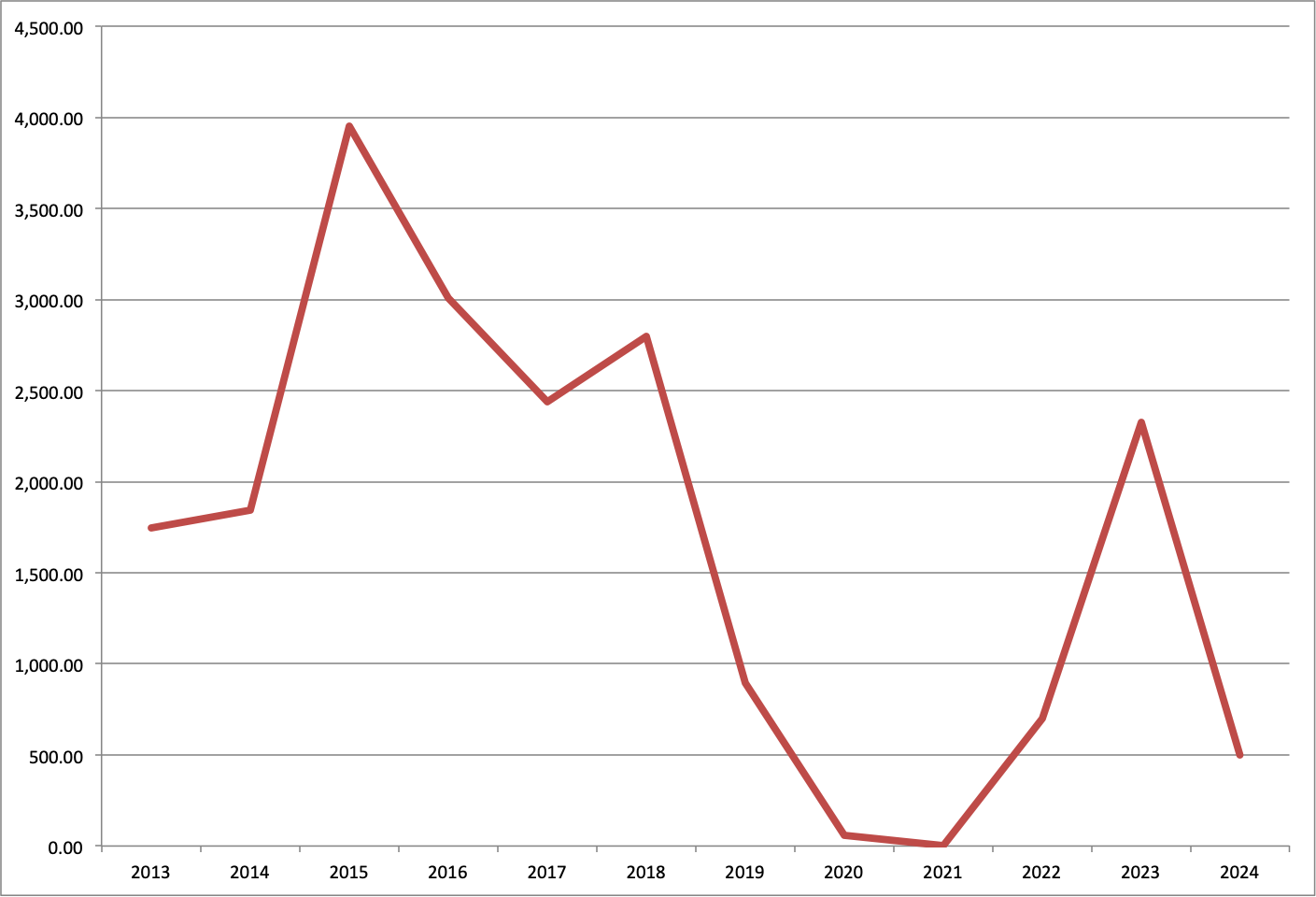
All told, gross revenues have been $20,268.75. I have had between 18 (2016) and 0 (2021) gigs per year.
Ill Sash: “Fireweed”
My brother Sasha has a new EP out: Fireweed
PhDs and job prospects in history
Previously I wrote about Bret Devereaux’s important and informative post: So You Want To Go To Grad School (in the Academic Humanities)?
Today I came across another strong summation of the dismal prospects for those considering PhDs in the ‘social sciences’ and humanities: Why You Should Not Get a History PhD (And How to Apply for One Anyway)
For decades the relentless message from parents, schools, and governments has been that higher levels of education will almost certainly mean more money, a place in the middle class, and long-term financial security. As the number of people with advanced degrees and the sizes of programs producing them has exploded, that trajctory is now seldom possible. And for people who do complete a PhD and then get a good job which does not require it, it’s likely they got the job because of the skills they already had and despite the PhD, instead of the other way around.
Peter Russell tributes
In January, my friend and mentor Peter Russell died. His son Alex invited me to give remarks at his funeral reception: Remarks at the funeral of Peter Russell
Yesterday, I spoke at Innis College’s memorial event: Remarks about Peter Russell at Innis College
Related:
- Peter Russell on recent decades of Canadian constitutional politics
- CPSA 2014, day 2
- CPSA conference 2015
- Peter Russell’s forthcoming book
- Contradictory thinking in Canadian treaty-making
- Canada’s history of oppressive Indigenous policies
- Canada’s deadly residential school system
- Canada’s courts and Indigenous rights
- Reviewing an unreleased book and TV show
- Canada’s origin in fraud